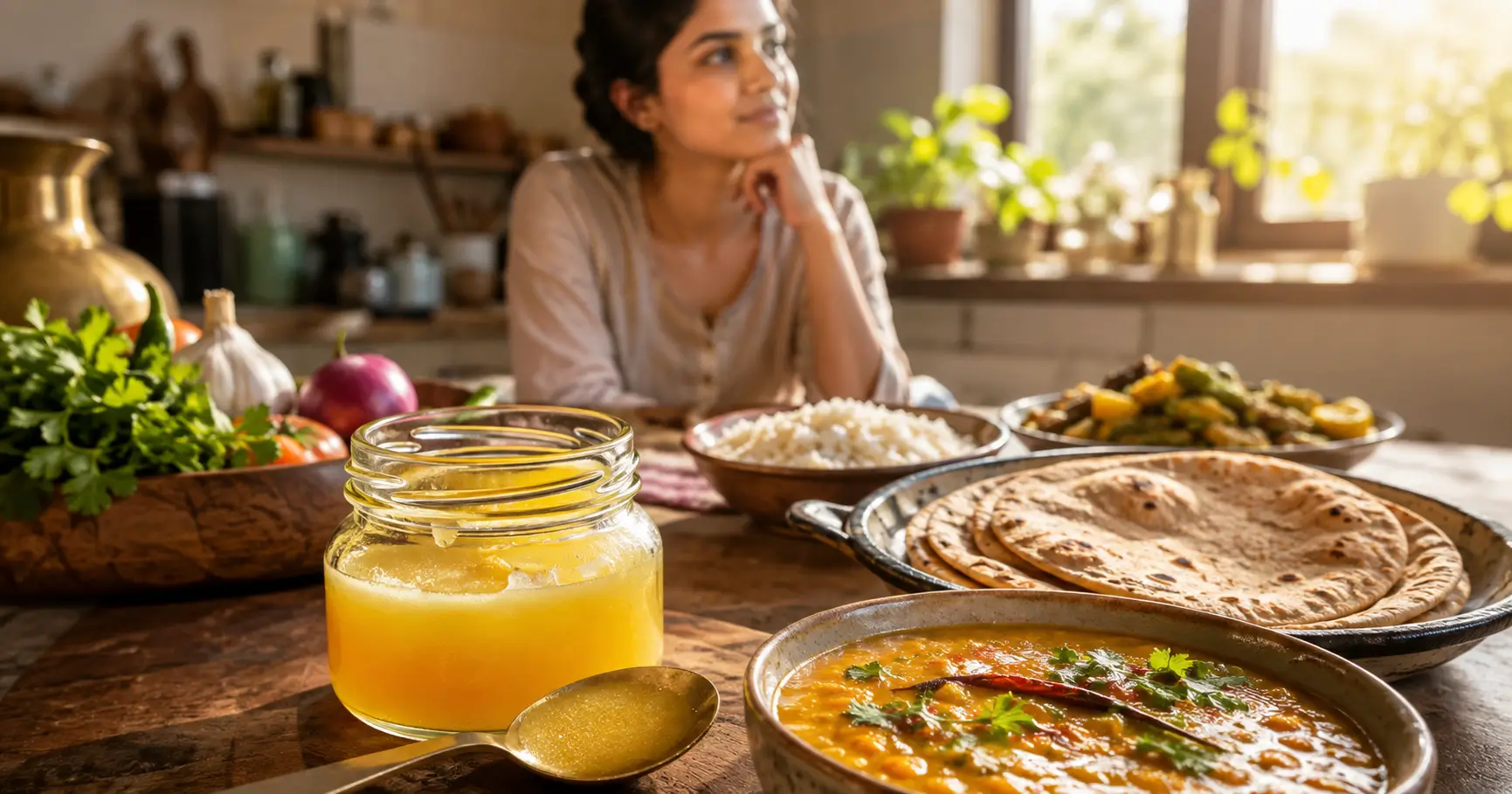

For generations, a spoonful of desi ghee on dal, roti or khichdi has been considered a symbol of nourishing Indian food. Today, however, the same golden fat sits at the centre of a very different debate: is desi ghee genuinely healthy, or is its reputation better than the science?
The answer is more nuanced than either side suggests.
Desi ghee is essentially clarified butter. It is rich in fat and contains a substantial amount of saturated fat, but it also has culinary and nutritional properties that make it different from many processed fats. Modern research has produced mixed findings rather than proving that ghee is either a “superfood” or something everyone should avoid.
So, what are the real desi ghee benefits, how much is reasonable, and who should be more careful?
Let’s separate tradition, marketing and evidence.
What is desi ghee?
Desi ghee is a form of clarified butter made by heating butter and removing water and milk solids. What remains is a concentrated dairy fat with a distinctive nutty flavour and long culinary history in South Asian cuisine.
Unlike butter, ghee contains virtually no water and very little of the milk solids. This makes it more concentrated by weight.
That concentration is important because a small spoonful provides a relatively large amount of energy.
For example, one tablespoon of ghee contains roughly 123 calories and 14 grams of fat, including about 9 grams of saturated fat, according to nutrition data summarized by Healthline.
That explains both its appeal and its main nutritional limitation.
Desi ghee benefits: what does the evidence actually support?
Ghee isn’t a magic health food. But that doesn’t mean it has no place in a balanced diet.
1. It provides concentrated energy
Fat provides approximately 9 calories per gram, making ghee an energy-dense food.
A small quantity can add substantial calories and flavour to a meal. For people who need more energy in their diet, this can be useful.
For someone trying to lose weight, however, repeatedly adding large spoonfuls without accounting for the extra calories can work against a calorie deficit.
The same characteristic can therefore be useful or unhelpful depending on the person’s overall diet.
2. It contains fat-soluble nutrients
Ghee contains small amounts of fat-soluble vitamins, including vitamin A, along with other compounds naturally present in dairy fat.
However, it is important not to exaggerate this benefit.
Ghee should not be treated as a substitute for vegetables, fruits, nuts, seeds or other nutrient-dense foods.
A balanced diet provides a much broader range of vitamins, minerals, fibre and protective plant compounds.
3. It can make nutritious foods more enjoyable
This is an underrated benefit.
A small amount of ghee can improve the flavour and texture of foods such as:
- Dal
- Khichdi
- Roti
- Rice
- Vegetables
- Certain traditional Indian dishes
If a person enjoys healthy home-cooked food more because of a modest amount of ghee, that can support dietary adherence.
Nutrition isn’t only about individual ingredients; the overall eating pattern matters.
4. It works well for many cooking applications
Ghee is popular for tempering, sautéing and other Indian cooking techniques.
Because it contains very little water and milk solids, it behaves differently from butter during cooking.
However, the existence of a relatively high smoke point does not automatically make ghee healthier than every cooking oil.
The type of fat you consume regularly matters more broadly than simply choosing a fat because it tolerates heat.
The WHO specifically recommends favouring unsaturated fats over saturated fats and lists ghee among foods containing saturated fat.
5. It may be easier to tolerate than butter for some people
Because most milk solids are removed during clarification, ghee contains very little lactose compared with ordinary butter.
That can make it more suitable for some people who have difficulty with lactose.
But “very little lactose” does not mean “safe for everyone with dairy allergy.”
People with milk-protein allergies should not assume that ghee is automatically suitable.
Does desi ghee increase cholesterol?
This is where the conversation becomes particularly important.
Ghee contains a high proportion of saturated fat. The WHO recommends keeping saturated fat below 10% of total daily energy intake for adults, with replacement by unsaturated fats where possible.
Research specifically examining ghee has produced mixed results.
One randomized trial in healthy young adults found that replacing mustard oil with ghee providing 10% of energy did not significantly change the overall serum lipid profile, although individual responses varied.
More recent randomized research comparing ghee with olive oil found that ghee increased apoB and non-HDL cholesterol relative to olive oil, supporting the broader recommendation to replace saturated-fat-rich foods with unsaturated-fat sources when reducing cardiovascular risk.
So the most responsible conclusion is:
Ghee should not be promoted as a cholesterol-lowering food.
If you already have elevated LDL cholesterol, cardiovascular disease or other cardiovascular risk factors, your overall fat pattern deserves particular attention.
Does desi ghee help with weight loss?
This is one of the biggest myths surrounding ghee.
Eating ghee does not automatically cause the body to burn stored body fat.
Ghee is calorie-dense. If you add several spoonfuls to an otherwise unchanged diet, your calorie intake can increase substantially.
Some people may find a small amount of fat satisfying, but that does not turn ghee into a fat-burning food.
Recent expert discussions have also highlighted the lack of evidence supporting the popular claim that eating ghee in the morning makes the body preferentially burn body fat.
A simple example
Imagine someone normally eats:
Dal + vegetables + roti
They begin adding three large spoonfuls of ghee every morning because they believe it will accelerate fat loss.
If those calories are not offset elsewhere, the addition can make maintaining a calorie deficit more difficult.
The better strategy is to treat ghee as one ingredient within the diet, not as a weight-loss treatment.
How much desi ghee should you eat?
There is no universal “perfect” amount that applies to every adult.
Your appropriate intake depends on your total calorie needs, dietary pattern, other sources of saturated fat, activity level and health profile.
A practical approach is to think in teaspoons rather than generous spoonfuls.
For example:
- Use a small amount for tadka.
- Measure rather than pouring directly from the jar.
- Account for ghee when tracking calories.
- Avoid combining large amounts of ghee with other high-saturated-fat foods throughout the day.
- If your LDL cholesterol is high, discuss your fat intake with a qualified healthcare professional.
The goal is not necessarily to eliminate ghee.
The goal is to prevent one concentrated source of saturated fat from dominating your diet.
Is desi ghee better than butter?
Ghee and butter are closely related because ghee is made from butter.
The major nutritional difference is concentration.
| Feature | Ghee | Butter |
|---|---|---|
| Main component | Milk fat | Milk fat + water + milk solids |
| Calories | Higher per tablespoon | Lower per tablespoon |
| Saturated fat | High | High |
| Lactose | Very low | Small amount |
| Flavour | Nutty, rich | Creamy |
| Typical use | Cooking, tadka, finishing | Spreads, baking, cooking |
Healthline’s comparison puts a tablespoon of ghee at about 123 calories and 9 grams of saturated fat versus approximately 100 calories and 7 grams of saturated fat for butter.
So ghee isn’t automatically a healthier version of butter simply because it is traditional or minimally processed.
What about A2 ghee and bilona ghee?
This is an important commercial distinction.
A2 refers to a type of beta-casein protein associated with milk, while bilona describes a traditional method of processing cultured butter into ghee.
Neither term should automatically be interpreted as proof that a product delivers dramatically superior health outcomes.
A premium label can describe sourcing or production methods without proving that the finished product will prevent disease, burn fat or lower cholesterol.
When buying ghee, focus on:
- Ingredient transparency
- Food-safety compliance
- Reputable manufacturing
- Clear packaging and storage information
- Traceable sourcing
- Reasonable price relative to the product claims
Don’t pay a large premium solely because a label promises extraordinary health effects.
How to choose good-quality desi ghee
Purity matters, particularly because ghee is a concentrated fat.
Look for products from established manufacturers with transparent labelling and appropriate food-safety information.
Avoid products making dramatic claims such as:
- “melts belly fat”
- “detoxifies the body”
- “cures cholesterol”
- “prevents heart disease”
- “guarantees weight loss”
Food can contribute to a healthy diet, but extraordinary disease claims require extraordinary evidence.
For packaged products in India, consumers should also pay attention to relevant FSSAI information and packaging requirements.
Common mistakes people make with ghee
Mistake 1: Treating ghee as medicine
Ghee is food, not a universal treatment.
Mistake 2: Assuming “natural” means unlimited
Natural foods can still be calorie-dense and high in saturated fat.
Mistake 3: Using several sources of saturated fat together
A diet containing substantial ghee, butter, cream, fatty meat and other saturated-fat-rich foods can quickly accumulate saturated fat.
Mistake 4: Believing morning ghee burns fat
There is no strong evidence that simply consuming ghee first thing in the morning activates a special fat-burning mechanism.
Mistake 5: Ignoring individual cholesterol response
People can respond differently to dietary changes. Older controlled trials involving ghee have documented variation between individuals.
Myths vs facts
| Myth | Fact |
|---|---|
| Ghee automatically causes weight loss | No. It is calorie-dense and does not independently burn body fat. |
| Ghee is a superfood that everyone should eat daily | There is no universal requirement to consume it daily. |
| Ghee lowers cholesterol | Evidence is mixed, and some controlled research shows less favourable cholesterol-related effects compared with unsaturated oils. |
| All saturated fat is harmless if it comes from natural food | Natural origin does not eliminate the physiological effects of saturated fat. |
| A2 ghee is automatically healthier | The label alone does not establish superior cardiovascular or weight-loss outcomes. |
| You must completely avoid ghee | Not necessarily. Small amounts can fit into many balanced diets. |
A smarter way to include desi ghee in your diet
If you enjoy ghee, you don’t necessarily need to abandon it.
Try this approach:
- Measure your portion.
- Use it primarily for flavour and cooking rather than as a health supplement.
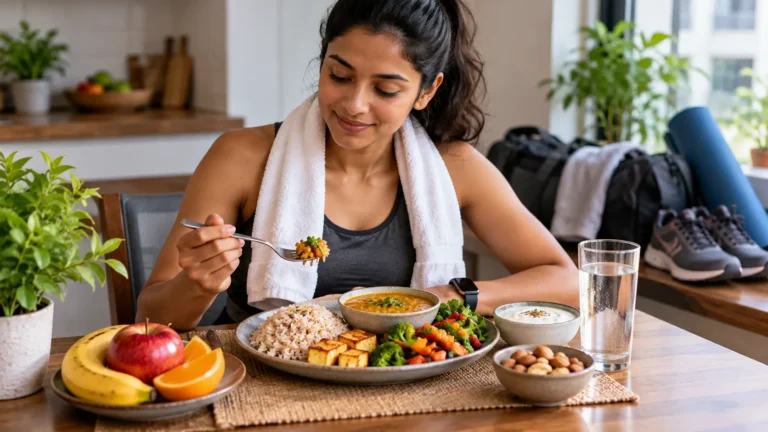
- Eat plenty of vegetables, pulses, fruits and whole grains alongside it.
- Include unsaturated-fat sources such as nuts, seeds and suitable plant oils.
- Avoid stacking large amounts of ghee with other saturated-fat-rich foods.
- If you have abnormal cholesterol or cardiovascular risk, personalize your diet with professional guidance.
This approach preserves the cultural and culinary value of ghee without turning it into a nutritional myth.
The bottom line on desi ghee benefits
The most accurate answer is neither “ghee is a superfood” nor “ghee is unhealthy.”
Desi ghee is a concentrated dairy fat with a long culinary history. It provides energy, contributes small amounts of certain fat-soluble nutrients and can make traditional foods more enjoyable.
But it is also high in saturated fat and calories.
Modern evidence on ghee itself is mixed, while broader dietary guidance consistently favours replacing substantial amounts of saturated fat with unsaturated fats when cardiovascular risk reduction is the goal.
The practical lesson is simple:
Enjoy desi ghee for what it is—a flavourful traditional fat—not as a miracle food.
FAQ
Is desi ghee healthy?
Desi ghee can fit into a balanced diet when consumed in appropriate amounts. However, it is calorie-dense and high in saturated fat, so it should not be treated as a limitless health food.
What are the main desi ghee benefits?
Desi ghee provides concentrated energy, contributes small amounts of fat-soluble nutrients and adds flavour to foods. However, claims that it cures disease or automatically causes weight loss are not supported by strong evidence.
Can I eat desi ghee every day?
Some people can include a small amount of ghee in their daily diet. The appropriate amount depends on total calorie intake, other sources of saturated fat and individual health factors.
Does desi ghee increase cholesterol?
It can affect cholesterol-related markers because it is high in saturated fat. Research on ghee itself is mixed, but controlled research has found less favourable apoB and non-HDL cholesterol effects compared with olive oil.
Does desi ghee help with weight loss?
There is no strong evidence that eating ghee directly burns body fat. Because ghee is calorie-dense, consuming excessive amounts can make weight management more difficult.
Is A2 ghee healthier than regular ghee?
A2 describes a type of beta-casein protein associated with the milk source, while bilona describes a production method. These labels alone do not prove that a ghee product provides superior weight-loss or cardiovascular benefits.
Conclusion
Desi ghee has earned its place in Indian kitchens for good reason: it is flavourful, versatile and deeply connected to culinary tradition.
But tradition and nutrition science do not have to compete.
The real desi ghee benefits are more modest—and more credible—than many social-media claims suggest. Ghee can contribute energy, flavour and certain nutrients, but it is also concentrated in calories and saturated fat.
The smartest approach is moderation rather than fear or hype.
Use a measured amount, build the rest of your diet around vegetables, fruits, pulses, whole grains, nuts and other nutrient-rich foods, and don’t expect a spoonful of ghee to compensate for an otherwise poor diet.
The takeaway: You don’t need to call desi ghee a superfood to enjoy it. Treat it as a traditional dietary fat, use it thoughtfully, and let the overall quality of your diet—not one ingredient—determine your health strategy.
Disclaimer
Disclaimer: This article is intended for general educational and informational purposes only. It does not constitute medical, nutritional or dietary advice and should not replace consultation with a qualified doctor, registered dietitian or other healthcare professional. Individual dietary requirements vary, particularly for people with high cholesterol, cardiovascular disease, diabetes, obesity, dairy allergies or other medical conditions. Always consider your complete diet and personal health circumstances before making significant dietary changes.