
Black pepper gets most of the attention in Indian kitchens. But there is another pepper with a much older culinary and Ayurvedic story—and most people barely recognize it.
Pippali, also called Pipli or Indian long pepper, is the dried fruit of Piper longum L., a plant belonging to the Piperaceae family. India’s Spices Board identifies long pepper as the dried fruit of Piper longum, while the National Medicinal Plants Board lists Pippali under the same botanical name.
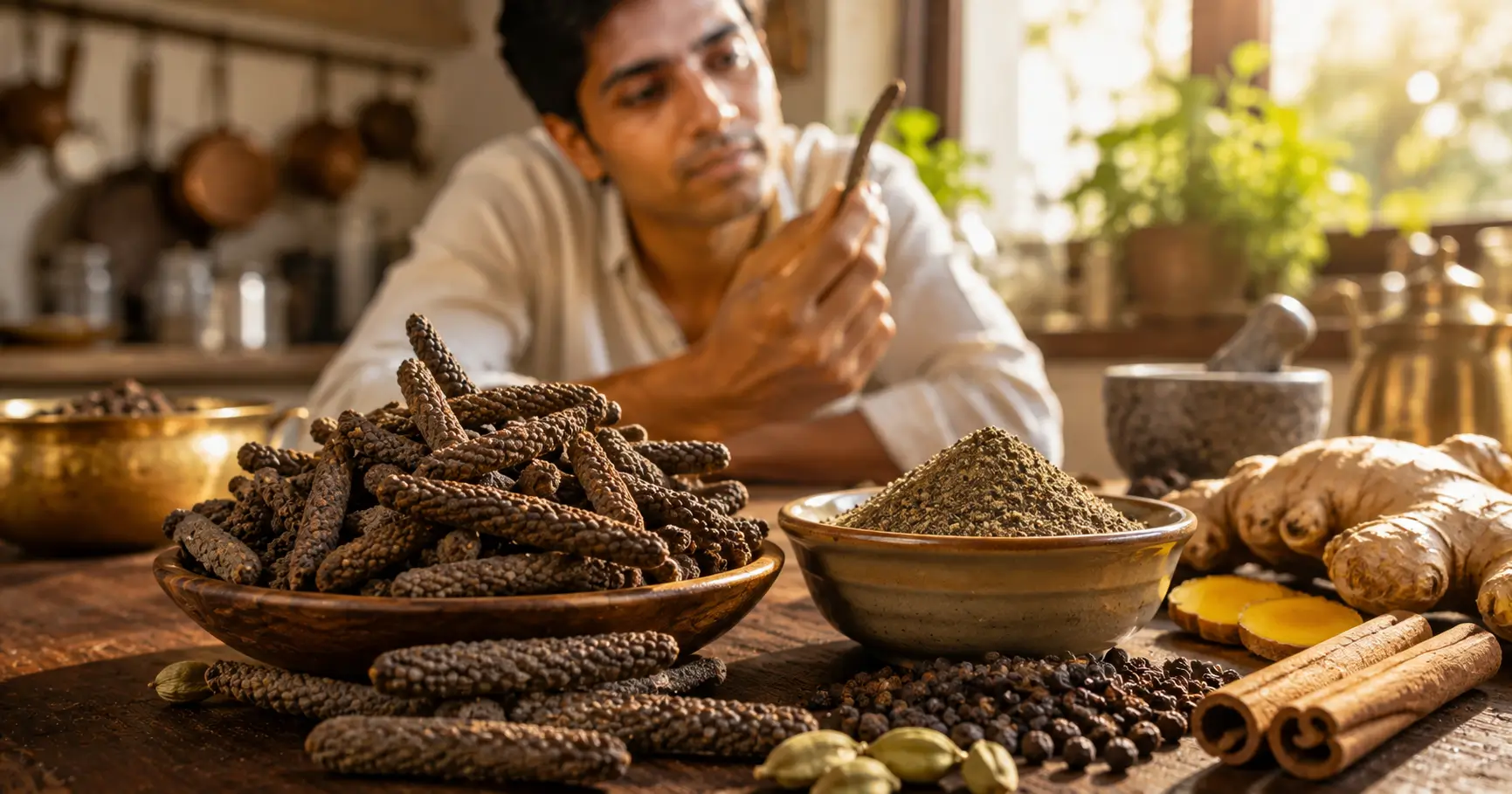
Its appearance is unmistakable: instead of the round berries of black pepper, Pippali forms a narrow, elongated fruit spike.
For centuries, it has been used as a spice and in Ayurvedic preparations. Modern researchers have also investigated its phytochemicals and possible biological effects.
But there is an important catch.
Traditional use is not the same as clinical proof.
So what are the real Pippali benefits, what does research actually show, and when should you be cautious?
Let’s separate the ancient reputation from the modern evidence.
What is Pippali spice?
Pippali is commonly known in English as long pepper or Indian long pepper.
Its scientific name is Piper longum L. and it belongs to the Piperaceae family—the same botanical family that includes black pepper.
The fruit is generally dried and used as a spice. The Spices Board notes that long pepper is also used in pickles and preserves, while traditional systems have used both the fruit and root for medicinal purposes.
Its flavour is different from ordinary black pepper.
Pippali has a pungent, warming character with more complex aromatic notes, which is why a small quantity can make a noticeable difference to a dish.
Pippali vs black pepper
| Feature | Pippali | Black pepper |
|---|---|---|
| Botanical name | Piper longum | Piper nigrum |
| Common name | Indian long pepper | Black pepper |
| Shape | Long, narrow spike | Small round peppercorn |
| Family | Piperaceae | Piperaceae |
| Traditional use | Spice and Ayurvedic preparations | Spice and traditional medicine |
| Major researched compounds | Piperine, piperlongumine and others | Piperine and other compounds |
Although both belong to the same family, Pippali and black pepper are different plants.
That distinction matters when evaluating research.
Pippali benefits: what does research actually suggest?
The scientific literature surrounding Pippali is surprisingly broad.
A major review published in Phytotherapy Research examined the traditional uses, phytochemistry and pharmacology of Piper longum. Researchers have identified alkaloids, flavonoids, esters, steroids and other compounds in different parts of the plant.
Studies have investigated potential antioxidant, anti-inflammatory, antimicrobial, metabolic, neurological and other biological effects.
But there is a crucial distinction:
Most interesting laboratory findings do not automatically translate into proven health benefits in humans.
A systematic review published in the Journal of Ethnopharmacology specifically highlighted gaps between traditional claims and clinical evidence and called for additional human safety, pharmacokinetic and efficacy research.
That is why this article treats Pippali as a promising traditional spice under scientific investigation, rather than a proven treatment for disease.
1. Pippali has a long history in traditional medicine
One of the strongest things we can say about Pippali is that its traditional use is well established.
It has been used in Ayurvedic medicine and other traditional systems for generations, particularly in preparations associated with digestion and respiratory complaints. The scientific literature documents its traditional use for conditions including cough, bronchitis, digestive problems and other ailments.
This traditional history makes Pippali scientifically interesting.
However, historical use establishes cultural and traditional relevance—not proof that a treatment works for a particular disease.
That distinction is essential when discussing herbal medicines online.
2. It contains biologically active compounds
Pippali isn’t simply a source of heat and flavour.
Researchers have identified several phytochemicals in Piper longum, including piperine and piperlongumine.
Piperine is particularly interesting because it has been investigated for its effects on absorption and metabolism.
Research on piperine indicates that it can influence drug-metabolizing enzymes and transport systems, which may alter the bioavailability of certain substances.
That sounds beneficial at first.
But it also explains why concentrated Pippali or piperine supplements deserve more caution than ordinary culinary use.
A compound that changes absorption can potentially change how medicines behave.
3. Pippali may support digestive research—but evidence is still developing
Digestion is one of the areas most strongly associated with Pippali in Ayurveda.
Traditional sources describe it as a digestive-supporting spice, and modern experimental research has investigated possible effects on digestive processes.
A recent paper in the Indian Journal of Traditional Knowledge examined the traditional “Deepana” and “Pachana” concepts associated with Pippali and Pippalimula and reported experimental findings relevant to digestive activity.
But readers should be careful with the wording.
It is reasonable to say that Pippali has traditional digestive uses and is being investigated for digestive effects.
It is not reasonable to claim that eating Pippali will definitely cure constipation, acidity, indigestion or other digestive disorders.
A practical example
Someone may use a tiny amount of Pippali as a culinary spice because they enjoy its flavour.
That is very different from taking concentrated Pippali powder every day as a treatment for chronic digestive symptoms.
Persistent symptoms deserve a proper medical evaluation rather than prolonged self-treatment with an herb.
4. Respiratory health is another major area of interest
Pippali has a long traditional association with cough and respiratory complaints.
The scientific literature also contains laboratory and clinical investigations into Piper longum and respiratory conditions.
However, the quality of human evidence is an important limitation.
A 2025 systematic review evaluating Piper longum for acute respiratory infections found no good-quality randomized controlled trials demonstrating its effectiveness. The available studies were limited and had methodological weaknesses.
That finding is particularly important because online articles frequently turn traditional respiratory use into statements such as “Pippali treats cough and asthma.”
The evidence does not justify such a broad claim.
Traditional respiratory use is well documented; clinical effectiveness remains insufficiently established.
5. Pippali is being studied for antioxidant and anti-inflammatory activity
Laboratory studies have identified antioxidant and anti-inflammatory properties among the biological activities associated with Piper longum extracts and compounds.
These findings help explain why scientists continue to study the plant.
But antioxidant activity measured in a laboratory is not equivalent to proving that eating Pippali prevents chronic disease.
This is one of the most common mistakes in herbal-health content.
The evidence ladder
Think about evidence in stages:
- Traditional use — people have used the plant historically.
- Laboratory research — compounds show biological activity.
- Animal studies — effects are observed in living organisms.
- Human trials — researchers test actual clinical outcomes.
- High-quality systematic evidence — findings are confirmed across rigorous studies.
Pippali has substantial evidence at the first two levels.
Some evidence exists at the experimental and clinical levels, but important gaps remain.
That is why strong disease-treatment claims should be avoided.
6. Pippali may influence the absorption of other substances
This is perhaps the most overlooked aspect of Pippali.
Piperine has been studied as a bioenhancer, meaning it can influence the bioavailability of certain compounds.
A PubMed-indexed review notes that piperine can affect gastrointestinal absorption and drug-metabolizing pathways, including cytochrome P450 and UDP-glucuronosyltransferase systems.
Human interaction research has also reported changes in exposure to certain medicines when piperine from black or long pepper was involved.
This creates an important rule:
If you take prescription medicines, don’t assume that a concentrated Pippali supplement is automatically harmless because it is “natural.”
Food-level culinary use and concentrated herbal supplementation are not the same exposure.
How is Pippali traditionally used?
Pippali appears in several traditional preparations.
It may be found as:
- Whole dried spice
- Coarsely ground spice
- Pippali churna
- Herbal formulations
- Traditional decoctions
- Multi-herb Ayurvedic preparations
It is also a component of traditional formulations such as Trikatu, which combines pungent spices.
The best approach for someone interested in Pippali as food is to start with its culinary role rather than treating it as a self-prescribed medicine.
How to use Pippali as a spice
If you’re new to Pippali, a simple culinary approach is safer than experimenting with concentrated doses.
Try these steps
- Start with a very small quantity.
- Grind dried Pippali shortly before use if appropriate.
- Add it to soups, dals or spice blends.
- Combine it with familiar spices rather than consuming large amounts alone.
- Stop if it causes burning, discomfort or other unwanted symptoms.
Pippali is naturally pungent, so more is not necessarily better.
There is also no universally established evidence-based “daily Pippali dose” that should be recommended to everyone.
Dosage depends on the preparation, concentration, purpose and individual circumstances.
Who should be cautious with Pippali?
Extra caution is appropriate when Pippali is being used as a concentrated powder, extract or supplement rather than as a normal culinary spice.
Talk to a qualified healthcare professional before medicinal use if you:
- Take prescription medicines
- Have significant digestive problems
- Have liver or kidney disease
- Are pregnant or breastfeeding
- Are giving herbal preparations to a child
- Have a history of sensitivity to pungent spices
- Are considering long-term supplementation
The reason isn’t that Pippali is automatically dangerous.
The issue is that human safety data are less complete than the internet often suggests, and piperine-related effects on drug absorption and metabolism can be clinically relevant.
Pippali side effects and safety
Pippali should not be treated as risk-free simply because it is an ancient spice.
Its pungent nature may cause discomfort in sensitive individuals, particularly when concentrated.
A recent systematic review of Piper longum for acute respiratory infections reported generally limited adverse effects in the available studies, but also emphasized the poor methodological quality and heterogeneity of the evidence.
Animal toxicity studies also cannot be used to establish human safety at every dose or formulation.
Watch for these warning signs
Stop using a concentrated preparation and seek appropriate medical advice if you experience:
- Persistent burning or severe stomach discomfort
- Allergic symptoms
- Unusual dizziness
- Worsening symptoms
- A suspected medicine interaction
And don’t use Pippali to delay evaluation of a persistent cough, unexplained weight loss, breathing difficulty, severe abdominal pain or other potentially serious symptoms.
Common Pippali myths vs facts
| Myth | Fact |
|---|---|
| Pippali cures asthma. | Traditional use exists, but strong clinical evidence is insufficient to establish it as an asthma treatment. |
| Pippali automatically boosts immunity. | Laboratory immunomodulatory effects have been studied, but this does not prove that routine consumption prevents infections. |
| Natural herbs cannot interact with medicines. | Piperine can affect drug absorption and metabolism. |
| More Pippali means greater benefits. | There is no basis for assuming that increasing the dose indefinitely improves health outcomes. |
| Pippali and black pepper are the same spice. | No. They are different species in the same plant family. |
| Every traditional claim has been clinically proven. | Research gaps remain, particularly for many therapeutic claims. |
A simple way to think about Pippali
The most balanced view is surprisingly straightforward.
As a spice: Pippali is an interesting traditional ingredient with a distinctive flavour.
As a traditional medicine: It has a long history and an established place in Ayurveda.
As a modern therapeutic: It contains biologically active compounds that deserve further research, but many proposed health benefits still lack strong human clinical evidence.
That distinction protects readers from both extremes: dismissing traditional knowledge entirely and turning every laboratory finding into a medical promise.
What makes Pippali scientifically interesting?
Three features stand out.
Its chemistry
Pippali contains compounds such as piperine and piperlongumine that have attracted pharmacological research.
Its traditional history
It has been used across South Asian traditional medicine for generations, particularly in digestive and respiratory preparations.
Its potential bioenhancing effects
Piperine’s ability to influence absorption and drug metabolism makes the plant scientifically interesting—and also explains why concentrated extracts deserve caution.
The bottom line on Pippali benefits
Pippali is much more than an obscure pepper.
This traditional Indian spice, scientifically known as Piper longum, has a documented culinary and Ayurvedic history and contains several biologically active compounds.
Research suggests potential antioxidant, anti-inflammatory, antimicrobial and other biological activities, while digestive and respiratory applications remain important areas of investigation.
But the most important takeaway is the one often missing from viral health articles:
Interesting science is not the same as proven treatment.
If you enjoy Pippali as a spice, small culinary amounts can be part of a varied diet.
If you’re considering concentrated Pippali powder or supplements for a health condition, especially while taking medication, professional guidance is the safer choice.
FAQ
What is Pippali spice?
Pippali, also called Pipli or Indian long pepper, is the dried fruit of Piper longum L., a plant in the Piperaceae family. It is used as a culinary spice and in traditional Ayurvedic preparations.
What are the main Pippali benefits?
Pippali has traditional uses related to digestion and respiratory health, while modern research has investigated antioxidant, anti-inflammatory, antimicrobial and other biological activities. Strong human evidence for many therapeutic claims remains limited.
Is Pippali the same as black pepper?
No. Pippali is Piper longum, while black pepper is Piper nigrum. They belong to the same botanical family but are different species and have different fruit shapes.
Can Pippali help with digestion?
Pippali has a long traditional association with digestive health, and experimental research has investigated its digestive effects. However, this does not establish Pippali as a proven treatment for chronic digestive disorders.
Is Pippali safe to take every day?
There is no universally established evidence-based daily dose appropriate for everyone. Culinary use and concentrated herbal supplementation are different, and people taking medicines should seek professional advice because piperine can influence drug absorption and metabolism.
Does Pippali cure cough or asthma?
Pippali has traditional respiratory uses, but current clinical evidence is not strong enough to establish it as a treatment for cough or asthma. A recent systematic review found no good-quality randomized controlled trials for acute respiratory infections.
Conclusion
Pippali may be small, unusual and easily overlooked—but its history is anything but small.
Known as Pipli, Pippali or Indian long pepper, this Piper longum fruit has been used in Indian cuisine and Ayurveda for generations. Modern research has identified intriguing compounds such as piperine and piperlongumine and has investigated potential antioxidant, anti-inflammatory, antimicrobial, digestive and respiratory effects.
But there is a critical lesson for anyone searching for Pippali benefits:
A traditional reputation is a reason to investigate a plant—not proof that every health claim about it is true.
The most sensible approach is to enjoy Pippali as a distinctive spice, understand what the research actually supports, and be cautious with concentrated preparations—particularly when medications are involved.
If you’re interested in Ayurvedic spices, Pippali is certainly worth knowing about. Just let evidence, not hype, decide what you expect it to do.
Disclaimer
Disclaimer: This article is provided for general educational and informational purposes only. It is not medical advice and should not be used to diagnose, treat, cure or prevent any disease. Traditional Ayurvedic uses described in this article should not be interpreted as clinically proven medical treatments. Evidence for Piper longum varies considerably by health condition, preparation and study type. Concentrated Pippali products may also differ from ordinary culinary use and may interact with medicines. If you are pregnant or breastfeeding, have a medical condition, take prescription medicines, or are considering Pippali for a specific health problem, consult a qualified healthcare professional before using it medicinally.