
If you are asking for the best source of vitamin D, the answer depends on what you mean by “best.”
For the human body, sunlight is an important natural source because the skin can make vitamin D3 when it is exposed to UVB radiation. But sunlight is not a predictable dose of vitamin D: the amount produced changes with season, time of day, skin pigmentation, clothing, location, air conditions and other factors.
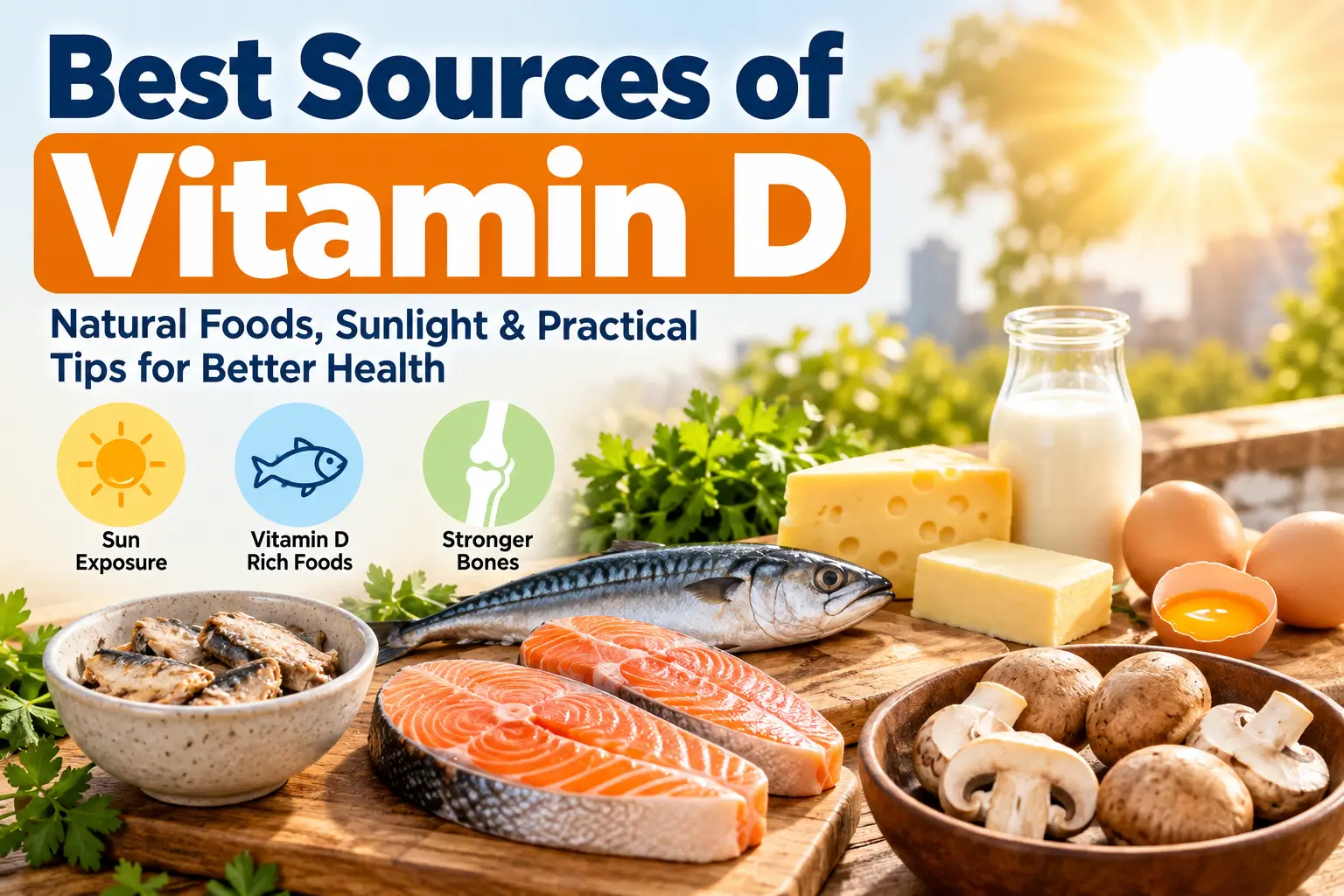
From food, fatty fish are among the richest naturally occurring sources of vitamin D. Fortified foods can also be useful, particularly for people who eat little or no fish. Supplements have an important role when vitamin D intake or status is inadequate, but they should not automatically be treated as the best option for everyone.
For Indian adults, the most practical answer is therefore not “take a supplement” or “sit in the sun for exactly 15 minutes.” It is to understand how the different sources work and choose an approach that fits your diet, sun exposure and medical situation.
Important: This article is general health education, not a diagnosis or treatment plan. If you have a confirmed vitamin D deficiency, a condition affecting vitamin-D absorption or metabolism, or you have been advised to take a therapeutic dose, follow the guidance of your qualified healthcare professional.
What Is the Best Source of Vitamin D?
A useful way to think about vitamin D sources is:
| Source | How useful is it? | Main limitation |
|---|---|---|
| Sunlight/UVB exposure | Major natural source of vitamin D3 | Production is highly variable and excessive UV exposure damages skin |
| Fatty fish | Among the best natural food sources | Not suitable for everyone; intake varies by species and portion |
| Fortified foods | Practical and useful, especially for vegetarians | Amount depends entirely on the product |
| UV-exposed mushrooms | Useful plant-based source of vitamin D2 when appropriately treated | Vitamin D content varies considerably |
| Egg yolks | Convenient source, but relatively modest | Not enough by themselves to reliably provide the full requirement |
| Ordinary unfortified milk/dairy | May contain small amounts | Content depends on the product and fortification |
| Supplements | Reliable way to deliver a known dose | Excessive intake can be harmful and higher doses should not be self-prescribed |
The key point is that these sources are not interchangeable.
Sunlight allows your skin to produce vitamin D. Food provides a measured dietary amount. A supplement provides a deliberately concentrated dose.
Very few foods naturally contain substantial amounts of vitamin D, which is why relying exclusively on ordinary foods can be difficult.
1. Sunlight: An Important Natural Source of Vitamin D
Vitamin D is unusual because the body can produce it.
When UVB radiation reaches uncovered skin, it triggers a chemical process that produces vitamin D3. The vitamin then undergoes further processing in the body before becoming biologically active.
This is why vitamin D is often called the “sunshine vitamin.”
However, more sunlight does not mean more vitamin D indefinitely. The body regulates vitamin-D production in the skin, while excessive ultraviolet exposure increases the risk of sunburn and long-term skin damage.
The World Health Organization recommends protecting against excessive UV exposure. The amount of UV exposure needed for vitamin-D production also varies from person to person.
Why there is no universal “15-minute rule”
You may have seen advice saying that everyone should get 10, 15 or 20 minutes of sunlight every day.
That is too simplistic.
Vitamin-D production depends on factors including:
- time of day
- season
- latitude
- cloud cover
- air pollution
- amount of skin exposed
- clothing
- skin pigmentation
- age
- sunscreen use
- individual biological variation
The NIH notes that these variables make it difficult to establish one universal amount of sunlight that guarantees adequate vitamin-D production.
Research from India has also demonstrated that the timing of sunlight affects vitamin-D synthesis, but a study from one Indian location should not be converted into a universal prescription for every Indian city or every skin type.
Does sunlight through a window provide vitamin D?
No.
The UVB radiation needed for cutaneous vitamin-D production does not pass effectively through ordinary window glass. Sitting beside a sunny window is therefore not equivalent to exposing your skin outdoors.
Should you deliberately stay in strong sunlight without protection?
No.
The goal should not be to expose yourself to enough UV radiation to burn or damage your skin simply to obtain vitamin D.
Vitamin-D production and UV protection have to be considered together. WHO recommends sun protection when the UV Index is 3 or above.
2. Fatty Fish: One of the Best Dietary Sources
If you are asking specifically about food, fatty fish are among the strongest naturally occurring sources of vitamin D.
Examples include:
- salmon
- mackerel
- sardines
- trout
- herring
- some types of tuna
The exact amount varies substantially according to the species, whether the fish is wild or farmed, its diet, and the portion.
The NIH specifically identifies fatty fish and fish-liver oils among the best natural food sources of vitamin D.
For an Indian diet, locally available fish can therefore be a more realistic option than assuming salmon is the only useful choice.
But does every fish provide a lot of vitamin D?
No.
This is an important distinction.
A food being called “fish” does not automatically mean it contains a large amount of vitamin D. The concentration varies between species.
Therefore, avoid treating every fish as nutritionally equivalent when the specific purpose is increasing vitamin-D intake.
3. Fortified Foods: Particularly Useful for Vegetarians
Fortification means that a nutrient has been deliberately added to a food.
This matters because vitamin D occurs naturally in relatively few foods.
Depending on the country and manufacturer, fortified products can include:
- milk
- plant-based milk alternatives
- breakfast cereals
- spreads
- some yogurts
- other specially fortified foods
But there is one rule that matters more than the food’s reputation:
Check the label.
Do not assume that every packet of milk, cereal, yogurt or plant-based beverage contains vitamin D.
Two otherwise similar products may have completely different vitamin-D content because one is fortified and the other is not.
For Indian consumers, this is particularly relevant when choosing products marketed toward vegetarians or vegans.
4. UV-Exposed Mushrooms: A Useful Plant-Based Option
Mushrooms naturally contain vitamin D2 in variable amounts, and some mushrooms can be exposed to ultraviolet light to increase their vitamin-D2 content.
This is different from assuming that every mushroom bought from a grocery store is automatically a high-vitamin-D food.
If vitamin D is one of your reasons for buying mushrooms, look for information about UV treatment or vitamin-D content on the product label when available.
Mushrooms can be useful in plant-based diets, but their vitamin-D content is too variable to assume that an ordinary serving will provide a predictable amount.
The NIH lists mushrooms among foods that can contain vitamin D2 and notes that UV-treated mushrooms can have increased vitamin-D content.
5. Egg Yolks: Convenient but Not a Major Source
Egg yolks contain vitamin D.
That makes eggs a useful part of a varied diet, but it is easy to exaggerate their importance.
Eggs generally provide much smaller amounts of vitamin D than rich fatty fish or a deliberately fortified food.
So eating eggs can contribute to vitamin-D intake, but an egg-based diet should not be presented as a guaranteed way to correct vitamin-D deficiency.
The vitamin-D content can also vary between eggs depending on factors such as the hen’s diet.
6. Milk: Is It a Good Source of Vitamin D?
This is one of the most confusing questions because the answer depends on whether the milk is fortified.
Milk itself is not automatically a rich source of vitamin D.
Some products have vitamin D added to them, while others may contain little vitamin D.
Therefore:
Fortified milk = potentially useful vitamin-D source.
Unfortified milk = do not assume it provides a meaningful amount.
The same principle applies to plant-based beverages.
A soy, almond, oat or other plant beverage may be a useful source if vitamin D has been added. Check the nutrition label rather than relying on the product category.
7. Cod Liver Oil: Powerful but Not Something to Take Casually
Cod liver oil can contain a substantial amount of vitamin D.
However, it is different from an ordinary vitamin-D supplement because cod liver oil also contains vitamin A and omega-3 fatty acids.
That means taking large amounts simply because it contains vitamin D is not a sensible strategy.
If someone is already taking other supplements containing vitamin A or vitamin D, combining products without checking their contents can result in unnecessarily high intake.
For routine vitamin-D supplementation, a product designed to provide vitamin D may be more straightforward than using cod liver oil purely as a vitamin-D source.
A Better Way to Compare Vitamin D Sources
Rather than asking which source is “number one,” ask what each source is best suited for.
| Your situation | Most practical source to consider |
|---|---|
| You regularly spend time outdoors | Sensible outdoor activity while avoiding excessive UV exposure |
| You eat fish | Fatty fish can provide meaningful dietary vitamin D |
| You are vegetarian | Fortified foods plus appropriate dietary sources |
| You are vegan | Fortified plant foods and, when appropriate, vitamin-D supplementation |
| You rarely go outdoors | Discuss dietary and supplementation options with a healthcare professional |
| You have confirmed deficiency | Follow a clinician’s treatment plan rather than relying only on food |
| You are taking multiple supplements | Check total vitamin-D intake before adding another product |
| You want to prevent deficiency | Focus on adequate dietary intake, appropriate outdoor activity and individualized advice where necessary |
This is a more useful framework than ranking foods from 1 to 10 because the best source depends on the person’s circumstances.
How Much Vitamin D Do Indians Need?
The ICMR-NIN 2020 recommendations list an RDA of 600 IU (15 micrograms) of vitamin D per day for adults, with 400 IU recommended for infants under one year. The recommendation also emphasizes outdoor physical activity as a means of supporting vitamin-D status in India’s tropical setting.
An important distinction is necessary here:
An RDA is not the same thing as a treatment dose for vitamin-D deficiency.
If a blood test shows deficiency, the amount and duration used for treatment may be different and should be determined according to the person’s clinical situation.
You should therefore not interpret “600 IU per day” as a universal prescription for treating deficiency.
Does Having Plenty of Sunlight Mean Indians Cannot Become Vitamin-D Deficient?
No.
This is one of the biggest misconceptions about vitamin D in India.
India receives substantial sunlight, but the human body does not receive an identical amount of useful UVB exposure simply because a person lives in a sunny country.
Indoor work, clothing, limited outdoor time, air pollution, season, skin pigmentation and other factors can influence vitamin-D production.
Indian research has repeatedly reported low vitamin-D status in different populations despite abundant sunshine. However, estimates of how common deficiency is vary considerably between studies because researchers have used different populations, locations and definitions.
So it is better to say:
Sunlight is available in India, but availability of sunlight is not the same as adequate individual vitamin-D production.
What About Early-Morning Sunlight?
Early-morning outdoor activity can be excellent for physical activity and general wellbeing, but it should not automatically be described as the most effective time for vitamin-D production.
Vitamin-D synthesis depends on UVB radiation, and UVB levels change throughout the day.
Research in India has found greater potential for vitamin-D synthesis around the middle of the day at the studied location.
That does not mean everyone should deliberately remain in harsh midday sunlight.
The appropriate balance is to obtain outdoor activity and sensible sun exposure while avoiding sunburn and unnecessary UV damage.
Can Food Alone Provide Enough Vitamin D?
Sometimes, but it can be difficult.
The problem is that only a relatively small number of foods naturally contain meaningful amounts of vitamin D.
A person who eats fatty fish regularly may obtain substantially more dietary vitamin D than someone whose diet consists primarily of cereals, pulses, vegetables and unfortified dairy products.
This is especially relevant for people following vegetarian or vegan diets.
Fortified foods can make dietary intake easier, but fortification varies by product.
For this reason, people who have little sun exposure or other risk factors may need individualized advice about supplementation.
The NIH specifically notes that obtaining enough vitamin D from natural, nonfortified foods alone can be difficult.
What About Vitamin D Supplements?
Supplements can be useful, but more vitamin D is not automatically better.
Vitamin D is fat-soluble, and excessive intake can cause toxicity. Very high vitamin-D intake can increase calcium levels and, in severe cases, contribute to kidney problems and other serious complications. Excessive intake is generally associated with supplements rather than sunlight.
For adults, the NIH lists an upper intake level of 4,000 IU per day from all sources, although this is not a target intake and does not replace individualized medical treatment when a clinician has diagnosed deficiency.
Do not use the upper limit as a recommended daily dose.
What about 60,000 IU vitamin D tablets?
High-dose vitamin-D products are widely discussed in India.
But a high-dose preparation is not an ordinary daily nutritional supplement simply because it is sold by a pharmacy.
High doses may be used in particular clinical circumstances under professional supervision. The appropriate dose and duration depend on the reason for treatment, baseline status and individual risk factors.
Do not self-prescribe repeated high-dose vitamin D simply because you feel tired or because somebody else takes it.
Do Healthy Adults Need Routine Vitamin-D Testing?
Not necessarily.
This is another area where online advice can become overly simplistic.
The 2024 Endocrine Society guideline recommends against routine 25-hydroxyvitamin-D screening in generally healthy adults without an established indication for testing. It also states that evidence has not established a specific blood level that should be targeted for disease prevention in these populations.
That does not mean vitamin-D testing is never appropriate.
A clinician may consider testing when there is a relevant medical reason, such as suspected deficiency, certain bone disorders, malabsorption or other conditions affecting vitamin-D metabolism.
The important distinction is between routine screening of everyone and testing because a person’s clinical circumstances justify it.
Common Mistakes People Make About Vitamin D
Mistake 1: Assuming more sunlight is always better
It isn’t.
Vitamin-D production has to be balanced against UV-related skin damage.
Mistake 2: Treating every “vitamin-D food” as equally rich
Egg yolks, ordinary milk and fatty fish should not be treated as equivalent sources.
The actual vitamin-D concentration matters.
Mistake 3: Assuming all milk is fortified
Check the label.
Mistake 4: Believing morning sunlight automatically provides enough vitamin D
The UVB intensity needed for vitamin-D production changes during the day and with environmental conditions.
Mistake 5: Taking high-dose supplements without a reason
A higher dose is not automatically a better dose.
Mistake 6: Assuming symptoms prove vitamin-D deficiency
Fatigue, body aches or low energy can have many causes.
Symptoms alone cannot establish vitamin-D deficiency.
Mistake 7: Assuming a sunny country eliminates deficiency
Individual exposure matters more than simply looking at the weather or country’s latitude.
A Simple Vitamin-D Strategy for an Indian Adult
For a generally healthy adult, a sensible approach is:
Step 1: Look at your lifestyle
Ask:
- Do I spend meaningful time outdoors?
- Is most of my working day indoors?
- Do I routinely cover most of my skin outdoors?
- Do I eat fish or other vitamin-D-containing foods?
- Do I consume fortified foods?
Step 2: Check your food labels
If a product claims to be fortified, look for vitamin D in its nutrition information.
Do not assume that a food contains vitamin D because it is marketed as “healthy.”
Step 3: Include genuine dietary sources
If you eat fish, fatty fish can be an effective dietary source.
If you are vegetarian or vegan, fortified foods and appropriately selected products become more important.
Step 4: Maintain sensible outdoor activity
Outdoor physical activity has benefits beyond vitamin D.
Do not deliberately seek sunburn as a method of increasing vitamin-D production.
Step 5: Treat diagnosed deficiency differently
If you have confirmed deficiency or a medical condition affecting vitamin-D status, use a clinician-guided plan rather than trying to correct it solely through food or arbitrary sun exposure.
So, What Is the Best Source of Vitamin D?
There is no single best source for every person.
For natural vitamin-D production, sunlight is a major source.
For food, fatty fish are among the richest natural sources.
For vegetarians and vegans, fortified foods and appropriately selected supplements can be particularly useful.
For confirmed deficiency, medical treatment may be necessary, and ordinary foods or sunlight may not be enough.
The most important lesson is that vitamin D should not be reduced to a list of “10 superfoods.”
A person who spends most of the day indoors and eats a vegetarian diet has a different vitamin-D strategy from someone who regularly eats fatty fish and spends substantial time outdoors.
And someone with diagnosed deficiency has a different problem altogether.
The best approach is therefore not to chase the single “strongest” source. It is to understand what your diet and lifestyle actually provide and use supplementation or medical treatment when there is a genuine need.
Bottom line
Sunlight, fatty fish and fortified foods are the major sources worth understanding. Supplements are useful in specific circumstances, but high-dose supplementation should not be treated as a routine shortcut to better health.
For most people, the goal should be adequate vitamin D—not the highest possible vitamin-D level.
FAQ
1. What is the best source of vitamin D?
There is no single best source for everyone. Sunlight enables the body to make vitamin D3, while fatty fish are among the best natural dietary sources. Fortified foods can be particularly useful when dietary intake or sun exposure is limited.
2. Is sunlight better than food for vitamin D?
Sunlight can be an important source because the body produces vitamin D3 in the skin. However, production varies considerably between people and conditions. Food provides a more measurable dietary source, but relatively few foods naturally contain substantial vitamin D.
3. Which Indian foods are rich in vitamin D?
Fatty fish are among the strongest natural food sources. Eggs provide smaller amounts, while fortified milk and other fortified products can contribute useful amounts when vitamin D has actually been added. UV-exposed mushrooms can provide vitamin D2.
4. Can vegetarians get enough vitamin D without supplements?
Possibly, but it can be difficult because relatively few foods naturally contain meaningful amounts of vitamin D. Fortified foods, sensible outdoor activity and individualized supplementation when appropriate can help.
5. Does milk naturally contain vitamin D?
Milk can contain some vitamin D, but the amount varies. Many products provide additional vitamin D through fortification. Check the nutrition label rather than assuming all milk contains a substantial amount.
6. Can I get enough vitamin D from morning sunlight?
Not necessarily. Vitamin-D production depends on UVB exposure, which changes with time of day, season, location, skin characteristics, clothing and other factors. Morning outdoor activity is healthy, but it should not automatically be assumed to provide a sufficient vitamin-D dose.
7. Is vitamin D supplementation safe?
Vitamin D can be safe when taken appropriately, but excessive supplementation can cause toxicity and high calcium levels. High-dose products should not be taken casually or indefinitely without appropriate medical guidance.
8. Should everyone get a vitamin-D blood test?
No. The 2024 Endocrine Society guideline recommends against routine 25(OH)D testing in generally healthy people without an established reason for testing. Testing can still be appropriate in particular clinical circumstances.