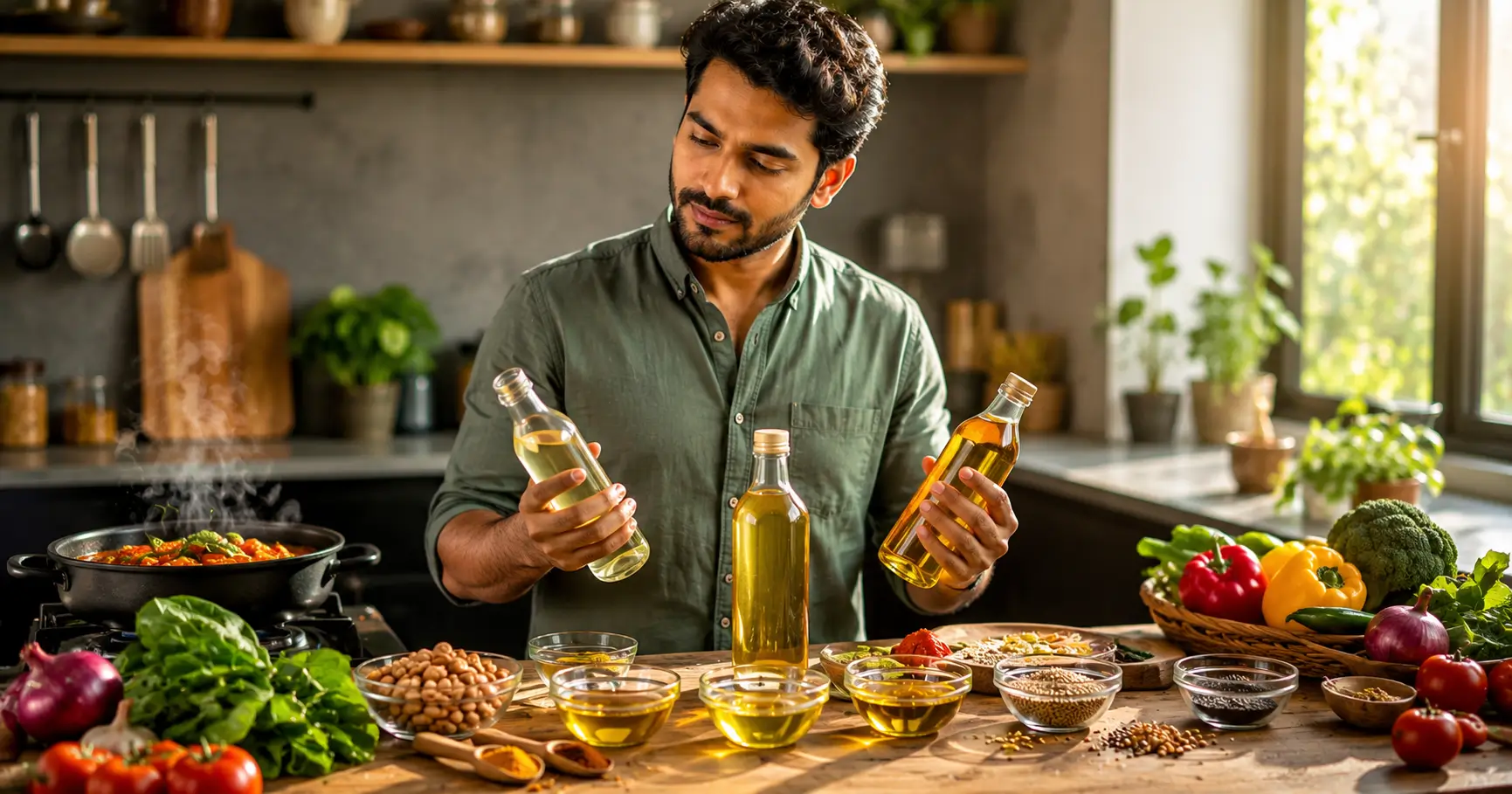

Walk into an Indian kitchen and you may find mustard oil beside sunflower oil, groundnut oil beside rice bran oil, or a bottle of olive oil reserved for “healthy” meals.
But which one actually deserves a place in your daily cooking?
The answer is more complicated—and more useful—than simply choosing the oil with the words “heart healthy,” “cold pressed” or “zero cholesterol” on the bottle.
For a healthy cooking oil, nutrition experts focus on the type and amount of fat, while food-safety authorities also emphasize proper storage and avoiding repeatedly heated oil. WHO recommends shifting fat intake away from saturated and trans fats toward unsaturated fats.
So instead of searching for one magical oil, it makes more sense to learn how to choose the right oil for the way you actually cook.
What makes a cooking oil healthy?
Cooking oil is mostly fat, but different oils contain different proportions of monounsaturated fatty acids (MUFA), polyunsaturated fatty acids (PUFA) and saturated fatty acids.
That composition matters.
WHO states that unsaturated fats are preferable to saturated and trans fats and recommends replacing saturated and trans fats with healthier unsaturated fats where possible.
However, healthy cooking is not only about the oil.
Quantity matters too.
Oil is energy-dense, so using a large amount of a nutritionally favorable oil can still add substantial calories to a meal.
India’s National Institute of Nutrition notes that visible fats—including cooking oils, ghee and butter—should be limited. Its Dietary Guidelines for Indians give a general visible-fat range of about 20–50 grams per day, depending on energy needs and physical activity, with approximately 27–30 grams for a 2,000-kcal diet as an example.
That leads to a simple principle:
The healthiest oil is not simply the one with the best label. It is the one that fits your diet, cooking method and portion size.
Which healthy cooking oil is best for Indian cooking?
There is no single winner for every recipe.
A better approach is to understand the strengths and limitations of commonly used oils.
| Oil | Main fatty-fat characteristic | Good fit for | Practical consideration |
| Groundnut oil | Relatively rich in MUFA | Sautéing, curries, frying | Strong traditional option with a distinctive flavor |
| Mustard oil | Contains MUFA and PUFA | North/East Indian cooking, tempering | Strong flavor; excellent culinary fit for many traditional dishes |
| Rice bran oil | Mix of MUFA and PUFA | Everyday cooking and frying | Mild flavor and versatile |
| Sunflower oil | High in PUFA | Everyday cooking | Widely available; avoid relying on large quantities |
| Soybean oil | PUFA-rich | Everyday cooking | Neutral flavor and widely available |
| Sesame oil | Contains MUFA and PUFA | Tempering and regional dishes | Strong, distinctive flavor |
| Canola oil | Relatively high in MUFA | General cooking | Mild flavor; useful where available |
| Olive oil | Rich in MUFA | Lower-to-medium heat cooking, dressings | More expensive; choose the type according to the cooking application |
FSSAI lists many of these oils among recognized edible vegetable oils and specifically notes that oils such as groundnut, refined rice bran and high-oleic sunflower can be suitable for frying.
So which should an Indian household buy?
For most households, a practical combination of suitable oils can make more sense than obsessing over one “perfect” bottle.
For example, a household that frequently prepares North Indian dishes may prefer mustard oil for its flavor, while another family may prefer the neutral taste of rice bran or groundnut oil.
The nutritional context of the whole diet remains more important than turning one oil into a health miracle.
Mustard oil: a traditional Indian choice
Mustard oil has a particularly strong place in several Indian cuisines.
Its pungent flavor works naturally with dishes that use mustard seeds, spices and strong tempering.
Nutritionally, mustard oil contains both monounsaturated and polyunsaturated fats. FSSAI recognizes mustard oil and low-erucic-acid rapeseed/mustard oil among edible vegetable oils under its standards.
The important point is not to assume that traditional automatically means healthiest.
Use mustard oil because it suits the cuisine and fits your overall dietary pattern—not because every traditional ingredient is automatically superior.
Groundnut oil: a versatile everyday option
Groundnut oil is popular for a reason.
Its relatively high MUFA content and culinary versatility make it useful for sautéing, curries and several frying applications.
FSSAI specifically identifies groundnut oil among the higher-MUFA oils that can be preferable for frying.
For families that want a neutral-to-mildly nutty oil that works across several Indian recipes, groundnut oil can be a practical choice.
The catch is simple: portion size still matters.
Rice bran oil: useful for everyday cooking
Rice bran oil has become increasingly common in Indian kitchens because of its mild flavor and versatility.
It contains a mixture of MUFA and PUFA and can work well in everyday cooking.
FSSAI includes refined rice bran oil among oils suitable for frying.
However, the word “refined” should not automatically scare you away.
FSSAI explicitly states that refined vegetable oils conforming to its standards are safe for use as cooking oils.
That is an important correction to the common internet claim that every refined oil is automatically unhealthy.
What about sunflower oil?
Sunflower oil is widely used in Indian households and is rich in polyunsaturated fat.
WHO includes sunflower oil among sources of unsaturated fat and recommends shifting away from saturated and trans fats toward unsaturated fats.
But “high in unsaturated fat” does not mean “use unlimited amounts.”
The overall diet, quantity of oil and cooking practices still matter.
If your meals already contain substantial amounts of added oil, simply changing brands or varieties may not produce the improvement you expect.
Is olive oil actually better for Indian cooking?
Olive oil has a strong reputation for healthy eating because it is rich in monounsaturated fat.
But that does not mean you need to replace every Indian cooking oil with imported olive oil.
WHO lists olive oil among sources of unsaturated fat, but a healthy diet can contain several appropriate oil choices.
Extra-virgin olive oil can be especially useful for dressings and lower-to-moderate heat applications where its flavor is desirable.
For Indian cooking, however, cost, flavor, cooking style and availability all matter.
A reasonably priced, compliant groundnut, mustard or rice bran oil used sensibly may be a perfectly practical choice.
Cold-pressed vs refined oil: which is healthier?
This is where marketing often gets ahead of science.
“Cold pressed,” “wood pressed” and “unrefined” sound automatically healthier, but the extraction method alone does not determine whether an oil fits a healthy diet.
FSSAI explains that refining removes undesirable compounds from crude oils and states that refined oils meeting FSSAI standards are safe for use.
Cold-pressed oils can retain more of some minor compounds and may have stronger flavors, but that does not turn them into calorie-free or disease-preventing foods.
When comparing oils, look beyond extraction claims.
Check:
- The oil’s fatty-acid profile
- Packaging and food-safety compliance
- Freshness and expiry date
- Storage conditions
- Whether the oil suits the recipe
- How much oil you actually use
The biggest cooking-oil mistake may not be the oil itself
Imagine two households.
Household A buys a good-quality vegetable oil but uses large quantities in every curry, repeatedly reheats frying oil and eats fried snacks several times a week.
Household B uses a conventional compliant oil in moderate quantities, rarely deep-fries food and avoids repeatedly reheating oil.
Which household has the healthier oil strategy?
The second.
That example illustrates why cooking habits can matter as much as oil selection.
WHO recommends limiting overall fat intake and shifting away from saturated and trans fats, while India’s dietary guidance emphasizes moderation of visible fats.
Why repeatedly heating cooking oil is a bad habit
This is one area where food safety deserves more attention.
Repeated heating changes the physical and chemical properties of edible oils and can increase the formation of total polar compounds (TPCs).
FSSAI has established a 25% TPC limit beyond which used cooking oil should not be used. Its RUCO initiative is designed to prevent used cooking oil from re-entering the food chain.
For a home kitchen, the practical lesson is straightforward:
Do not repeatedly heat the same frying oil whenever you can avoid it.
Watch for obvious deterioration such as an unusual smell, excessive darkening, foaming or other changes.
How much cooking oil should you use?
This question deserves more attention than “Which oil is number one?”
The NIN Dietary Guidelines for Indians explain that visible fat should be limited according to energy requirements and physical activity. For a 2,000-kcal diet, the guideline gives approximately 27–30 grams of visible fat per day as an example.
That amount is not a universal prescription for every person.
Your needs can differ because of:
- Age
- Body size
- Physical activity
- Pregnancy or lactation
- Overall calorie intake
- Medical conditions
- The amount of fat already present in your foods
Remember that nuts, seeds, dairy, meat and other foods also contribute fat.
A simple step-by-step method for choosing oil
1. Start with the cuisine
Choose an oil whose flavor works with the food.
Mustard oil may suit sarson-based or North/East Indian dishes, while sesame oil can complement several South Indian preparations.
2. Look at the fat profile
Favor oils that provide more unsaturated fats and avoid industrial trans fats.
WHO specifically recommends replacing saturated and trans fats with unsaturated fats where possible.
3. Match the oil to the cooking method
Sautéing, tempering, shallow frying and deep frying place different demands on an oil.
FSSAI identifies groundnut, refined rice bran and high-oleic sunflower oils among options preferable for frying.
4. Control the quantity
Even a nutritionally favorable oil is calorie-dense.
Measure oil rather than pouring directly from the bottle when you are trying to reduce intake.
5. Avoid repeatedly heated oil
This is one of the simplest food-safety improvements you can make.
FSSAI advises avoiding repeatedly heated oil and regulates TPC levels in used cooking oil.
6. Buy properly packaged oil
FSSAI advises consumers not to purchase loose edible oils because of potential adulteration concerns and recommends packaged edible oils.
7. Store it correctly
Keep the bottle tightly closed and away from excessive heat and direct light.
Buying a large quantity is not necessarily economical if the oil sits open for months and loses freshness.
Common mistakes to avoid
Mistake 1: Believing “cold pressed” means automatically healthy
Processing matters, but so do fat composition, quantity and overall diet.
Mistake 2: Thinking “zero cholesterol” makes an oil heart healthy
Plant oils naturally contain no dietary cholesterol, so this marketing claim tells you little about the overall quality of the fat.
Mistake 3: Using ghee as the only cooking fat
Ghee can contribute flavor, but it is relatively high in saturated fat. WHO recommends limiting saturated fat and replacing it with unsaturated fat where appropriate.
Mistake 4: Reusing frying oil again and again
Repeated heating can increase undesirable compounds. FSSAI specifically warns against repeatedly heated oil.
Mistake 5: Assuming expensive oil equals healthier oil
Price is not a nutritional score.
A compliant, appropriately chosen everyday oil used in moderation can be more sensible than an expensive oil used excessively.
Myths vs Facts
| Myth | Fact |
| Cold-pressed oil is always healthier. | Extraction method alone does not determine overall dietary quality. |
| Refined oil is automatically harmful. | FSSAI states that refined oils meeting its standards are safe for use. |
| Olive oil is the only healthy cooking oil. | Several oils provide unsaturated fats and can fit a balanced diet. |
| More oil makes food healthier. | Oil is energy-dense, so quantity matters. |
| Reheating oil is harmless. | Repeated heating changes oil and increases total polar compounds. |
| One oil must be used for everything. | Different oils can suit different recipes, flavors and cooking methods. |
The bottom line for Indian kitchens
If you want a healthy oil for Indian cooking, stop looking for a single magical winner.
Instead, prioritize unsaturated fats, moderate portions, food-safety compliance and appropriate cooking practices.
Mustard, groundnut, rice bran, sunflower, soybean, sesame, canola and olive oils can all have a place in different diets and cooking styles. The right choice depends on what you cook, how you cook it, your budget and the rest of your diet.
The most important upgrade may not even require changing your oil.
Use less of it, avoid repeatedly heating it, choose properly packaged products and build meals around vegetables, fruits, pulses, whole grains, nuts, seeds and appropriate protein sources.
That approach is much more useful than chasing the latest “miracle oil.”
FAQ
Which is the healthiest oil for Indian cooking?
There is no single healthiest oil for every Indian household. Oils richer in unsaturated fats, such as groundnut, mustard, rice bran, sunflower, soybean, canola and olive oils, can fit a balanced diet when used in appropriate amounts. WHO recommends favoring unsaturated fats over saturated and trans fats.
Is mustard oil healthy for daily cooking?
Mustard oil can fit a balanced diet and is widely used in Indian cuisine. Its suitability depends on the overall diet, quantity and cooking method. FSSAI recognizes mustard oil among its standards for edible vegetable oils.
Is refined oil unhealthy?
Not automatically. FSSAI states that refined oils that conform to its standards are safe to use as cooking oils. The overall fatty-acid profile, quantity consumed and cooking practices are more useful considerations than the word “refined” alone.
Which is better: groundnut oil or rice bran oil?
Both can be suitable cooking oils. Groundnut oil is relatively rich in monounsaturated fat, while rice bran oil contains a mixture of monounsaturated and polyunsaturated fats. The better choice depends on your cooking style, flavor preference, budget and overall diet.
Is cold-pressed oil healthier than refined oil?
Cold-pressed oil is not automatically healthier simply because it is less processed. Refined oils that meet FSSAI standards are considered safe, while the nutritional value of any oil also depends on its fatty-acid composition and how much you consume.
Can cooking oil be reused after frying?
Repeatedly heating oil is best avoided. FSSAI explains that repeated frying changes oil properties and increases total polar compounds; it has set a 25% TPC limit beyond which used cooking oil should not be used.
Conclusion
Choosing a healthy cooking oil for an Indian kitchen does not have to become a confusing battle between mustard, groundnut, rice bran, sunflower and olive oil.
The evidence points toward a more practical strategy:
- Favor unsaturated fats over saturated and trans fats.
- Use cooking oil in moderation.
- Choose packaged, compliant edible oils.
- Match the oil to your recipe and cooking method.
- Avoid repeatedly heating frying oil.
- Do not assume cold-pressed or expensive automatically means healthier.
- Look at your entire diet, not just the bottle in your kitchen.
The biggest improvement may be surprisingly simple: choose a suitable oil, use less of it, and cook more whole foods.
That is a much more sustainable definition of healthy cooking than searching for one perfect bottle.
Disclaimer
Disclaimer: This article is intended for general educational and informational purposes only and does not constitute medical, nutritional or dietary advice for an individual. Cooking-oil requirements vary according to age, activity level, dietary pattern, medical conditions and other personal factors. People with cardiovascular disease, diabetes, obesity, lipid disorders or other medical conditions should consult a qualified healthcare professional or registered dietitian for individualized dietary guidance. Always check the current product label and applicable food-safety standards before purchasing edible oil.