
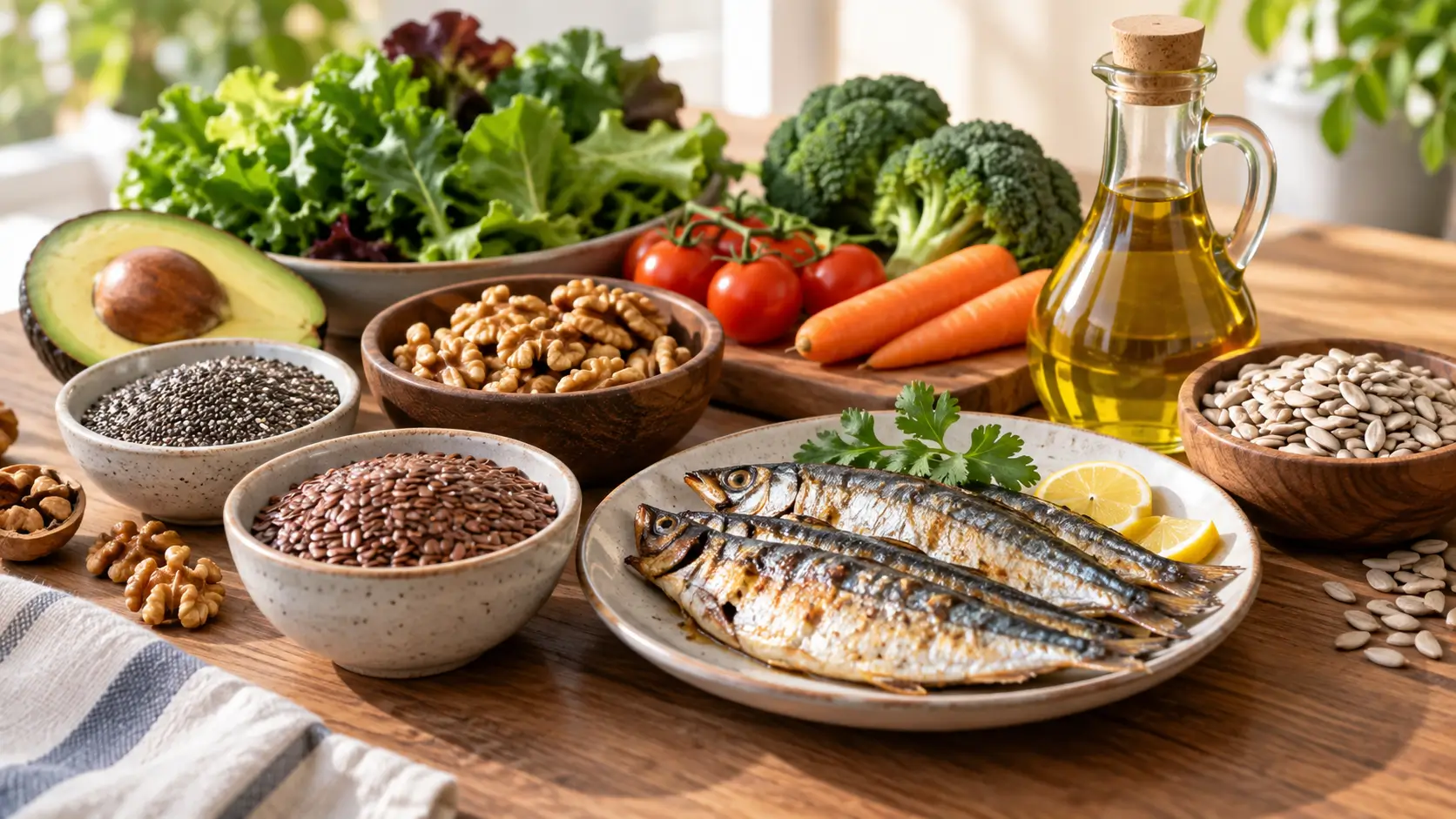

If you have ever searched for healthy fats, you have probably seen omega-3 praised as beneficial and omega-6 described as something to avoid. The reality is more nuanced.
Omega 3 and omega 6 are both families of polyunsaturated fatty acids, and both are important to normal body function. The body needs two essential fatty acids from food: alpha-linolenic acid (ALA), an omega-3 fatty acid, and linoleic acid (LA), an omega-6 fatty acid.
The main question is therefore not whether omega-3 is “good” and omega-6 is “bad.” A more useful question is whether your overall diet provides appropriate sources of unsaturated fats and enough omega-3-rich foods.
Quick Answer
Omega-3 and omega-6 are both essential polyunsaturated fats, but they are not identical. Omega-3 includes ALA, EPA and DHA, while linoleic acid is the main dietary omega-6 fatty acid. ALA is found in foods such as flaxseed, chia seeds and walnuts, while EPA and DHA are particularly concentrated in fish and seafood. Omega-6 is abundant in many plant oils, nuts and seeds.
You do not need to eliminate omega-6 from a healthy diet. Current evidence does not establish a single ideal omega-6-to-omega-3 ratio for everyone, and research does not support the simple claim that dietary linoleic acid automatically causes inflammation.
What Are Omega-3 and Omega-6?
Both omega-3 and omega-6 belong to the family of polyunsaturated fatty acids (PUFAs).
They have important structural and signaling roles in the body. Some fatty acids can be produced internally, but humans cannot make ALA and linoleic acid in sufficient amounts. They therefore need to come from the diet.
Omega-3
The three omega-3 fatty acids most often discussed are:
- ALA (alpha-linolenic acid)
- EPA (eicosapentaenoic acid)
- DHA (docosahexaenoic acid)
ALA is found mainly in plant foods and oils. EPA and DHA are found predominantly in fish and seafood and are also available from algae-based supplements.
Your body can convert some ALA into EPA and DHA, but this conversion is limited. Therefore, people who want to increase EPA and DHA levels generally obtain them directly from seafood or an appropriate supplement.
Omega-6
The most important dietary omega-6 fatty acid is linoleic acid (LA). Another important omega-6 fatty acid is arachidonic acid (AA).
Omega-6 fatty acids are found in many plant oils, nuts, seeds and other foods. They are involved in cell membranes and biological signaling and are not simply “bad fats.”
Omega-3 vs Omega-6: Key Differences
| Feature | Omega-3 | Omega-6 |
|---|---|---|
| Main essential fatty acid | ALA | Linoleic acid |
| Other important forms | EPA, DHA | Arachidonic acid |
| Plant sources | Flaxseed, chia, walnuts, some oils | Many vegetable oils, nuts and seeds |
| Animal/seafood sources | Fatty fish and seafood provide EPA/DHA | Meat and eggs provide some longer-chain omega-6 |
| Essential? | ALA is essential | Linoleic acid is essential |
| Main misconception | “More is always better” | “All omega-6 causes inflammation” |
The most important point is that omega-3 and omega-6 should not be treated as opposing nutrients where one must be eliminated to make room for the other.
Is Omega-6 Bad for You?
No. Calling omega-6 “bad” is an oversimplification.
One reason the claim became popular is that some omega-6-derived signaling molecules can participate in inflammatory processes. However, the biology is considerably more complicated than simply saying “omega-6 causes inflammation.”
A systematic review of randomized controlled trials found no convincing evidence that increasing dietary linoleic acid increased a broad range of inflammatory markers in healthy adults.
A later systematic review and meta-analysis of 30 randomized controlled trials involving 1,377 participants similarly found no significant overall effect of increased linoleic acid intake on several inflammatory markers, including C-reactive protein, although the researchers noted some uncertainty around larger dietary increases.
This does not mean every source or amount of dietary fat is automatically healthy. It means the blanket statement “omega-6 causes inflammation” is not supported by the available human evidence.
Does the Omega-6-to-Omega-3 Ratio Matter?
This is one of the most misunderstood parts of the topic.
You may see recommendations online suggesting that humans should maintain a particular ratio, such as 1:1, 2:1 or 4:1.
There is no universally accepted optimal omega-6-to-omega-3 ratio.
The NIH Office of Dietary Supplements notes that although researchers have proposed that the ratio could influence chronic disease risk, the optimal ratio has not been defined. It also notes that some researchers consider the ratio less useful than looking at individual fatty-acid levels.
This is important because a ratio can become misleading.
For example, someone could theoretically improve a ratio by dramatically reducing omega-6 intake without actually improving the overall quality of the diet. A healthier approach is to consider the whole dietary pattern.
What Foods Provide Omega-3?
For an Indian diet, practical sources include:
- Flaxseed (alsi)
- Chia seeds
- Walnuts
- Soy and soybean products
- Canola oil where available
- Fatty fish such as sardines and mackerel
- Other seafood containing EPA and DHA
Plant foods primarily provide ALA. Fish and seafood provide the long-chain omega-3 fatty acids EPA and DHA.
If you eat fish, including appropriate portions as part of a balanced diet can be a practical way to obtain EPA and DHA.
Vegetarians and vegans can obtain ALA from plant foods. Algal oil is another source of DHA and, depending on the product, EPA.
What Foods Provide Omega-6?
Omega-6 is widely available in everyday diets.
Sources include:
- Sunflower oil
- Soybean oil
- Corn oil
- Sesame and other seeds
- Nuts
- Seeds and seed products
- Many packaged foods made using vegetable oils
The presence of omega-6 alone does not make a food unhealthy.
The overall food matters. A diet based largely on minimally processed foods can contain omega-6 while still being nutritionally sound.
What About Omega-3 and Inflammation?
Omega-3s have biological effects that differ from those of many omega-6-derived signaling molecules, which is one reason researchers have studied their role in inflammation.
But it would be inaccurate to say that eating omega-3 automatically “turns off inflammation.”
Human research is more complicated, and effects depend on the fatty acid, dose, population and health outcome being studied.
Likewise, reducing omega-6 solely to “lower inflammation” is not an evidence-based universal recommendation.
The better strategy is to focus on the overall dietary pattern and replace less desirable fats and highly processed foods with nutrient-rich foods.
Should You Take an Omega-3 Supplement?
Not everyone needs an omega-3 supplement.
Fish-oil, krill-oil and algal-oil supplements can provide omega-3 fatty acids, but supplementation should not be treated as a universal requirement for healthy adults.
The NIH notes that evidence for cardiovascular benefits from omega-3 supplements is not straightforward, while seafood consumption and supplements are not interchangeable exposures.
Some prescription omega-3 products are also used in specific medical circumstances. Those are different from casually taking an over-the-counter supplement and should not be treated as interchangeable.
If you take medicines, have a medical condition, are pregnant or breastfeeding, or are considering a high-dose supplement, discuss it with an appropriately qualified healthcare professional.
What Should You Actually Do?
Instead of trying to calculate an exact omega-6-to-omega-3 ratio, focus on a few practical habits.
1. Include omega-3-rich foods regularly
For example, add ground flaxseed or chia to suitable meals, eat walnuts, or include fish such as sardines or mackerel if you eat seafood.
2. Do not fear all omega-6 foods
Omega-6 fatty acids are essential nutrients. There is no general reason for a healthy person to eliminate them from the diet.
3. Pay attention to the quality of your overall diet
WHO recommends emphasizing unsaturated fats over saturated and trans fats as part of a healthy dietary pattern.
That means the broader pattern matters more than obsessing over one fatty-acid ratio.
4. Reduce reliance on highly processed foods
Many packaged and fried foods can contain substantial amounts of fat, salt, refined carbohydrates and calories. Looking only at their omega-3-to-omega-6 ratio misses the bigger nutritional picture.
5. Do not treat supplements as substitutes for diet
A supplement cannot turn an otherwise poor dietary pattern into a healthy one.
Common Myths
Myth: Omega-6 is an unhealthy fat.
Fact: Omega-6 includes essential fatty acids and has important biological functions. The blanket claim that omega-6 is harmful is not supported.
Myth: Everyone needs a 1:1 omega-6-to-omega-3 ratio.
Fact: No universally accepted optimal ratio has been established.
Myth: More omega-3 is always better.
Fact: Omega-3s are important, but more is not automatically better. Supplements can have risks and are not appropriate for everyone.
Myth: Eating sunflower or soybean oil automatically causes inflammation.
Fact: Human randomized-trial evidence does not support the simple claim that dietary linoleic acid necessarily increases inflammatory markers.
Practical Takeaway
Omega-3 and omega-6 are both important polyunsaturated fats, not nutritional enemies.
The most useful distinction is between their individual fatty acids and food sources. ALA is an essential omega-3, while linoleic acid is an essential omega-6. EPA and DHA are longer-chain omega-3s found mainly in seafood and algae-based products.
You do not need to eliminate omega-6 or chase a particular omega-6-to-omega-3 ratio. Instead, build a varied diet that includes sources of unsaturated fats and omega-3-rich foods while limiting trans fats, excessive saturated fat and heavily processed foods.
For most people, the quality of the overall dietary pattern matters more than winning an “omega-3 versus omega-6” competition.
FAQ
Is omega-3 better than omega-6?
Neither should simply be labeled “better.” Both are important fatty-acid families. Omega-3 and omega-6 perform different biological roles, and both include essential fatty acids that need to come from the diet.
Is omega-6 inflammatory?
It is inaccurate to describe all omega-6 fats as inflammatory. Human randomized-trial evidence has not shown that increasing dietary linoleic acid generally increases inflammatory markers.
What is the ideal omega-6-to-omega-3 ratio?
There is no universally established ideal ratio. NIH notes that the optimal ratio, if one exists, has not been defined.
Which foods are high in omega-3?
Flaxseed, chia seeds and walnuts provide ALA. Fatty fish such as sardines and mackerel provide EPA and DHA. Algal oil can provide DHA and sometimes EPA.
Which foods contain omega-6?
Omega-6 fatty acids are found in many plant oils, nuts, seeds and other foods. Linoleic acid is particularly common in many vegetable oils.
Should I stop eating sunflower oil because it contains omega-6?
Not solely because it contains omega-6. The nutritional quality of the overall diet matters more than eliminating one essential fatty-acid family. WHO recommends emphasizing unsaturated fats over saturated and trans fats.
Do vegetarians get omega-3?
Vegetarians can obtain ALA from foods such as flaxseed, chia, walnuts and some plant oils. However, ALA conversion to EPA and DHA is limited, so people seeking direct EPA/DHA may consider algae-derived sources.
Does everyone need an omega-3 supplement?
No. Supplementation is not automatically necessary for every healthy adult. Whether a supplement is appropriate depends on diet, health status, medications and individual circumstances.
MEDICAL DISCLAIMER
This article is for general educational and informational purposes and does not replace individualized medical or nutritional advice. Nutritional needs vary with age, health status, medications, allergies, pregnancy, activity level and other factors. If you are considering an omega-3 supplement, particularly a high-dose product, discuss it with an appropriately qualified healthcare professional or registered dietitian.