


Alzheimer’s disease is a progressive brain disease that gradually affects memory, thinking, reasoning and the ability to manage everyday activities. It is the most common cause of dementia, but Alzheimer’s disease and dementia are not the same thing.
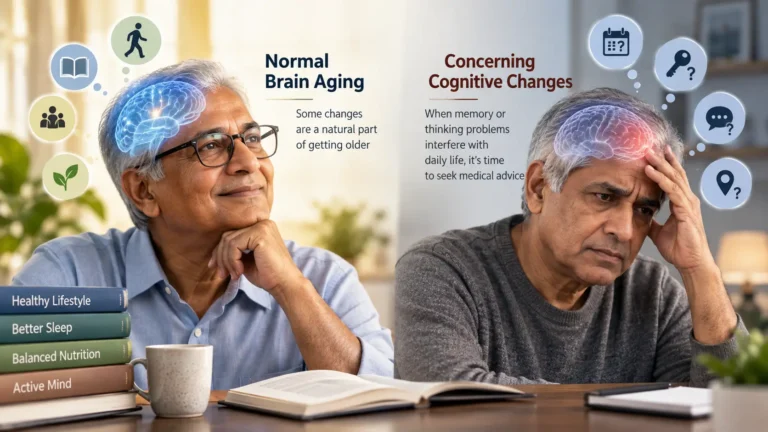
For families, one of the most important distinctions is that occasional forgetfulness does not automatically mean Alzheimer’s. Memory and thinking can change with normal aging, while persistent or progressively worsening problems that interfere with daily life deserve medical evaluation.
There is currently no cure for Alzheimer’s disease. However, research has identified several factors associated with dementia risk, and updated World Health Organization guidance in 2026 emphasizes healthy behaviours and management of conditions such as high blood pressure, diabetes and high cholesterol as part of dementia-risk reduction.
Quick Answer
Alzheimer’s disease is a progressive neurological disease that damages brain cells and gradually affects memory, thinking, behaviour and everyday functioning. Age is its strongest known risk factor, but genetics, cardiovascular health, physical inactivity, smoking, hearing loss, diabetes and other factors can also influence dementia risk.
No lifestyle change can guarantee that an individual will avoid Alzheimer’s. However, regular physical activity, a balanced diet, avoiding tobacco, managing cardiovascular and metabolic health, staying socially and cognitively engaged, and addressing hearing or vision problems can support healthier aging and may reduce the risk of cognitive decline and dementia.
What Is Alzheimer’s Disease?
Alzheimer’s disease is a brain disorder in which changes in the brain progressively damage neurons and their connections.
Researchers have identified abnormal changes involving proteins such as beta-amyloid and tau, but the biological process is complex and scientists still do not fully understand why Alzheimer’s develops in most people.
The disease can begin years before noticeable symptoms appear.
As it progresses, a person may have increasing difficulty remembering information, finding words, solving problems, making decisions or completing familiar activities.
Alzheimer’s is not simply “normal aging.”
Alzheimer’s Disease vs Dementia
The terms are related but should not be used interchangeably.
Dementia is a broad clinical term describing significant problems with memory, thinking or other cognitive abilities that interfere with everyday life.
Alzheimer’s disease is one specific brain disease that can cause dementia.
Other diseases can also cause dementia, including vascular dementia and dementia with Lewy bodies.
This distinction matters because someone experiencing memory problems may have a condition other than Alzheimer’s, and some causes of cognitive problems may be treatable.
What Are the Early Signs of Alzheimer’s?
Memory problems are often among the earliest noticeable symptoms, but Alzheimer’s can affect more than memory.
Possible warning signs include:
- repeatedly forgetting recently learned information;
- asking the same questions repeatedly;
- difficulty planning or solving problems;
- trouble completing familiar activities;
- confusion about time or place;
- difficulty finding words or following conversations;
- frequently misplacing things and being unable to retrace steps;
- increasingly poor judgment;
- withdrawing from work or social activities;
- noticeable changes in mood or personality.
These signs are not a self-diagnosis checklist.
For example, occasionally forgetting where you put your keys and remembering later can happen with normal aging. More concerning is a persistent or worsening pattern that affects independence or everyday functioning.
What Causes Alzheimer’s?
There is no single cause in most cases.
Researchers believe Alzheimer’s usually develops through an interaction between factors such as:
- aging-related biological changes;
- genetics;
- family history;
- cardiovascular and metabolic health;
- lifestyle factors;
- environmental exposures;
- other changes affecting the brain.
One well-known genetic factor is the APOE gene. Some variants, including APOE ε4, can increase Alzheimer’s risk. However, carrying a risk-associated gene does not mean a person will definitely develop Alzheimer’s.
Likewise, a person can develop Alzheimer’s without having a known family history.
What Increases the Risk?
Some risk factors cannot be changed.
Age is the strongest known risk factor. Family history and genetics can also influence risk.
Other factors are potentially modifiable.
These include:
High blood pressure and metabolic health
Hypertension, diabetes and abnormal cholesterol are associated with dementia risk. Managing these conditions appropriately is therefore important for overall cardiovascular and brain health.
This does not mean that controlling blood pressure or cholesterol guarantees prevention of Alzheimer’s. It means that managing established health risks is part of a broader risk-reduction strategy.
Physical inactivity
Regular physical activity benefits cardiovascular health, metabolic health, mood and physical function. WHO includes physical activity among the interventions relevant to dementia-risk reduction.
Smoking and harmful alcohol use
Tobacco use is associated with dementia risk, while harmful alcohol use can also damage health and the brain.
Avoiding tobacco and reducing harmful alcohol exposure can provide benefits well beyond dementia prevention.
Hearing and vision problems
Hearing loss is associated with dementia risk, and WHO’s updated guidance includes hearing-related interventions within its broader dementia-risk-reduction framework.
Untreated vision problems have also become an increasingly recognized area of interest in dementia research.
Social and cognitive engagement
Staying socially connected and mentally active supports overall well-being and healthy aging.
However, it would be misleading to claim that puzzles, brain-training apps or a particular game can prevent Alzheimer’s. Evidence for commercial brain-training products remains insufficient to make that kind of promise.
Can Alzheimer’s Be Prevented?
There is currently no guaranteed method for preventing Alzheimer’s disease.
However, prevention research has increasingly focused on reducing modifiable dementia risks.
WHO’s updated 2026 guidance recommends or supports measures involving healthy behaviours, physical activity, tobacco cessation, healthy diet, appropriate alcohol reduction, management of hypertension, diabetes and high cholesterol, cognitive stimulation and engagement, and reducing exposure to air pollution.
The WHO also reports that up to 45% of dementia risk could potentially be prevented or delayed at the population level through addressing modifiable risk factors.
That number should not be interpreted as meaning that an individual can reduce their personal Alzheimer’s risk by exactly 45%. Population-attributable risk and individual risk are different concepts.
The practical message is simpler: healthy habits and appropriate medical care can improve overall health and may reduce dementia risk, but they cannot guarantee an Alzheimer’s-free future.
What About Diet?
A balanced diet is part of healthy aging, but there is no single food proven to prevent Alzheimer’s.
Instead of searching for a “brain-boosting” food, focus on an overall dietary pattern containing vegetables, fruits, whole grains, pulses such as dal, beans and chana, nuts and seeds, and appropriate sources of protein.
For Indian households, this can often be achieved through ordinary meals rather than expensive supplements or specialty products.
WHO’s 2026 guidance also states that vitamin B, vitamin E, omega-3 supplements and multivitamin/mineral supplements should not be used specifically for dementia-risk reduction in people without a diagnosed deficiency because evidence of benefit is insufficient.
How Is Alzheimer’s Diagnosed?
There is no single symptom that proves someone has Alzheimer’s.
A healthcare professional may review:
- symptoms and how they developed;
- medical and family history;
- medicines being taken;
- cognitive abilities;
- ability to manage everyday activities;
- physical and neurological findings;
- laboratory tests for other possible causes.
Depending on the situation, clinicians may also use brain imaging, cerebrospinal-fluid biomarkers or blood-based biomarkers.
The goal is not simply to label memory loss. It is also to identify other conditions that may contribute to cognitive symptoms.
What Treatments Are Available?
There is currently no cure for Alzheimer’s disease.
Some medicines can help manage symptoms. More recently, disease-modifying therapies targeting amyloid have become available in some countries for selected people with early Alzheimer’s disease.
These treatments are not appropriate for everyone and can involve significant risks and monitoring requirements. For example, amyloid-targeting antibodies can cause amyloid-related imaging abnormalities involving brain swelling or bleeding.
Treatment decisions therefore require appropriate medical assessment rather than self-treatment based on an online article.
When Should You Seek Medical Advice?
Consider arranging a medical evaluation if memory or thinking changes:
- progressively worsen;
- interfere with work or household activities;
- affect managing money or medicines;
- cause repeated navigation problems;
- interfere with familiar tasks;
- produce significant changes in language or behaviour;
- concern family members or other people who know the individual well.
A sudden change in mental status is different from gradual memory decline and may require urgent medical assessment, particularly when accompanied by symptoms such as sudden weakness, speech difficulty, severe headache, loss of consciousness or other neurological warning signs.
Common Myths
Myth: Alzheimer’s is just normal aging.
Fact: Alzheimer’s is a disease. Dementia is not considered a normal part of aging.
Myth: Forgetfulness means you have Alzheimer’s.
Fact: Memory problems have many possible causes and require context and, when appropriate, clinical evaluation.
Myth: One food or supplement can prevent Alzheimer’s.
Fact: There is no established food or supplement that guarantees prevention.
Myth: A family history means you will definitely develop Alzheimer’s.
Fact: Family history can increase risk, but it does not determine an individual’s outcome.
Myth: Healthy habits guarantee prevention.
Fact: Healthy behaviours may reduce dementia risk and improve overall health, but they cannot guarantee prevention.
Practical Takeaway
Alzheimer’s disease is a complex, progressive brain disease—not an inevitable consequence of getting older and not something that can be diagnosed from one symptom.
The most useful approach is to pay attention to persistent changes in memory and thinking, seek appropriate medical evaluation when needed, and address modifiable health risks.
For everyday brain and cardiovascular health, that means staying physically active, eating a balanced diet, avoiding tobacco, limiting harmful alcohol use, managing blood pressure, diabetes and cholesterol appropriately, maintaining social and cognitive engagement, and addressing hearing or vision problems.
These actions are not a cure and cannot promise prevention. They are simply part of a broader evidence-informed approach to healthier aging.
Sources used for this article: World Health Organization 2026 dementia guidance; National Institute on Aging; CDC; FDA; peer-reviewed Indian dementia research.
FAQ
What is Alzheimer’s disease?
Alzheimer’s disease is a progressive brain disease that gradually damages memory, thinking and other cognitive abilities and can eventually interfere substantially with everyday activities.
Is Alzheimer’s the same as dementia?
No. Dementia is a broad term describing significant cognitive impairment affecting daily life, while Alzheimer’s is a specific disease and the most common cause of dementia.
What are the early signs of Alzheimer’s?
Early signs can include persistent memory problems, difficulty planning or solving problems, trouble completing familiar tasks, language problems, getting lost, poor judgment and changes in mood or personality.
Is Alzheimer’s a normal part of aging?
No. Alzheimer’s becomes more common with age, but dementia is not considered a normal consequence of aging.
Can Alzheimer’s be prevented?
There is no guaranteed way to prevent Alzheimer’s. However, evidence supports addressing several modifiable dementia-risk factors, including physical inactivity, tobacco use, hypertension, diabetes and other cardiovascular/metabolic risks.
Does family history mean someone will get Alzheimer’s?
No. Family history can increase risk, and genetics influence susceptibility, but having a family member with Alzheimer’s does not mean an individual will definitely develop the disease.
How is Alzheimer’s diagnosed?
Diagnosis involves a clinical assessment that can include medical and family history, cognitive testing, laboratory investigations and, when appropriate, brain imaging or biomarker testing.
Is there a cure for Alzheimer’s disease?
There is currently no cure. Treatments are available that may help manage symptoms, and disease-modifying therapies are available for selected people with early Alzheimer’s in some healthcare systems.
MEDICAL DISCLAIMER
Medical Disclaimer: This article provides general health and educational information about Alzheimer’s disease and does not diagnose, treat or rule out any medical condition. Memory or thinking changes can have many possible causes. If symptoms are persistent, progressive or affecting everyday life, seek evaluation from an appropriately qualified healthcare professional. Do not start, stop or change medicines based solely on this article. Sudden neurological or mental-status changes may require urgent medical attention.



[…] important in medical research because abnormal tau changes and aggregates are a major feature of Alzheimer’s disease and several other neurodegenerative […]