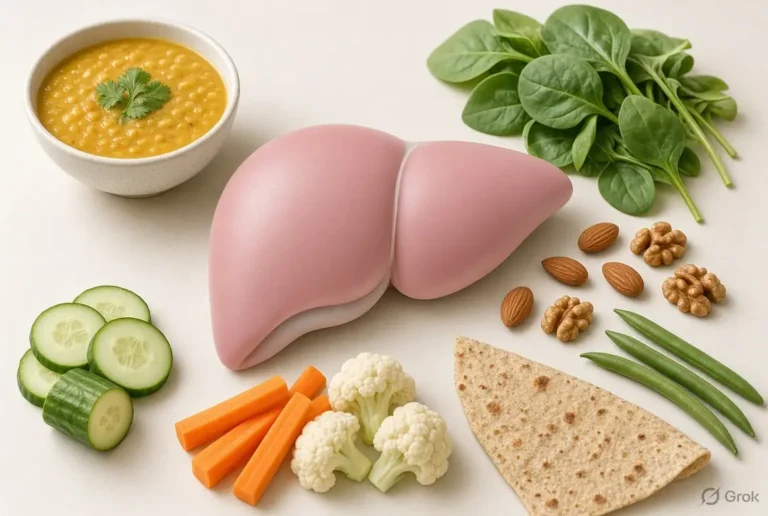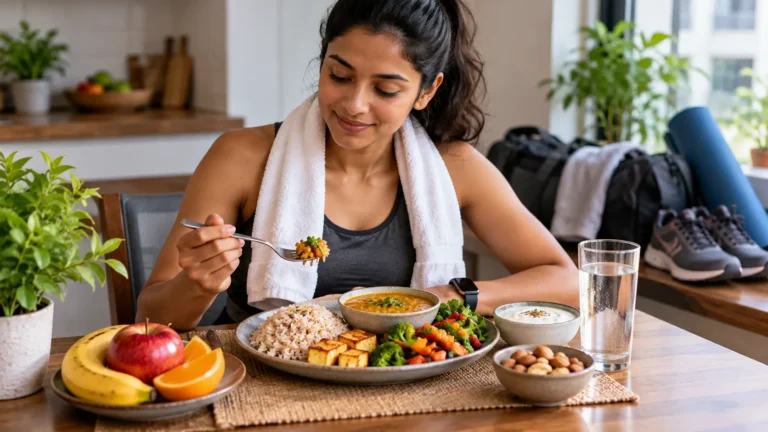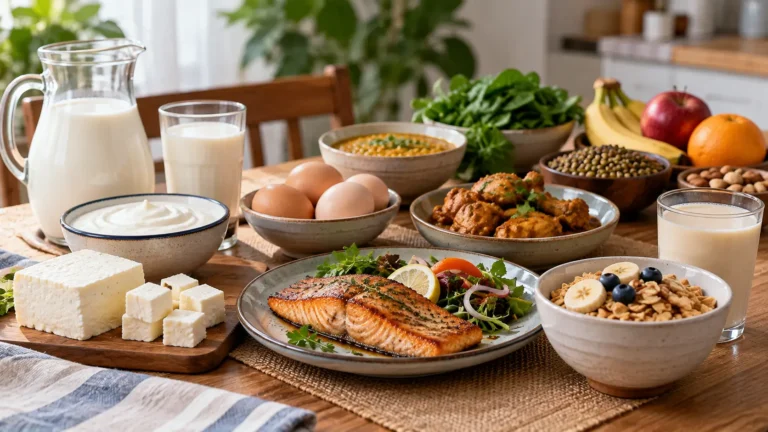
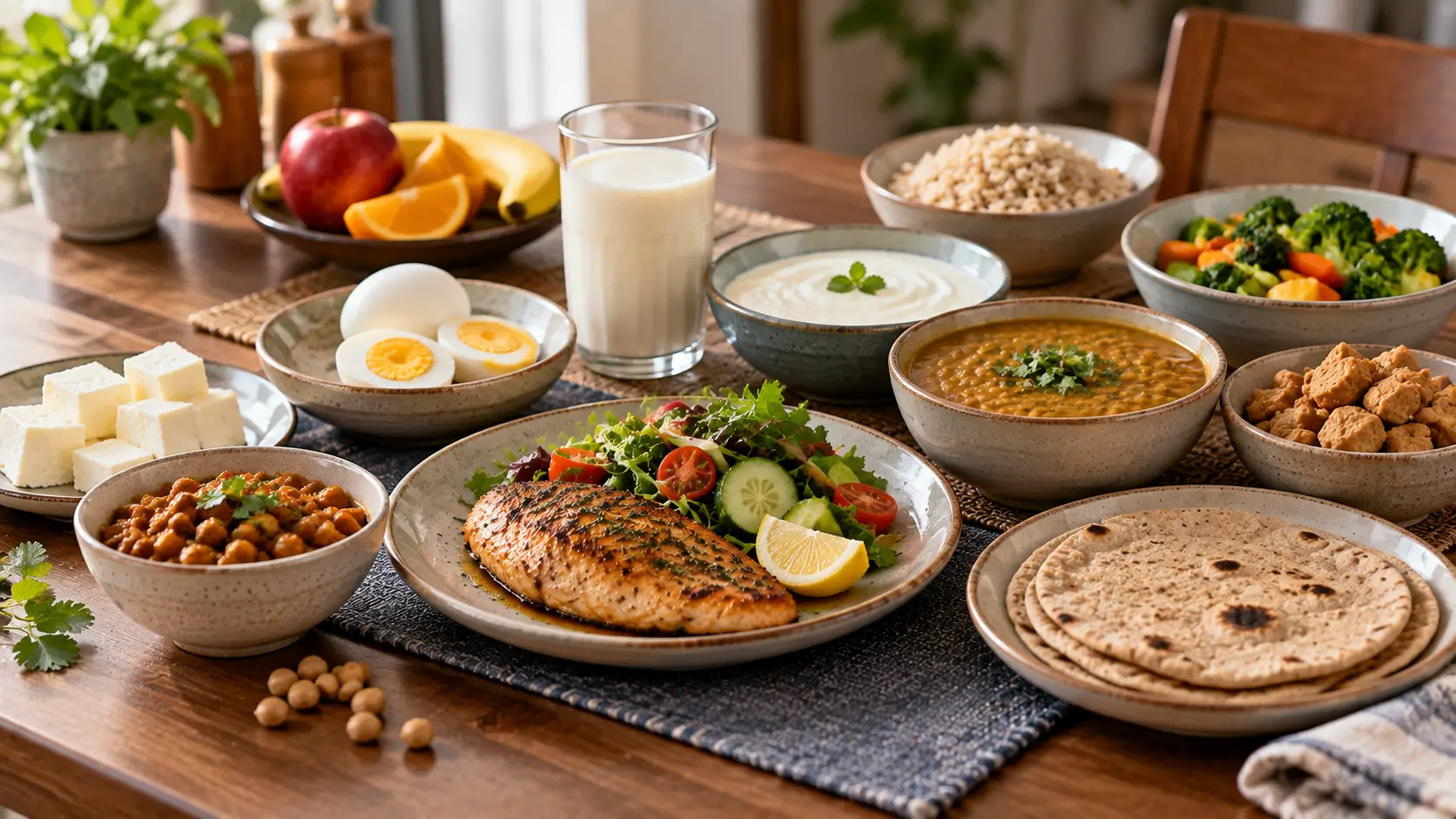

Getting around 80 grams of protein a day is possible with ordinary Indian foods. You do not necessarily need protein powder, expensive “high-protein” products or a diet built around meat.
However, there is an important point before you start: 80 grams is a target, not a universal requirement. Your protein needs depend on factors such as body weight, age, activity level, training, overall diet and health status.
For healthy Indian adults, ICMR-NIN’s 2020 recommendation is 0.83 grams of protein per kilogram of body weight per day. That means the right starting point is your individual requirement—not simply copying someone else’s 80-gram target.
Quick Answer
An 80 gram protein diet means consuming approximately 80 grams of protein across the day. A practical Indian pattern could combine foods such as dal, beans, curd, milk, paneer, eggs, soy, fish or chicken.
For example, an active adult may use an 80-gram target as a practical planning number, while another person may need less or more. Protein should also remain part of a balanced diet containing vegetables, fruit, grains, healthy fats and other nutrient-rich foods.
What Does an 80 Gram Protein Diet Actually Mean?
It simply means that the day’s total protein intake adds up to approximately 80 grams.
It does not mean eating 80 grams of chicken, paneer or dal.
Food contains different amounts of protein. For example, ICMR-NIN’s Indian Food Composition Tables report approximately 18.9 grams of protein per 100 grams of paneer and about 3.3 grams per 100 grams of cow’s milk. Food composition varies with the food, variety and preparation.
This is why an 80-gram target is usually easier to achieve by combining several protein sources.
Think:
Breakfast protein + lunch protein + snack protein + dinner protein = daily total
You do not need one enormous protein-heavy meal.
Is 80 Grams of Protein Enough for You?
It depends.
ICMR-NIN’s recommended dietary allowance for healthy Indian adults is 0.83 g/kg/day.
For illustration:
| Body weight | 0.83 g/kg/day |
|---|---|
| 50 kg | ~42 g |
| 60 kg | ~50 g |
| 70 kg | ~58 g |
| 80 kg | ~66 g |
| 90 kg | ~75 g |
| 96 kg | ~80 g |
These calculations show why the number 80 should not automatically be treated as everyone’s requirement.
Someone weighing 60 kg does not become nutritionally deficient simply because they consume less than 80 grams. Conversely, a person with substantial training demands may have a different protein target.
People who regularly participate in resistance training or other athletic activity can require more protein than the basic requirement for sedentary adults. The appropriate amount still depends on the individual and the overall training and diet context.
How to Build an 80 Gram Protein Diet With Indian Foods
The easiest strategy is to distribute protein across ordinary meals.
Breakfast
Choose one protein foundation:
- 2 eggs with milk
- Paneer with whole-grain roti
- Curd or Greek-style yogurt with oats
- Milk with a balanced breakfast
- Soy-based food with roti or another grain
For example, two eggs provide roughly 12 grams of protein, while a glass of milk can add several more grams. Exact values vary by size and product.
Lunch
Build lunch around a substantial protein source rather than relying mainly on rice or roti.
Examples:
- Dal + roti + vegetables + curd
- Rajma + rice + vegetables
- Chana + roti + salad
- Paneer + roti + vegetables
- Chicken or fish + rice/roti + vegetables
ICMR-NIN’s dietary guidance emphasizes appropriate combinations of foods to obtain good-quality protein and essential amino acids.
Evening snack
A snack can contribute meaningful protein without becoming a supplement-heavy meal.
Options include:
- Roasted chana
- Plain curd
- Milk
- Soy foods
- Nuts and seeds alongside another protein-rich food
Remember that nuts and seeds contain protein but are also relatively energy-dense, so they should not be treated as pure protein foods.
Dinner
Use another substantial protein source:
- Dal + vegetables + roti
- Paneer + vegetables + roti
- Soy-based curry + rice/roti
- Fish + rice + vegetables
- Chicken + roti + vegetables
This approach makes an 80-gram target much easier than trying to consume most of the day’s protein in one sitting.
Example: Approximately 80 g Protein Day
The following is an illustrative meal structure, not a personalized diet prescription.
Breakfast
- 2 eggs
- 250 ml milk
- Vegetable or whole-grain breakfast
Protein: roughly 20 g
Lunch
- 1 serving dal
- 2 rotis
- 100 g plain curd
- Vegetables
Protein: roughly 18 g
Evening
- Roasted chana
- Fruit
Protein: roughly 6 g
Dinner
- Approximately 80 g cooked chicken
- 2 rotis
- Vegetables
Protein: roughly 35 g
Daily total: approximately 79–80 g
The actual total will vary because egg size, milk composition, roti size, dal consistency, chicken preparation and serving sizes differ.
For this reason, treat the example as a planning framework rather than a laboratory-precise calculation.
Can Vegetarians Reach 80 Grams?
Yes, many vegetarian diets can provide substantial protein when meals are planned around pulses, dairy, soy and other protein-containing foods.
A practical combination could include:
- Milk
- Curd
- Paneer
- Dal
- Rajma
- Chana
- Soy foods
- Nuts and seeds
- Whole grains
For example, a lacto-vegetarian day could distribute protein between milk or curd at breakfast, dal and curd at lunch, roasted chana as a snack, and paneer or soy at dinner.
Vegetarian diets benefit from variety rather than depending on a single “perfect” protein food.
For people following a vegan diet, soy foods, beans, lentils, peas, nuts, seeds and fortified foods can contribute protein. Product nutrition labels are useful because protein concentrations vary substantially between packaged foods.
Do You Need Protein Powder to Reach 80 Grams?
No.
Protein powder is a convenient source of protein, but it is not a requirement for everyone trying to reach an 80-gram target.
ICMR-NIN’s 2024 Dietary Guidelines specifically emphasize obtaining good-quality protein through appropriate combinations of foods and advise against relying on protein supplements simply to build muscle mass.
Whole foods also contribute other nutrients that a protein powder may not provide.
A supplement can have a practical role in some situations, but the question should be whether it fills a genuine nutritional gap—not whether a larger protein number on the label automatically makes the diet better.
What About an 80 Gram Protein Diet for Weight Loss?
A higher-protein diet can be useful within a weight-management plan, but 80 grams of protein does not automatically cause weight loss.
Weight management depends on overall energy intake, food quality, physical activity, sleep and individual factors.
A useful meal structure is:
Protein source + vegetables/fruit + appropriate carbohydrate + sensible amount of fat
There is no need to eliminate rice or roti simply because you are trying to increase protein.
A meal such as dal, vegetables and roti can be nutritionally different from a meal dominated by refined carbohydrates and fried foods.
What About Muscle Gain?
Protein is important for maintaining and building muscle, but protein alone does not guarantee muscle gain.
For someone training regularly, protein intake needs to be considered alongside:
- resistance training
- adequate energy intake
- recovery
- sleep
- total diet quality
People who train regularly may need more protein than the basic adult requirement. The appropriate target should be based on the person’s body size, training and goals rather than automatically choosing 80 grams.
Common Mistakes
Mistake 1: Treating 80 g as a universal requirement
Your protein requirement is individual.
Mistake 2: Counting only meat or dairy
Dal, beans, soy and other plant foods also contribute protein.
Mistake 3: Eating huge amounts of paneer or nuts
Protein content is only one part of a food’s nutritional profile. Some protein-rich foods also provide substantial fat and calories.
Mistake 4: Assuming protein powder is necessary
Many people can obtain substantial protein from ordinary foods.
Mistake 5: Forgetting the rest of the diet
A high-protein diet can still be poorly balanced if vegetables, fruit, whole grains, pulses and healthy fats are neglected.
WHO emphasizes adequacy, balance, moderation and dietary diversity as foundations of healthy eating.
Who Should Personalize an 80 Gram Target?
A generic protein target deserves extra caution if you have:
- kidney disease
- significant liver disease
- another condition affecting protein or energy requirements
- pregnancy or breastfeeding
- significant undernutrition
- an eating disorder
- a medically prescribed diet
Older adults may also have different protein considerations. For example, geriatric nutrition guidance commonly considers higher protein intakes for older adults than the basic adult requirement, while emphasizing individual adjustment according to health and nutritional status.
If you have a medical condition or take a prescribed therapeutic diet, discuss your protein target with an appropriately qualified healthcare professional or registered dietitian.
Practical Takeaway
An 80 gram protein diet can be built from familiar Indian foods.
You can spread protein across breakfast, lunch, snacks and dinner using combinations such as:
Eggs + milk → dal + curd → roasted chana → paneer, soy, fish or chicken
The most important point is that 80 grams is not a magic number.
Start with your body weight, activity level, health status and dietary pattern. Then use ordinary protein-containing foods to build a balanced diet that meets your actual needs.
For many people, the goal should not be “eat as much protein as possible.”
It should be:
Eat enough protein, from a varied diet, in an amount that makes sense for you.
FAQ
Is 80 g protein a day enough?
It can be enough for some adults, but not everyone. ICMR-NIN’s recommended dietary allowance for healthy Indian adults is 0.83 g/kg/day, so requirements depend partly on body weight and individual circumstances.
How can I get 80 g protein a day from Indian food?
Combine several sources rather than relying on one food. Dal, beans, milk, curd, paneer, soy, eggs, fish and chicken can all contribute.
Can vegetarians eat 80 g protein?
Yes. A vegetarian diet can use dal, beans, soy foods, paneer, curd, milk, nuts, seeds and grains. Variety and appropriate food combinations are important.
Do I need whey protein for an 80 g target?
No. Many people can obtain substantial protein from ordinary foods. Protein powder is a convenience option rather than an automatic requirement.
Is 80 g protein good for weight loss?
It may fit into a weight-management diet, but 80 g itself does not guarantee weight loss. Total energy intake, dietary quality, physical activity and other individual factors matter.
Is 80 g protein enough for muscle gain?
Not necessarily. Muscle-building protein requirements vary with body weight, training volume, energy intake and other factors. Resistance training and adequate overall nutrition are also important.
Is eating 80 g protein every day safe?
For many healthy adults, an 80 g intake may be compatible with a normal diet, but safety and appropriateness depend on the individual. People with kidney disease or other conditions affecting protein requirements should obtain individualized advice.
Can I get 80 g protein without supplements?
Yes. Combining several ordinary protein-containing foods can make this practical.
MEDICAL DISCLAIMER
This article is for general nutrition and health education and does not provide individualized medical advice. Protein requirements vary with body weight, age, activity level, pregnancy, health conditions, medications and dietary pattern. If you have kidney disease, liver disease, significant nutritional problems or another condition affecting your diet, consult an appropriately qualified healthcare professional or registered dietitian before deliberately increasing protein intake.