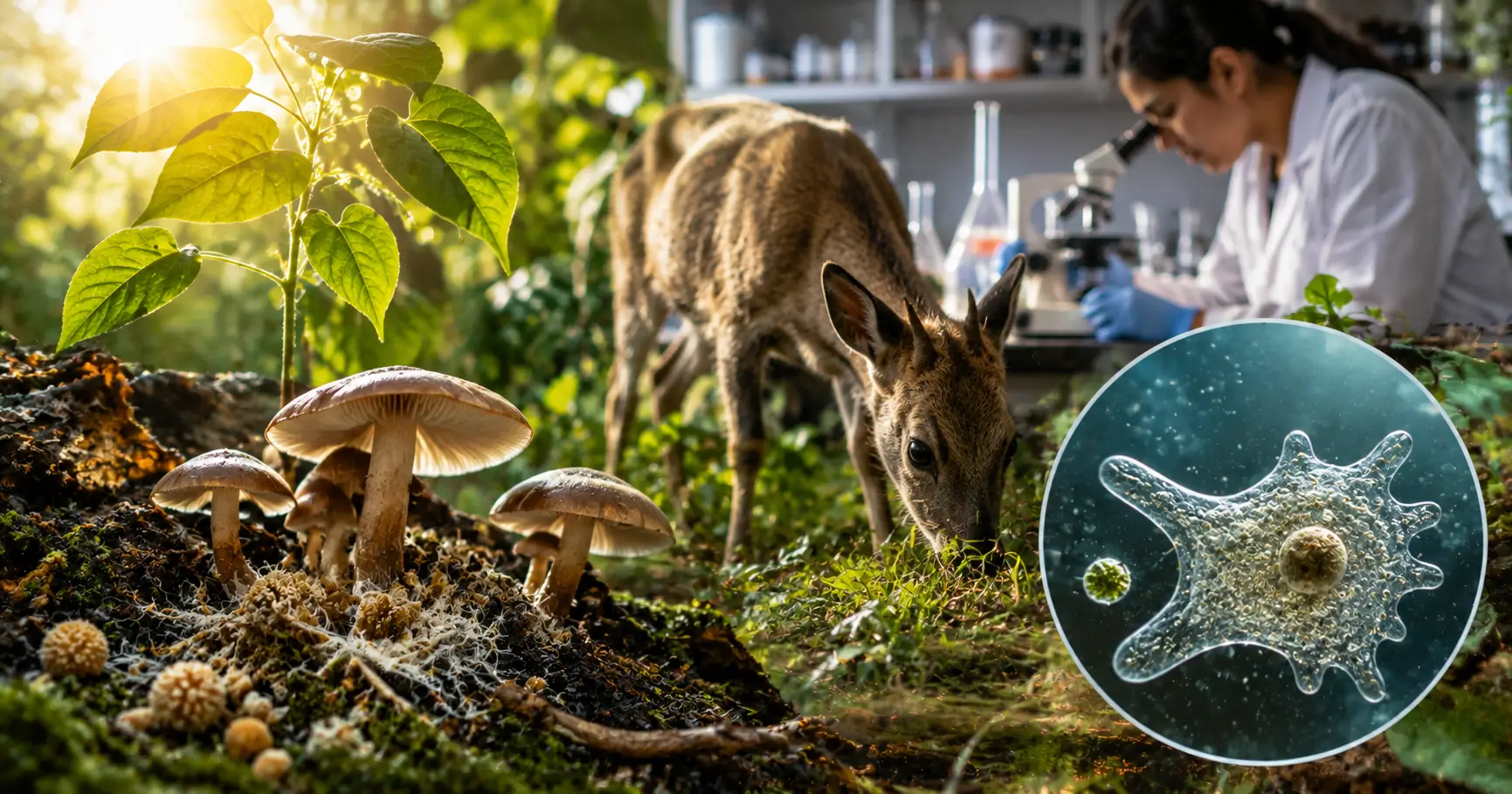

A green plant can make food from sunlight, carbon dioxide and water. A lion has to hunt. A fungus can digest food outside its body. And an Amoeba can surround a food particle with part of its own cell.
So, how do organisms obtain their nutrition when their bodies and lifestyles are so different?
The answer lies in their mode of nutrition.
Nutrition is the process by which organisms obtain and use materials needed for energy, growth, repair and maintenance. Different organisms have evolved different strategies depending on their structure, environment and food sources. NCERT describes both autotrophic and heterotrophic modes and explains how increasing body complexity leads to specialized ways of obtaining and processing food.
Understanding these differences also reveals something bigger: the way an organism gets food is closely connected to how its body is built.
What is nutrition?
Nutrition refers to the processes through which an organism obtains food or nutrients and uses them for its life processes.
Food supplies materials and energy required for activities such as:
- Growth
- Repair of tissues
- Reproduction
- Movement
- Maintenance of cells
- Metabolism
NPTEL defines nutrition as the collective processes through which organisms obtain food needed for growth, maintenance and energy, while the chemical substances present in food are called nutrients.
The important point is that not every organism obtains food in the same way.
Some organisms manufacture organic food from simpler inorganic substances. Others consume existing organic matter.
This produces two major nutritional categories:
Autotrophic nutrition and heterotrophic nutrition.
The two major modes of nutrition
| Mode | Basic strategy | Examples |
|---|---|---|
| Autotrophic | Makes organic food from simpler substances | Green plants, algae, some bacteria |
| Heterotrophic | Obtains organic food from other organisms or organic matter | Animals, fungi, many bacteria |
OpenStax similarly distinguishes autotrophs, which synthesize organic compounds using inorganic carbon sources, from heterotrophs, which obtain organic molecules from other organisms or their products.
Let’s look at each one.
How do organisms obtain their nutrition through autotrophic nutrition?
What is autotrophic nutrition?
Autotrophic nutrition is a mode of nutrition in which an organism produces organic food from simpler substances.
The word “autotroph” comes from Greek roots meaning essentially self-feeding.
Green plants are the most familiar examples.
They use:
- Carbon dioxide from the atmosphere
- Water
- Light energy
- Photosynthetic pigments such as chlorophyll
to produce carbohydrates through photosynthesis.
NCERT identifies green plants and some bacteria as autotrophs and explains that photosynthesis fulfills the carbon and energy requirements of photosynthetic autotrophs.
How does photosynthesis provide food?
In simplified form:
Carbon dioxide + Water → Glucose + Oxygen
Light energy and photosynthetic machinery drive the process.
The glucose produced can be used in cellular processes or converted into storage compounds such as starch.
OpenStax explains that photosynthesis uses carbon dioxide and water to assemble carbohydrate molecules and releases oxygen as a by-product.
What are the raw materials needed?
Plants require several materials for healthy growth.
The major inputs for photosynthesis include:
- Carbon dioxide — enters mainly through stomata in leaves.
- Water — absorbed from the soil through roots.
- Light — supplies energy.
- Chlorophyll — captures light energy.
Plants also require mineral nutrients such as nitrogen, phosphorus, magnesium and others for growth and metabolism.
This is why saying “plants only need sunlight and water” is incomplete.
Are all autotrophs plants?
No.
Plants are the most familiar autotrophs, but algae and some bacteria can also be autotrophic.
In broader biology, autotrophs can use either light or chemical energy. Photoautotrophs use light, while chemoautotrophs use energy derived from inorganic chemical compounds.
This distinction becomes particularly important when studying microorganisms and ecosystems.
How do organisms obtain their nutrition through heterotrophic nutrition?
What is heterotrophic nutrition?
Heterotrophic nutrition occurs when an organism obtains organic food from other organisms or organic matter rather than producing all of its organic food from inorganic carbon.
Animals are familiar examples.
Humans cannot make food from carbon dioxide and water through photosynthesis. Instead, we consume plants, animals or products derived from them.
Heterotrophs include animals, fungi and many bacteria.
Heterotrophic nutrition can take several forms.
Types of heterotrophic nutrition
Holozoic nutrition
In holozoic nutrition, an organism takes in food and then digests it internally.
This is common among animals.
The general sequence can be represented as:
Ingestion → Digestion → Absorption → Assimilation → Egestion
Humans are a classic example.
Food enters through the mouth, is mechanically and chemically processed through the digestive tract, nutrients are absorbed, and the body uses those nutrients for energy, growth and repair.
Other holozoic organisms include many herbivores, carnivores and omnivores.
Herbivores
Herbivores primarily eat plants or plant products.
Examples include:
- Cow
- Goat
- Deer
- Rabbit
Their digestive systems have adaptations that help them process plant material.
Carnivores
Carnivores primarily obtain food by eating other animals.
Examples include:
- Lion
- Tiger
- Eagle
- Snake
Their feeding structures and digestive systems reflect their particular food sources.
Omnivores
Omnivores consume both plant and animal foods.
Humans are a familiar example.
Many other animals also have flexible diets.
The key idea is not the label itself but the nutritional strategy: the organism obtains organic matter by consuming food.
Saprophytic nutrition
Some organisms obtain nutrition from dead and decaying organic matter.
Fungi provide a classic example.
Instead of swallowing food in the way humans do, many fungi release digestive enzymes onto organic material.
The enzymes break complex substances into simpler molecules, which can then be absorbed.
NCERT specifically describes fungi such as bread moulds, yeast and mushrooms as organisms that can break down food material outside the body and then absorb it.
This process is extremely important in ecosystems because decomposer organisms help return nutrients from dead material to the environment.
A simple example
Imagine a fallen piece of fruit.
A fungus grows over it.
The fungus releases enzymes.
The enzymes break down complex organic substances.
The resulting simpler molecules are absorbed by the fungal body.
So the fungus doesn’t need a mouth or stomach to obtain nutrition.
Its body structure allows it to digest externally and absorb internally.
Parasitic nutrition
A parasite obtains nutrients from another living organism called the host.
The parasite benefits while the host may be harmed.
Examples include:
- Cuscuta
- Tapeworms
- Lice
- Ticks
- Leeches
NCERT identifies parasitism as another heterotrophic strategy and gives examples including Cuscuta, ticks, lice, leeches and tapeworms.
Cuscuta, commonly called dodder or amar-bel in Indian textbooks, is particularly useful for understanding plant parasitism.
It obtains nutrients from a host plant rather than relying entirely on its own photosynthesis.
How does Amoeba obtain its nutrition?
Amoeba provides one of the clearest examples of how body structure determines nutritional strategy.
Amoeba is unicellular, so it does not have a complex digestive system like a human.
Instead, it uses temporary finger-like extensions called pseudopodia.
Step-by-step process
- Amoeba detects a food particle.
- It extends pseudopodia around the particle.
- The extensions surround and engulf the food.
- A food vacuole forms.
- Digestive processes break complex substances into simpler ones.
- Useful nutrients move into the cytoplasm.
- Undigested material is expelled.
NCERT describes this process and explains that the food vacuole is the site where complex food substances are broken down before simpler substances diffuse into the cytoplasm.
Why is Amoeba important?
Amoeba demonstrates a fundamental biological principle:
A simple organism can perform nutrition without a specialized digestive tract.
Its entire cell participates in feeding and digestion.
How does Paramecium obtain its nutrition?
Paramecium is also unicellular, but its feeding strategy is more specialized.
Unlike Amoeba, it has a definite cell shape.
Cilia cover its surface and help move food particles toward a specific feeding region.
NCERT notes that Paramecium uses cilia to move food toward the point where food is taken into the cell.
This gives us an interesting comparison:
| Feature | Amoeba | Paramecium |
|---|---|---|
| Organization | Unicellular | Unicellular |
| Body shape | Flexible | More definite |
| Food capture | Pseudopodia | Cilia help direct food |
| Digestive structure | Food vacuole | Specialized feeding region and food vacuoles |
| Example | Engulfs food particles | Cilia move food toward feeding area |
Both organisms are single-celled, but their structures produce different feeding mechanisms.
How do humans obtain their nutrition?
Humans use holozoic nutrition.
The digestive system is specialized for taking in food, breaking it down and absorbing nutrients.
The major stages are:
Ingestion
Food enters the body through the mouth.
Digestion
Mechanical and chemical processes break food into smaller substances.
Absorption
Digested nutrients pass into the bloodstream, mainly through the small intestine.
Assimilation
Cells use absorbed nutrients for energy, growth, repair and other metabolic functions.
Egestion
Undigested material is eliminated from the body.
The human digestive tract is therefore much more specialized than the feeding system of a single-celled organism.
NCERT notes that increasing organismal complexity is associated with specialized structures for different nutritional functions.
Why do organisms have different ways of obtaining nutrition?
This is the question behind the entire topic.
The answer is adaptation.
An organism’s nutritional strategy depends on factors such as:
- Body structure
- Habitat
- Food availability
- Mobility
- Type of food
- Size of the organism
- Evolutionary adaptations
Consider three organisms:
Plant: Food source is produced internally through photosynthesis.
Fungus: Food may be dead organic material, so external digestion and absorption are effective.
Lion: Food is mobile, so capturing and ingesting prey requires specialized structures and behavior.
NCERT makes this connection explicitly: nutritional form varies with the type and availability of food and with how the food is obtained.
From nutrition to the food chain
There is an even bigger story behind these feeding strategies.
Plants and other autotrophs form the foundation of many ecosystems.
They capture energy and convert it into chemical energy stored in organic molecules.
Herbivores obtain that energy by consuming plants.
Carnivores can obtain it by consuming herbivores.
Decomposers process dead organic matter.
OpenStax describes autotrophs as foundational producers in ecosystems, while heterotrophs acquire energy through consuming living or previously living organisms.
A simplified food chain might look like:
Sun → Grass → Deer → Tiger
The tiger doesn’t receive sunlight directly.
The energy originally captured by photosynthetic organisms moves through the food chain.
This is why understanding nutrition also helps explain energy flow through ecosystems.
Autotrophic vs heterotrophic nutrition
| Basis | Autotrophic | Heterotrophic |
|---|---|---|
| Food production | Produces organic food | Obtains organic food from other sources |
| Main carbon source | Generally inorganic carbon such as CO₂ | Organic compounds |
| Typical examples | Plants, algae, some bacteria | Animals, fungi, many bacteria |
| Position in food webs | Usually producers | Usually consumers/decomposers |
| Dependence on other organisms | Often less direct for organic food | Depends directly or indirectly on producers for organic matter |
| Major examples | Photosynthesis, chemosynthesis | Holozoic, saprotrophic, parasitic strategies |
A useful distinction is that autotrophy and heterotrophy describe how organisms obtain carbon and organic nutrients, while terms such as phototroph and chemotroph describe where they obtain energy. This broader classification is important in microbiology.
Common mistakes students make
Mistake 1: Saying every plant is completely autotrophic
Most green plants make organic food through photosynthesis, but plants can also obtain nutrients through relationships with microbes or, in some cases, parasitic strategies.
Mistake 2: Saying fungi eat food like animals
Many fungi digest organic material externally and absorb the resulting simpler molecules.
Mistake 3: Confusing ingestion with nutrition
Ingestion is simply taking food into the body.
Nutrition is a broader process involving obtaining and utilizing nutrients.
Mistake 4: Assuming all heterotrophs are animals
Animals are heterotrophs, but fungi and many microorganisms are also heterotrophic.
Mistake 5: Thinking nutrition is only about energy
Nutrition supplies both energy and materials required for growth, maintenance, repair and other life processes.
Myths vs facts
| Myth | Fact |
|---|---|
| Only animals need nutrition | Every living organism needs materials and energy |
| All plants obtain food by eating | Most green plants produce organic food through photosynthesis |
| Fungi have no role in nutrition cycles | Fungi can decompose organic matter and recycle nutrients |
| All heterotrophs hunt animals | Heterotrophs include herbivores, fungi, parasites and many microorganisms |
| Amoeba has a digestive system like humans | It uses its cell membrane and food vacuoles for feeding and digestion |
| All autotrophs use sunlight | Some autotrophs use chemical energy instead of light |
Quick revision: How do organisms obtain their nutrition?
Remember the topic using this simple chain:
Autotrophs → make organic food
Heterotrophs → obtain organic food from other sources
Then remember three important heterotrophic strategies:
Holozoic → ingest and digest food
Saprotrophic → digest externally and absorb
Parasitic → obtain nutrients from a living host
For unicellular organisms:
Amoeba → pseudopodia + food vacuole
Paramecium → cilia + specialized feeding region
For plants:
Photosynthesis → CO₂ + water + light → carbohydrates + oxygen
This framework captures the core of the topic without requiring students to memorize disconnected facts.
Key takeaways
- Nutrition is essential for energy, growth, repair and maintenance.
- Organisms have evolved different ways to obtain nutrients.
- Autotrophs produce organic food from simpler substances.
- Green plants are major photoautotrophs.
- Heterotrophs obtain organic nutrients from other organisms or organic matter.
- Heterotrophic strategies include holozoic, saprotrophic and parasitic nutrition.
- Amoeba uses pseudopodia and food vacuoles.
- Paramecium uses cilia to direct food toward a specialized feeding region.
- Humans use holozoic nutrition and have a specialized digestive system.
- Nutritional strategies are closely connected to an organism’s structure, habitat and food availability.
FAQ
How do organisms obtain their nutrition?
Organisms obtain nutrition in different ways depending on their structure and food source. Autotrophs make organic food from simpler substances, while heterotrophs obtain organic nutrients from other organisms or organic matter.
What are the two main modes of nutrition?
The two broad modes are autotrophic nutrition and heterotrophic nutrition. Autotrophs produce organic food, while heterotrophs obtain organic food from external sources.
What is autotrophic nutrition?
Autotrophic nutrition is a mode in which organisms synthesize organic food from simpler substances. Green plants use photosynthesis, while some microorganisms can use chemical energy instead of sunlight.
What is heterotrophic nutrition?
Heterotrophic nutrition is a mode in which organisms obtain organic nutrients from other organisms or organic matter. Animals, fungi and many microorganisms are heterotrophs.
How does Amoeba obtain its nutrition?
Amoeba uses temporary extensions called pseudopodia to surround and engulf food particles. A food vacuole forms, where digestion occurs, and simpler nutrients then move into the cytoplasm.
What are the types of heterotrophic nutrition?
At the school level, important types include holozoic, saprophytic and parasitic nutrition. Holozoic organisms ingest food, saprotrophs digest organic material externally and absorb it, and parasites obtain nutrients from living hosts.
Conclusion
The answer to “How do organisms obtain their nutrition?” begins with a simple idea: different organisms have different ways of getting the materials and energy needed to stay alive.
Plants and other autotrophs can manufacture organic food using processes such as photosynthesis. Heterotrophs depend on organic matter obtained from other organisms or their products. Among them, some ingest food, some digest organic material externally, and others obtain nutrients from living hosts.
Amoeba shows how a single cell can capture and digest food. Paramecium demonstrates how even a unicellular organism can develop specialized feeding structures. Humans take the process further with a highly organized digestive system.
The bigger lesson is even more important:
An organism’s method of nutrition is closely connected to its body structure, habitat and lifestyle.
For exam preparation, remember the core sequence:
Autotrophic → makes food
Heterotrophic → obtains food from other sources
Holozoic → ingestion and internal digestion
Saprotrophic → external digestion and absorption
Parasitic → nutrition from a living host
Once these relationships are clear, the entire nutrition section of Class 10 Life Processes becomes much easier to understand rather than memorize.
Disclaimer
Educational Disclaimer: This article is intended for educational and revision purposes, particularly for students studying school-level biology and Life Processes. Scientific terminology and classification can vary slightly between school curricula and advanced biology texts. Students should use their prescribed NCERT textbook, classroom instruction and official curriculum materials as the primary authority for examinations.