
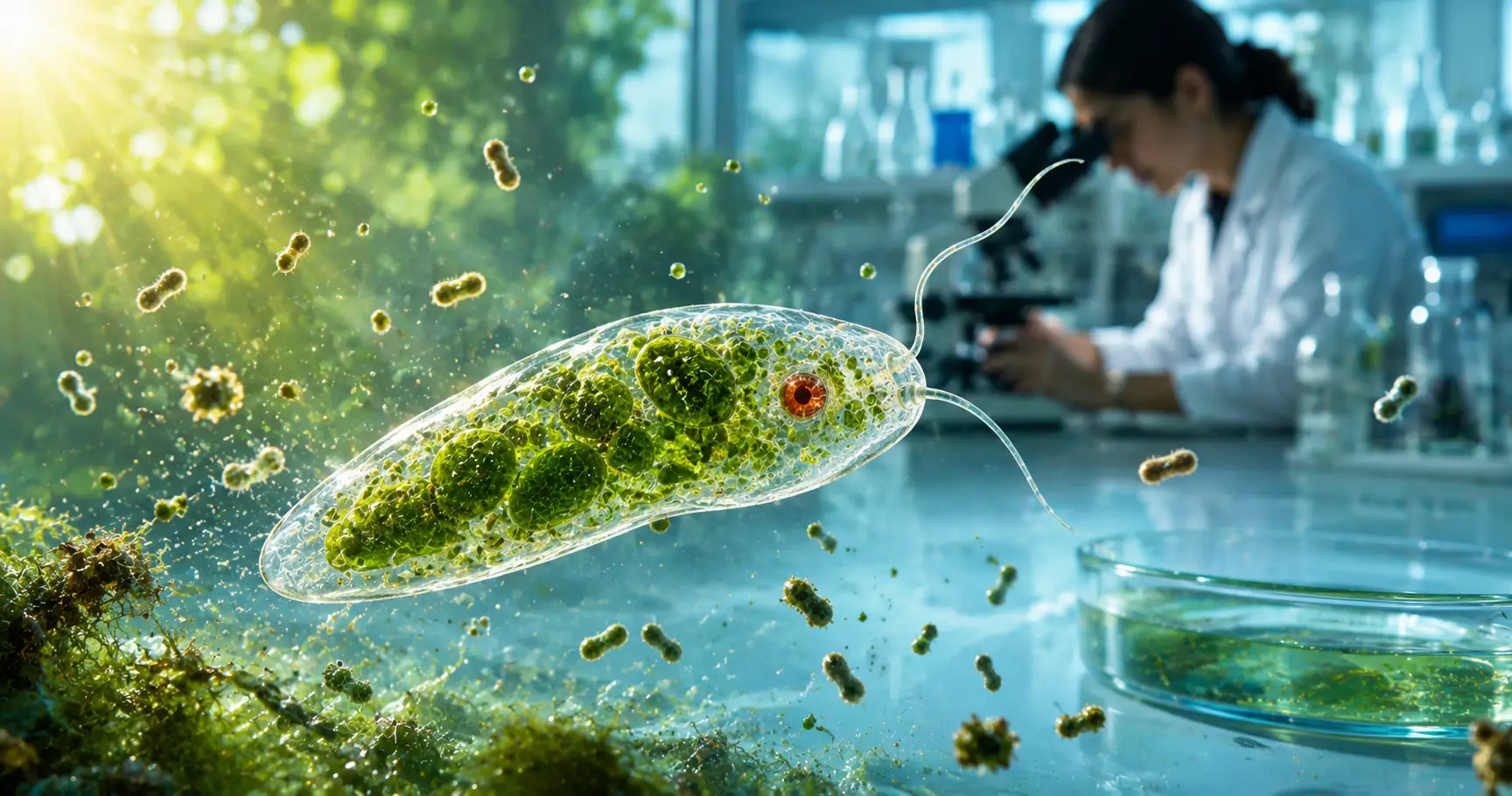

An organism does not always have to choose between making its own food and obtaining food from outside.
Some organisms can use both strategies. This unusual flexibility is called mixotrophic nutrition.
So, what is mixotrophic nutrition? In simple terms, it is a mode of nutrition in which an organism combines autotrophic and heterotrophic methods to obtain carbon, energy or nutrients. Depending on the organism, this can mean photosynthesis plus uptake of organic compounds, or photosynthesis plus ingestion of other organisms.
Euglena is the classic school-level example: it can photosynthesize when light is available and can switch to heterotrophic nutrition under conditions where light is unavailable.
But there is much more to mixotrophy than this simple textbook example.
What is mixotrophic nutrition?
Mixotrophic nutrition is a nutritional strategy that combines autotrophic and heterotrophic processes in the same organism.
An autotroph can produce organic matter from inorganic carbon using an energy source such as light.
A heterotroph, by contrast, obtains organic carbon or nutrients from preformed organic material.
A mixotroph can use both pathways, although the balance between them can vary considerably between species and environmental conditions.
The word itself gives a useful clue:
- “Mixo” = mixed
- “Trophic” = related to feeding or nutrition
Therefore:
Mixotrophy = mixed nutritional strategy.
Simple definition
Mixotrophic nutrition is the ability of an organism to obtain nutrition using both autotrophic and heterotrophic methods.
This definition is useful for exams, but scientists use the term more broadly because mixotrophic organisms can combine nutritional pathways in several different ways.
How does mixotrophic nutrition work?
Think of a mixotroph as having two nutritional options.
When light and inorganic resources are available
A photosynthetic mixotroph can use light energy to fix carbon dioxide through photosynthesis.
This is its photoautotrophic side.
When nutrients or light become limiting
The organism may supplement its nutrition by taking up organic compounds or consuming other organisms.
This is its heterotrophic side.
The exact mechanism depends on the organism.
Some mixotrophs absorb dissolved organic compounds, while others ingest bacteria, algae or other prey. Some organisms obtain resources through symbiotic relationships.
This flexibility can be especially useful in environments where light, nutrients or prey availability changes.
Why is mixotrophic nutrition important?
At first glance, using two nutritional strategies may seem unnecessary.
Why maintain the machinery for photosynthesis and also invest energy in obtaining food from outside?
The answer is environmental flexibility.
A purely photosynthetic organism depends heavily on suitable light and inorganic nutrients. A strict heterotroph, meanwhile, depends on an external supply of organic food.
A mixotroph can potentially draw on both resource pools.
Research on aquatic microorganisms shows that mixotrophy can be advantageous when nutrients are scarce or when environmental conditions fluctuate.
A simple example
Imagine a microscopic organism living in water.
During a bright period, it can photosynthesize.
Later, light levels may fall, while bacteria are abundant.
Instead of depending entirely on photosynthesis, the organism can consume some of those bacteria or use organic carbon.
That nutritional flexibility is the key advantage of mixotrophy.
Euglena and mixotrophic nutrition
Why is Euglena called a mixotroph?
Euglena is one of the most familiar examples of mixotrophic nutrition in school biology.
It contains chloroplasts, which allow it to carry out photosynthesis when adequate light is available.
Under conditions where light is unavailable, Euglena can obtain nutrients heterotrophically.
Educational biology material from the Delhi Directorate of Education specifically describes Euglena as photosynthetic in sunlight but heterotrophic when sunlight is absent, identifying this as mixotrophic nutrition.
This makes Euglena an excellent example because one organism demonstrates two contrasting nutritional modes.
Euglena in simple terms
| Condition | Nutritional mode |
|---|---|
| Light available | Autotrophic/photoautotrophic |
| Suitable photosynthetic conditions | Produces organic food through photosynthesis |
| Light unavailable | Heterotrophic |
| Overall ability | Mixotrophic |
This is why a common exam answer is:
Euglena shows mixotrophic nutrition because it can perform photosynthesis in the presence of light and obtain nutrition heterotrophically when light is unavailable.
Examples of mixotrophic organisms
Mixotrophy is not limited to Euglena.
It occurs across a surprisingly broad range of organisms, especially in aquatic environments.
1. Euglena
Euglena is the classic educational example.
It combines photosynthetic capability with heterotrophic nutrition under appropriate conditions.
2. Mixotrophic algae
Several algae can combine photosynthesis with the uptake of organic compounds or ingestion of prey.
Some photosynthetic plankton can consume bacteria and other small organisms while continuing to photosynthesize.
3. Dinoflagellates
Some dinoflagellates combine photosynthesis with heterotrophic feeding.
Recent research describes mixotrophy as an important nutritional strategy among dinoflagellates and notes that environmental factors such as light, nutrient availability and temperature can influence the balance between nutritional modes.
4. Mixotrophic ciliates
Some ciliates combine heterotrophic feeding with photosynthetic partners or retained photosynthetic structures.
Research shows that mixotrophic ciliates can obtain organic matter from photosynthetic symbionts while also maintaining heterotrophic feeding abilities.
5. Some plants
Mixotrophy also occurs among certain terrestrial and aquatic plants.
For example, some orchids can remain photosynthetic while also obtaining carbon through associations with fungi. Recent research describes several forms of mixotrophic nutrition in orchids.
This is an important reminder that the simple school distinction between “plants = autotrophs” and “animals = heterotrophs” does not capture all biological diversity.
Types of mixotrophic nutrition
There is no single universal mechanism of mixotrophy.
Scientists describe different forms depending on how the organism obtains organic resources.
Photoautotrophy plus heterotrophy
This is the most intuitive form.
The organism photosynthesizes but also obtains organic carbon or nutrients from external sources.
Phagotrophic mixotrophy
In this form, a photosynthetic organism ingests prey.
The prey can provide carbon, nitrogen, phosphorus or other nutrients.
This is particularly common among aquatic microorganisms.
Absorptive mixotrophy
Some organisms obtain dissolved organic molecules directly from their environment.
Recent research on aquatic plants describes the uptake of dissolved organic carbon as one pathway through which mixotrophy can occur.
Symbiotic mixotrophy
Some organisms obtain photosynthetic products from symbiotic algae or other photosynthetic partners while also relying on heterotrophic nutrition.
This mechanism occurs in several aquatic organisms and symbiotic systems.
Mixotrophic vs autotrophic vs heterotrophic nutrition
The easiest way to understand the concept is to compare the three modes.
| Feature | Autotrophic | Heterotrophic | Mixotrophic |
|---|---|---|---|
| Makes organic food through photosynthesis | Usually yes in photoautotrophs | No | Often yes |
| Uses external organic material | Generally not as the main carbon source | Yes | Yes |
| Can ingest prey | Generally no | Some do | Some do |
| Depends on light | Photoautotrophs do | Not necessarily | Often partly |
| Nutritional flexibility | Lower | Lower | Higher |
| Example | Green plants | Animals | Euglena |
The important point is that mixotrophy is not simply “half autotrophic and half heterotrophic.”
The proportions can vary.
Some organisms may obtain most of their carbon through photosynthesis and only supplement it with heterotrophy. Others may rely heavily on prey while using photosynthesis as an additional energy or carbon source.
Advantages of mixotrophic nutrition
1. Greater nutritional flexibility
The organism can potentially use more than one resource.
This is valuable when environmental conditions change.
2. Better survival during low light
When photosynthetic productivity falls because of insufficient light, heterotrophic feeding can provide an alternative resource.
3. Access to additional nutrients
Prey can supply nutrients that may be difficult to obtain solely through photosynthesis.
Research on mixotrophic microorganisms has linked this strategy with environments where inorganic nutrients are limiting.
4. Competitive advantage in some environments
Mixotrophs can use resources that are unavailable to organisms restricted to only one nutritional strategy.
This does not mean they always outcompete specialist organisms. The advantage depends on environmental conditions and the costs of maintaining multiple systems.
5. Greater ecological importance
Mixotrophs can simultaneously participate in photosynthetic production and grazing.
This allows them to influence nutrient cycling and the movement of carbon through aquatic food webs.
Are there disadvantages to mixotrophic nutrition?
Yes.
Mixotrophy is not a free biological advantage.
An organism must maintain the cellular machinery needed for more than one nutritional strategy.
That can involve metabolic and energetic costs. Research has therefore emphasized that mixotrophy can involve trade-offs rather than providing an unlimited advantage.
Main limitations
- Maintaining photosynthetic machinery requires resources.
- Feeding mechanisms also require cellular investment.
- Suitable prey may not always be available.
- Photosynthesis can be limited by light.
- Organic substrates may be scarce.
- Different environments favor different nutritional strategies.
So, mixotrophy is best understood as flexibility with a cost, not as a universally superior form of nutrition.
Why is mixotrophy common in aquatic organisms?
Water environments can change dramatically over relatively short distances and time periods.
Light decreases with depth.
Nutrient concentrations vary.
Bacterial and algal prey fluctuate.
Temperature and other environmental conditions also change.
This creates an environment where having more than one way to acquire resources can be useful.
Scientific reviews describe mixotrophy as particularly widespread among planktonic organisms in marine and freshwater systems.
Recent research continues to show that mixotrophy plays an important role in aquatic ecosystems and carbon cycling. A 2026 study on duckweed, for example, described simultaneous photosynthesis and dissolved organic carbon assimilation as mixotrophy and emphasized its ecological and biotechnological significance.
Mixotrophic nutrition and the food chain
Mixotrophs can occupy an unusual position in food webs.
A typical photosynthetic organism converts inorganic carbon into organic matter and becomes food for other organisms.
A typical heterotroph consumes organic matter.
A mixotroph can potentially do both.
For example, a photosynthetic planktonic organism may fix carbon from the atmosphere or water while simultaneously consuming bacteria.
That means it can influence both primary production and grazing interactions.
Scientists therefore consider mixotrophy important when studying aquatic food webs and carbon transfer.
Mixotrophic nutrition: common mistakes students make
Mistake 1: Saying mixotrophs are always half plant and half animal
This is incorrect.
Mixotrophic organisms do not necessarily divide their nutrition equally between two modes.
The relative contribution can vary substantially.
Mistake 2: Saying Euglena is always autotrophic
Euglena can photosynthesize, but its ability to obtain nutrition heterotrophically is why it is commonly described as mixotrophic.
Mistake 3: Assuming every green organism is strictly autotrophic
Photosynthetic ability does not rule out additional heterotrophic pathways.
Research has identified mixotrophy in several aquatic plants and microorganisms.
Mistake 4: Thinking mixotrophy means only “eating food”
Some mixotrophs ingest prey, but others can acquire dissolved organic compounds or obtain resources through symbiotic relationships.
Myths vs facts
| Myth | Fact |
|---|---|
| Mixotrophy means an organism eats both plants and animals. | False. It means combining autotrophic/photoautotrophic and heterotrophic nutritional pathways. |
| Euglena is the only mixotrophic organism. | False. Mixotrophy occurs across many aquatic microorganisms and some plants. |
| Mixotrophs always use both methods equally. | False. The balance can vary greatly. |
| Mixotrophy is only found in algae. | False. It occurs in diverse protists and some plants and animals with photosynthetic partnerships. |
| Mixotrophy is always better than autotrophy or heterotrophy. | False. It provides flexibility but also has energetic and physiological costs. |
How to remember mixotrophic nutrition for an exam
Use this simple formula:
AUTO + HETERO = MIXO
Then remember the classic example:
Euglena = Mixotrophic
For a short-answer question, write:
“Mixotrophic nutrition is a mode of nutrition in which an organism uses both autotrophic and heterotrophic methods. Euglena is a common example because it performs photosynthesis in suitable light and can obtain nutrition heterotrophically when light is unavailable.”
For a longer answer, add:
- Definition
- Mechanism
- Example
- Advantages
- Difference from autotrophic and heterotrophic nutrition
That structure covers the core concept without unnecessary detail.
Why mixotrophic nutrition matters beyond textbooks
Mixotrophy is more than an examination term.
It helps scientists understand how aquatic ecosystems function.
Mixotrophic plankton can influence bacterial populations, primary production, nutrient cycling and carbon transfer through food webs. Research has shown that these organisms can be important components of marine and freshwater ecosystems.
It is also attracting interest in biotechnology.
Research into microalgal cultivation has investigated mixotrophic growth because combining photosynthetic and heterotrophic metabolism can sometimes improve biomass production under suitable conditions.
This means a concept that appears in basic biology textbooks is connected to much larger questions about ecosystems, climate-related carbon cycling and biotechnology.
Key takeaways
- Mixotrophic nutrition combines autotrophic and heterotrophic nutritional strategies.
- Euglena is the classic school-level example.
- Mixotrophs can use photosynthesis and also obtain organic carbon or nutrients externally.
- Some mixotrophs ingest bacteria or other prey.
- Others absorb dissolved organic compounds or rely on photosynthetic symbionts.
- Mixotrophy is especially widespread among aquatic microorganisms.
- The balance between autotrophy and heterotrophy can change with environmental conditions.
- Mixotrophy offers flexibility but also carries metabolic costs.
The simplest definition to remember is:
Mixotrophic nutrition is the ability of an organism to obtain nutrition through both autotrophic and heterotrophic modes.
And that is precisely what makes mixotrophs so interesting: they do not have to rely on just one nutritional strategy when their environment gives them more than one option.
FAQ
What is mixotrophic nutrition?
Mixotrophic nutrition is a mode of nutrition in which an organism combines autotrophic and heterotrophic methods to obtain carbon, energy or nutrients.
What is an example of mixotrophic nutrition?
Euglena is the classic example. It can photosynthesize when suitable light is available and can obtain nutrition heterotrophically under conditions where light is unavailable.
Why is Euglena called a mixotroph?
Euglena is called a mixotroph because it can use photosynthetic nutrition as well as heterotrophic nutrition, allowing it to use different nutritional strategies depending on environmental conditions.
What is the difference between autotrophic and mixotrophic nutrition?
Autotrophs primarily produce organic food from inorganic resources, while mixotrophs combine autotrophic processes with one or more heterotrophic ways of acquiring organic resources or nutrients.
Where is mixotrophic nutrition commonly found?
Mixotrophy is especially common among aquatic microorganisms, phytoplankton, protists and some algae, although it also occurs in certain plants and other organisms.
What are the advantages of mixotrophic nutrition?
Mixotrophy can provide greater nutritional flexibility, allowing organisms to supplement photosynthesis with external organic carbon, prey or nutrients when light or inorganic nutrients become limiting.
Conclusion
Mixotrophic nutrition is essentially a strategy of nutritional flexibility.
Instead of depending entirely on photosynthesis or entirely on external organic food, a mixotrophic organism can combine both approaches.
Euglena provides the familiar textbook example, but modern research shows that mixotrophy is much broader. It occurs extensively among aquatic microorganisms, plankton, algae, ciliates and some plants.
The key points to remember are:
- Autotrophic = produces organic food using inorganic resources.
- Heterotrophic = obtains organic resources externally.
- Mixotrophic = combines both strategies.
The most important idea is that mixotrophy is not necessarily a 50:50 combination. Some organisms rely mostly on photosynthesis and supplement it with heterotrophy, while others can depend heavily on heterotrophic feeding under particular conditions.
So, if you need a one-line exam answer, remember:
“Mixotrophic nutrition is a mode of nutrition in which an organism uses both autotrophic and heterotrophic methods for obtaining nutrients.”
That simple definition opens the door to a much larger biological story about adaptation, aquatic food webs, nutrient cycling and the remarkable flexibility of living organisms.
Disclaimer
Disclaimer: This article is provided for educational and informational purposes. Biological terminology can vary slightly between school-level textbooks and scientific literature, particularly because “mixotrophy” encompasses several nutritional mechanisms. Students should follow the terminology and definitions prescribed by their specific board, syllabus or textbook for examinations. Scientific claims in this article are supported where possible by peer-reviewed research and educational sources.