
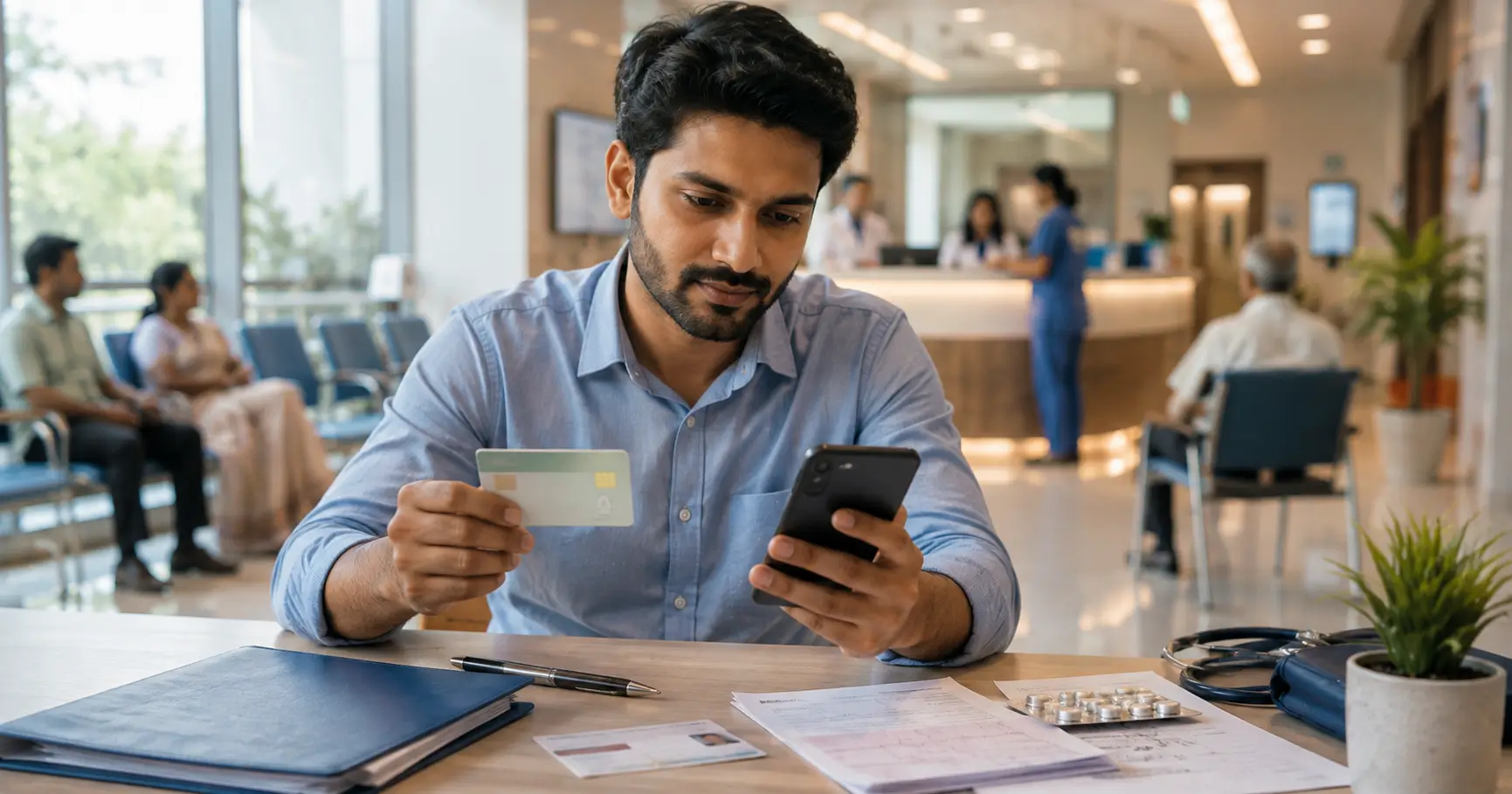

A hospital bill can become a major financial shock within hours. For eligible Uttar Pradesh government employees, pensioners and their dependent family members, the Deen Dayal Health Card is designed to reduce that burden through cashless medical treatment.
But there is an important detail many people miss: having the card does not mean every treatment is automatically cashless everywhere.
The scheme has specific rules for eligibility, hospitals, inpatient treatment, eKYC and the ₹5 lakh annual limit applicable in empanelled private hospitals. The official State Agency for Comprehensive Health and Integrated Services (SACHIS) confirms that the scheme covers eligible UP government employees, retired employees and dependent family members.
Here is how the scheme works, who can use it and what you should check before going to a hospital.
What is the Deen Dayal Health Card?
The Deen Dayal Health Card is the State Health Card issued under the Pandit Deendayal Upadhyay Rajya Karmchari Cashless Chikitsa Yojana of Uttar Pradesh.
The scheme was introduced to provide cashless healthcare to eligible state government employees, retired state government employees and their dependent family members. It operates under the Uttar Pradesh Government Servant (Medical Attendance) Rules and related government orders.
The card is important because the beneficiary’s identity must be verified through the State Health Card before cashless treatment is provided at an empanelled hospital.
Who manages the scheme?
Implementation is associated with SACHIS — State Agency for Comprehensive Health and Integrated Services.
The official SACHIS website provides information about the scheme and lists the helpline number 1800-1800-4444 for beneficiary assistance.
What benefits does the Deen Dayal Health Card provide?
The central benefit is cashless treatment for eligible beneficiaries.
According to SACHIS, the scheme provides:
| Benefit | Current provision |
|---|---|
| Eligible beneficiaries | UP state government employees, retired employees/pensioners and dependents |
| Private empanelled hospitals | Cashless treatment up to ₹5 lakh per family per year |
| Government hospitals/institutions | Treatment without a financial limit under the scheme |
| State Health Card | Mandatory for scheme benefits |
| Hospital network | PM-JAY empanelled hospitals, subject to scheme rules |
SACHIS states that the ₹5 lakh private-hospital limit applies per family per year, while treatment in government medical colleges, institutions and government hospitals in Uttar Pradesh is provided without a financial limit under the scheme.
That distinction is extremely important.
A reader should not interpret “₹5 lakh cover” as the maximum benefit available in every type of hospital.
Is the ₹5 lakh limit per person or per family?
The current SACHIS description specifies ₹5 lakh per family per year for cashless treatment in empanelled private hospitals.
For example, if an eligible employee and covered dependent require treatment during the same year, the applicable private-hospital benefit is governed by the scheme’s family-level limit and other rules.
This is different from a private health insurance policy where a sum insured may be structured differently.
Always confirm the applicable authorization and available benefit with the hospital before planned treatment.
Is OPD treatment covered by the Deen Dayal Health Card?
This is one of the most important points.
The scheme’s FAQ states that the cashless medical facility is available for admitted/inpatient patients, while the previous reimbursement arrangement continues for OPD treatment, investigations and related services.
In simple terms:
Do not assume that showing the Deen Dayal Health Card at a hospital makes every OPD consultation cashless.
If you are visiting a doctor only for a routine consultation, ask the hospital whether the service falls under the cashless scheme or the existing reimbursement process.
Who is eligible for the Deen Dayal Health Card?
The scheme is intended for:
- Serving Uttar Pradesh state government employees
- Retired state government employees/pensioners
- Eligible dependent family members
SACHIS states that the scheme covers state government employees, retired employees and their dependent family members.
Eligibility is not simply based on living in Uttar Pradesh.
A person generally needs to fall within the relevant definition of government employee or retired government employee under the applicable rules and government orders.
What about family pensioners?
The scheme FAQ states that people receiving family pension can also apply for a State Health Card under the applicable process.
This is useful for families who assume the card is available only to the original employee or pensioner.
What documents are needed?
Before starting the online application, keep the required information ready.
The scheme FAQ identifies several important items, including:
- Aadhaar number
- Aadhaar-linked mobile number
- Details of eligible dependents
- Aadhaar numbers of dependents
- Passport-size photographs
- Disability certificate where applicable
- Birth certificate for children below one year, where required
- Relevant employee or pension information
The FAQ specifically advises applicants to carefully enter the Aadhaar number and Aadhaar-linked mobile number because these fields have restrictions on modification after submission.
Why should you check the information twice?
A small data-entry mistake can delay verification.
Before pressing Submit, check:
- Name spelling
- Aadhaar number
- Mobile number
- Department
- Designation
- Pay information
- Dependent details
- Photographs
- Pension-related information, where applicable
The official FAQ specifically advises applicants to review the complete information before submission.
How to apply for the Deen Dayal Health Card online
The application process is online.
Step 1: Open the official scheme portal
Go to the official SECTS portal.
Step 2: Select the State Health Card application option
Choose the option for applying for the State Health Card.
Step 3: Enter your personal details
Fill in your employee or pensioner information carefully.
Use the information that matches your official records.
Step 4: Add eligible dependents
Enter the details of eligible dependent family members who need to be included.
Step 5: Save and submit
Review the complete application before submitting it.
According to the scheme FAQ, the application is then sent for verification by the appropriate DDO or Treasury Officer, depending on whether the applicant is an employee or pensioner.
Step 6: Wait for verification
Do not assume that submitting the form means the card is immediately active.
The application must go through the relevant verification process.
Step 7: Complete Aadhaar eKYC
After approval, the beneficiary receives an SMS with instructions or a link for completing eKYC.
The FAQ states that Aadhaar eKYC and card downloading are completed through the National Health Authority’s Setu portal after approval.
Step 8: Download the State Health Card
Complete the eKYC process and download the generated State Health Card.
Keep a digital copy and, where practical, a printed copy for hospital visits.
How to check Deen Dayal Health Card application status
If your application remains pending, the first thing to understand is who is responsible for the pending verification.
The scheme FAQ states that employee applications are verified by the relevant Drawing and Disbursing Officer (DDO), while pensioner applications are verified by the Treasury Officer (TO).
Therefore, if your application is showing pending:
- Check your application status on the scheme portal.
- Identify whether it is awaiting DDO or TO verification.
- Contact the relevant office if the application has remained pending.
- Do not submit multiple applications unnecessarily.
This is a common point of confusion.
How to download the Deen Dayal Health Card
Downloading the card generally happens after the application has been approved and Aadhaar eKYC has been completed.
The scheme FAQ directs approved beneficiaries to the Setu portal for eKYC and downloading.
NHA Setu eKYC portal for the scheme
The basic sequence is:
Application → DDO/TO verification → approval SMS → Aadhaar eKYC → State Health Card download.
If eKYC fails, the scheme FAQ advises beneficiaries to capture the relevant error screen and contact the scheme’s support email so the issue can be investigated.
How to find Deen Dayal Health Card hospitals
Having a card is only one part of using the scheme.
You should also verify whether the hospital is part of the applicable network.
The scheme FAQ says beneficiaries can use the Hospital List option on the portal and filter hospitals by:
- District
- Specialty
- Public or private hospital
The portal then provides the applicable hospital results.
Why checking the hospital first matters
Imagine a beneficiary needs planned surgery.
Instead of reaching an unfamiliar private hospital and asking for cashless treatment at admission, the safer approach is to:
- Check the hospital on the official list.
- Confirm that the required specialty is available.
- Ask the hospital’s scheme/Arogya Mitra desk about cashless authorization.
- Carry the State Health Card and required identity documents.
- Confirm the treatment authorization before proceeding.
This can prevent avoidable confusion at the time of admission.
Can the Deen Dayal Health Card be used outside Uttar Pradesh?
This is another area where online articles can be misleading.
The scheme FAQ currently states that cashless treatment through the State Health Card is not available outside Uttar Pradesh. It also notes that a request had been made for software changes to enable cashless treatment at eligible private hospitals outside the state through the Ayushman Bharat network.
Therefore, do not assume that a hospital in Delhi, Haryana, Punjab or another state will automatically accept the State Health Card for cashless treatment.
Verify the current position before travelling for planned treatment.
What happens if a listed hospital refuses cashless treatment?
First, ask the hospital to explain why the cashless request cannot be processed.
If the issue remains unresolved, contact the scheme helpdesk.
The official FAQ provides the helpline:
1800-1800-4444
It also lists upsects@gmail.com for scheme-related assistance.
When contacting support, keep these details available:
- State Health Card details
- Application/registration information
- Hospital name
- Date of admission
- Treatment or specialty
- Screenshot of any portal error
- Relevant documents
A clear record can make grievance resolution easier.
Common mistakes to avoid
Mistake 1: Confusing the card with universal health insurance
The Deen Dayal Health Card operates under a specific government scheme.
Its benefits depend on eligibility, hospital network, treatment type and applicable rules.
Mistake 2: Assuming OPD is cashless
The scheme FAQ specifically distinguishes cashless inpatient treatment from the existing reimbursement process for OPD and investigations.
Mistake 3: Going to an unverified private hospital
Always check the official hospital list before planned treatment.
Mistake 4: Ignoring eKYC
Approval alone is not necessarily the final step.
The beneficiary must complete the required Aadhaar eKYC process to generate/download the State Health Card.
Mistake 5: Entering incorrect Aadhaar information
The FAQ warns applicants to enter Aadhaar and Aadhaar-linked mobile details carefully because these fields cannot simply be edited after submission.
Myths vs facts
| Myth | Fact |
|---|---|
| The card works in every hospital | False. Hospital eligibility/network rules apply. |
| ₹5 lakh is available to every individual | False. The private-hospital benefit is stated as ₹5 lakh per family per year. |
| OPD is automatically cashless | False. The FAQ says cashless treatment is for admitted/inpatient patients. |
| Applying online immediately activates the card | False. Verification and eKYC are required. |
| The card automatically works outside UP | False. The FAQ says cashless State Health Card treatment is currently not available outside Uttar Pradesh. |
| Pensioners cannot apply | False. Retired employees/pensioners are included, subject to eligibility. |
Key things to remember before using the card
Before planned hospitalization, use this checklist:
- Confirm your State Health Card is active.
- Check the hospital’s current empanelment.
- Confirm the relevant specialty.
- Ask whether the treatment is eligible for cashless authorization.
- Carry the card and required identification.
- Ask about pre-authorization before admission where applicable.
- Keep copies of important medical and scheme documents.
- Contact the official helpline if the hospital refuses eligible cashless treatment.
Is the Deen Dayal Health Card worth having?
For an eligible UP government employee, pensioner or dependent family member, the card can be extremely valuable because it provides access to the state’s cashless treatment framework.
Its biggest practical advantage is reducing the need to pay the full eligible hospitalization bill upfront at participating facilities.
But the card should not be treated as a replacement for understanding the rules.
The most important details are hospital eligibility, inpatient treatment, the private-hospital ₹5 lakh family limit, government-hospital treatment provisions, eKYC and the distinction between cashless treatment and reimbursement.
Final takeaway
The Deen Dayal Health Card is a significant healthcare benefit for eligible Uttar Pradesh state government employees, pensioners and their dependent families.
The process is straightforward once you understand the sequence:
Apply online → DDO/TO verification → approval → Aadhaar eKYC → download State Health Card → use it at an eligible hospital.
The most important thing is not simply getting the card.
It is knowing exactly where and when it can be used.
Before planned treatment, check the latest official hospital list and scheme rules rather than relying on an old blog post or social-media message. For help with scheme-related problems, use the official SACHIS helpline 1800-1800-4444.
FAQ
What is the Deen Dayal Health Card?
The Deen Dayal Health Card is the State Health Card associated with Uttar Pradesh’s Pandit Deendayal Upadhyay Rajya Karmchari Cashless Chikitsa Yojana for eligible state government employees, pensioners and dependent family members.
Who can get a Deen Dayal Health Card?
Eligible Uttar Pradesh state government employees, retired state government employees/pensioners and their dependent family members can receive the State Health Card under the scheme.
What is the ₹5 lakh benefit under the scheme?
Eligible families can receive cashless treatment up to ₹5 lakh per family per year in empanelled private hospitals, subject to the scheme’s rules. Government hospitals have separate treatment provisions.
Is Deen Dayal Health Card treatment available for OPD?
The scheme FAQ states that cashless treatment is available for admitted/inpatient patients. OPD treatment and investigations continue under the applicable reimbursement arrangement.
How can I download the Deen Dayal Health Card?
After the application is verified and approved, the beneficiary completes Aadhaar eKYC through the designated Setu process and can then download the State Health Card.
Can I use the Deen Dayal Health Card outside Uttar Pradesh?
The current scheme FAQ states that cashless treatment through the State Health Card is not currently available outside Uttar Pradesh. Beneficiaries should verify the latest official rules before seeking treatment outside the state.
Conclusion
The Deen Dayal Health Card can provide substantial healthcare support to eligible Uttar Pradesh government employees, pensioners and their dependent families.
The key points are straightforward:
- ₹5 lakh per family per year is available for cashless treatment in eligible private hospitals under the stated scheme provisions.
- Government hospitals have no financial limit under the scheme’s current SACHIS description.
- The cashless facility is primarily for inpatient treatment, not routine cashless OPD.
- Applicants need to complete the verification and Aadhaar eKYC process.
- Hospital eligibility should be checked before planned treatment.
- The current FAQ says cashless State Health Card treatment is not available outside Uttar Pradesh.
The safest approach is to use the official SECTS/SACHIS information, verify the hospital before admission and contact the official helpline if a genuine problem occurs.
Official helpdesk: 1800-1800-4444.
Disclaimer
Disclaimer: This article is for informational purposes only and is not an official government notification or legal/medical advice. Government scheme rules, eligibility criteria, hospital empanelment, treatment authorization procedures and portal processes can change. Beneficiaries should verify the latest information through the official SACHIS/SECTS portal before applying or seeking treatment. Do not share Aadhaar numbers, OTPs or other sensitive personal information with unofficial websites, agents or individuals.