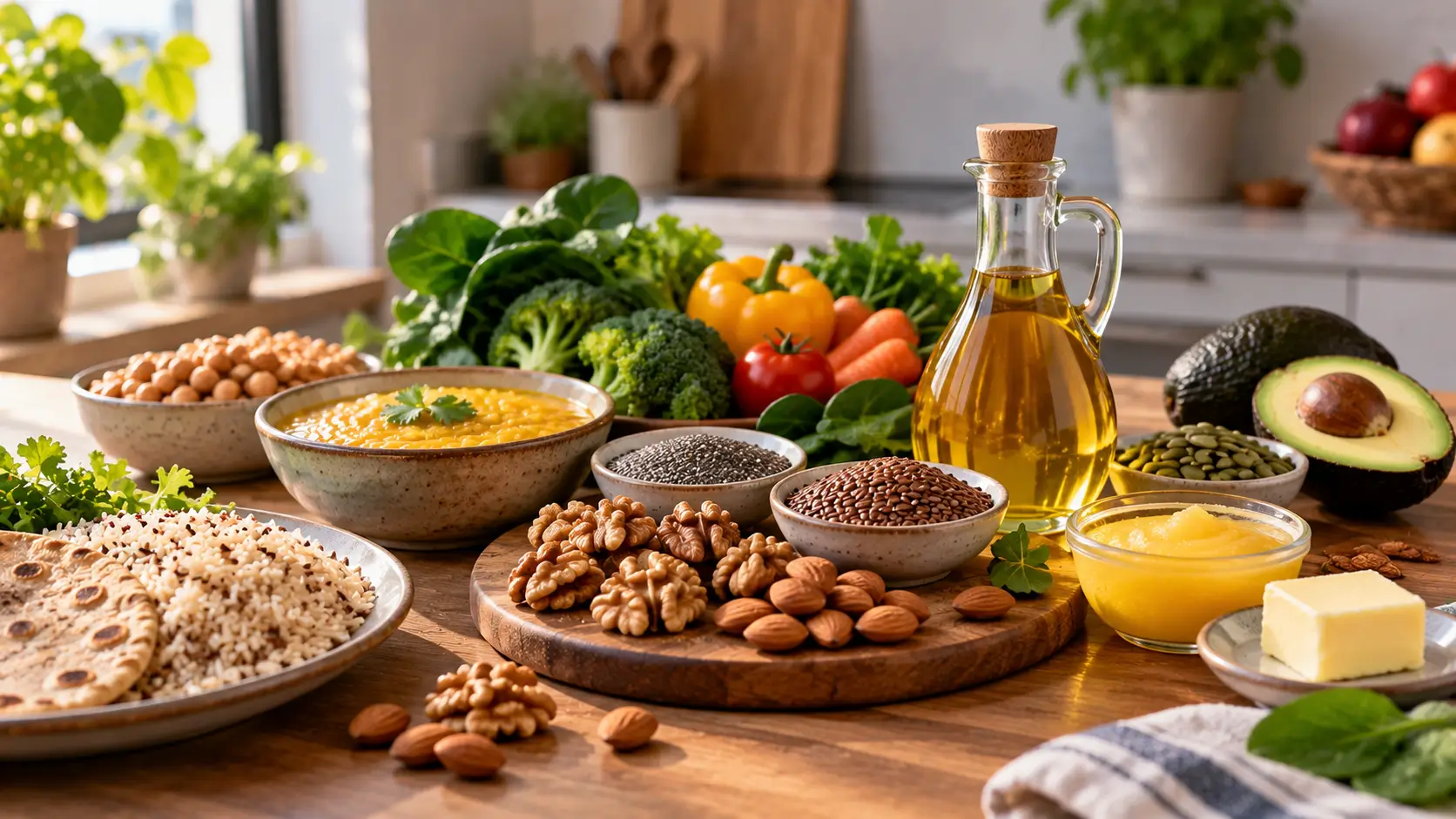

Unsaturated fat is a broad category of dietary fat that includes monounsaturated fat (MUFA) and polyunsaturated fat (PUFA). These fats are found naturally in foods such as nuts, seeds, fish and many plant oils.
The important nutrition question is not whether you should simply “eat more fat.” It is which fats are replacing which other fats. Current dietary guidance from the World Health Organization (WHO) recommends shifting fat intake away from saturated and trans fats toward unsaturated fats. ICMR-NIN’s Dietary Guidelines for Indians similarly recommend using oils and fats in moderation while including varied sources of essential fatty acids such as nuts, oilseeds and legumes.
Quick Answer
Unsaturated fat includes MUFA and PUFA, two types of fatty acids found in foods such as nuts, seeds, fish and plant oils. Replacing some saturated fat with unsaturated fat—particularly PUFA—can improve blood lipid profiles and may reduce cardiovascular risk. However, unsaturated fat is still energy-dense, so it should be part of an overall balanced diet rather than something to consume without limits.
What Is Unsaturated Fat?
The term unsaturated refers to the chemical structure of the fatty acid. Unlike saturated fatty acids, unsaturated fatty acids contain one or more double bonds.
There are two main categories:
Monounsaturated fat (MUFA)
MUFA contains one double bond. Common dietary sources include:
- groundnut or peanut oil
- olive oil
- some other plant oils
- almonds and other nuts
- seeds
- avocados
Polyunsaturated fat (PUFA)
PUFA contains two or more double bonds. Important dietary PUFA include omega-3 and omega-6 fatty acids.
Sources include:
- sunflower and soybean oils
- flaxseed
- chia seeds
- walnuts
- sunflower and other seeds
- fatty fish
ICMR-NIN identifies linoleic acid (omega-6) and alpha-linolenic acid (omega-3) as essential fatty acids because the body cannot synthesize them and therefore needs them from food.
Why Does Unsaturated Fat Matter?
The main reason unsaturated fat receives attention in nutrition guidance is its role as a replacement for saturated fat.
WHO states that the quality of dietary fat matters and recommends that saturated fat be replaced with polyunsaturated or monounsaturated fat.
This distinction is important.
Replacing butter with a handful of nuts is nutritionally different from replacing butter with refined carbohydrates or sugary foods. Likewise, simply adding extra oil to a meal without reducing something else increases total calorie intake.
The practical principle is therefore:
Replace less favourable sources of fat rather than simply adding more fat.
What Does the Evidence Say About Heart Health?
One of the most consistent effects of replacing saturated fat with unsaturated fat is an improvement in LDL cholesterol.
LDL stands for low-density lipoprotein. It is commonly called “bad” cholesterol because higher LDL levels are associated with higher cardiovascular risk.
The American Heart Association recommends choosing foods containing MUFA and PUFA in place of foods rich in saturated and trans fats.
The evidence concerning actual cardiovascular events is more nuanced than simply saying “less saturated fat is always better.”
A 2026 systematic review in Annals of Internal Medicine examined 17 randomized trials involving 66,337 participants. It found low-to-moderate certainty evidence that reducing or modifying saturated fat may reduce some cardiovascular outcomes, with more pronounced effects for nonfatal myocardial infarction when saturated fat was replaced with PUFA. The authors also highlighted limitations involving the replacement nutrients and differences between trials.
That is why a responsible nutrition message should focus on food substitution and overall dietary pattern, rather than treating one nutrient as an isolated cure or danger.
Unsaturated Fat vs Saturated Fat
A useful everyday comparison looks like this:
| Fat type | Common sources | General dietary approach |
|---|---|---|
| Monounsaturated fat | Nuts, seeds, some plant oils | Include regularly |
| Polyunsaturated fat | Fish, seeds, walnuts, many plant oils | Include regularly |
| Saturated fat | Butter, ghee, fatty meat, full-fat dairy, coconut and palm oils | Limit |
| Trans fat | Some industrially produced foods and partially hydrogenated fats | Avoid/minimize |
WHO recommends limiting saturated fat to no more than 10% of total energy intake for adults and recommends replacing saturated fat with unsaturated fat.
What About Coconut Oil?
This is an important point for Indian readers.
Coconut oil is a plant-derived oil, but that does not make it an unsaturated-fat-rich oil. WHO lists coconut oil among foods high in saturated fat.
So the fact that an oil comes from a plant does not automatically tell you which type of fat predominates.
The same principle applies to other foods: evaluate their nutritional composition rather than assuming that “natural” means “healthy” or that “plant-based” means “low in saturated fat.”
How Much Unsaturated Fat Should You Eat?
There is no single universal daily gram target for “unsaturated fat” that applies to every adult.
Your overall requirement depends on energy needs, age, activity level and dietary pattern.
ICMR-NIN’s 2024 guidelines emphasize moderation of oils and fats and note that a varied diet containing nuts, oilseeds, pulses and other foods can provide essential fatty acids. For a 2,000-kcal diet, the guideline describes minimum requirements of about 6.6 g of n-6 PUFA and 2.2 g of n-3 PUFA.
The guideline also states that visible cooking fats should be limited according to energy needs and physical activity, rather than consumed without restriction.
This means there is little value in trying to maximize oil intake just because an oil contains unsaturated fat.
Practical Indian Food Swaps
Small substitutions can make the concept easier to apply.
Instead of:
- using large amounts of butter on toast, use nuts or seeds alongside the meal;
- relying heavily on ghee for every preparation, vary cooking fats and include nuts, seeds, pulses and fish where appropriate;
- choosing deep-fried snacks frequently, choose roasted nuts, chana or other less heavily processed options;
- treating coconut oil as automatically healthier than other oils, consider its saturated-fat content;
- adding extra oil because it is considered “healthy,” first consider whether the meal already contains enough fat.
ICMR-NIN recommends a variety of oilseeds, nuts and legumes and advises using oils and fats in moderation.
Does Unsaturated Fat Cause Weight Gain?
Unsaturated fat contains calories, just like other dietary fats. Therefore, replacing some saturated fat with unsaturated fat does not mean calories become irrelevant.
For someone trying to manage body weight, the overall dietary pattern, portion sizes, energy intake, physical activity and other lifestyle factors matter.
A food should not be classified as “weight-loss food” simply because it contains unsaturated fat.
Common Myths
Myth: All unsaturated fats are equally healthy.
Fact: Unsaturated fat is a broad category containing different fatty acids and food sources. The overall food and dietary pattern matters.
Myth: Coconut oil is mainly an unsaturated fat.
Fact: Coconut oil is high in saturated fat. WHO specifically lists coconut oil among major sources of saturated fat.
Myth: You should eat as much healthy fat as possible.
Fact: Unsaturated fats can be valuable replacements for saturated fats, but fats are energy-dense and should still be consumed in the context of total dietary needs.
Myth: Omega-6 is automatically unhealthy.
Fact: Linoleic acid, an omega-6 fatty acid, is an essential fatty acid. ICMR-NIN identifies it as a nutrient that must come from food.
When Should You Seek Individual Advice?
General nutrition guidance cannot determine the ideal fat intake for every person.
Individual advice may be appropriate if you have:
- diagnosed cardiovascular disease
- significantly abnormal cholesterol levels
- diabetes
- kidney disease
- another condition requiring dietary management
- food allergies or intolerances
- pregnancy or other specific nutritional needs
A qualified healthcare professional or registered dietitian can account for your medical history, medications, dietary pattern and nutritional requirements.
Practical Takeaway
Unsaturated fat is not a single nutrient but a category that includes MUFA and PUFA. Nuts, seeds, fish and many plant oils are useful dietary sources.
The strongest practical lesson is not “eat more fat.” It is choose unsaturated fats more often when they are replacing saturated or trans fats, while keeping total dietary intake appropriate for your needs.
For an Indian diet, that can mean building meals around vegetables, pulses, whole grains, nuts and seeds, while using cooking fats moderately and avoiding the assumption that every plant-derived oil is automatically low in saturated fat.
FAQ
What is unsaturated fat?
Unsaturated fat is a type of dietary fat containing one or more carbon-carbon double bonds; its main categories are monounsaturated fat (MUFA) and polyunsaturated fat (PUFA).
Is unsaturated fat healthier than saturated fat?
Generally, dietary guidance recommends replacing saturated fat with unsaturated fat rather than simply adding more fat to the diet. This substitution can improve LDL cholesterol and may reduce cardiovascular risk.
Which foods are high in unsaturated fat?
Common sources include nuts, seeds, fish and many plant oils. Walnuts, flaxseed, chia seeds and several vegetable oils provide PUFA, while many nuts and some plant oils provide MUFA.
Is coconut oil an unsaturated fat?
No. Coconut oil is a plant-derived oil, but it is high in saturated fat and should not be treated as an unsaturated-fat-rich substitute.
Are omega-3 and omega-6 unsaturated fats?
Yes. Omega-3 and omega-6 fatty acids are types of polyunsaturated fatty acids. Linoleic acid and alpha-linolenic acid are essential fatty acids that must come from food.
How much unsaturated fat should I eat per day?
There is no single universal gram target for total unsaturated fat for every adult. Dietary guidance focuses on overall fat intake, adequate essential fatty acids and replacing saturated and trans fats with healthier unsaturated sources.
Does eating unsaturated fat help lower cholesterol?
Replacing saturated fat with unsaturated fat can lower LDL cholesterol. The health effect depends on the replacement food and the overall dietary pattern.
Can unsaturated fat cause weight gain?
Yes, if it contributes to excess overall calorie intake. Unsaturated fat can be part of a healthy diet, but it is still calorie-dense.
MEDICAL DISCLAIMER
This article is for general educational and nutritional information and does not replace individualized medical advice. Nutritional needs vary according to age, activity level, health conditions, medications, allergies, pregnancy and other factors. If you have cardiovascular disease, abnormal cholesterol or another condition requiring dietary management, seek advice from an appropriately qualified healthcare professional or registered dietitian.