
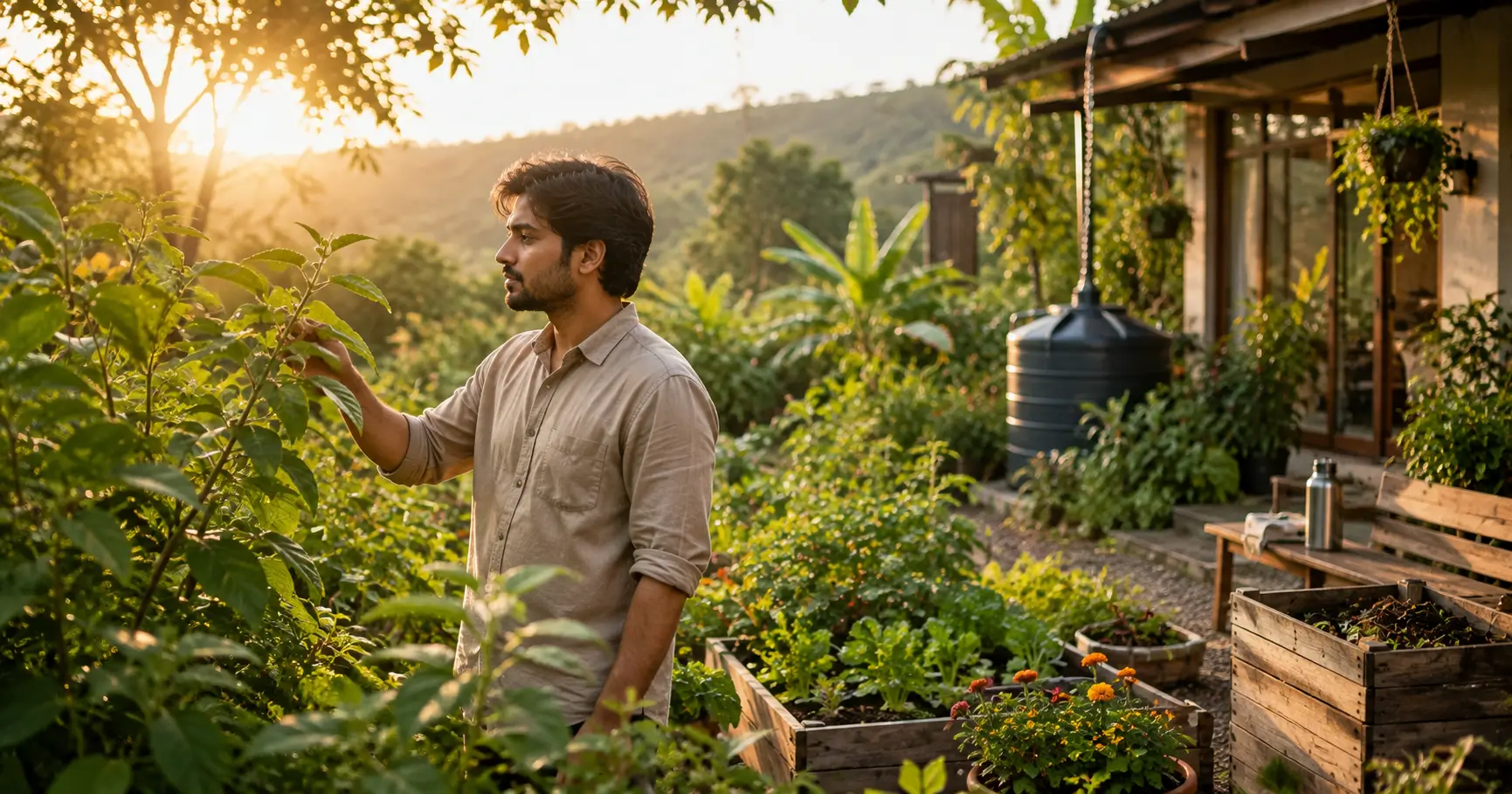

What if living better did not require buying more, optimizing every minute or completely changing your lifestyle?
Sometimes the answer is surprisingly simple: change your relationship with the natural world.
Living in harmony with nature does not mean abandoning modern life. It means learning to use resources more thoughtfully, spend meaningful time outdoors and make everyday choices that respect the systems that keep us alive.
That idea sits at the heart of sustainable living.
The United Nations has repeatedly linked harmony with nature to sustainable lifestyles, responsible consumption and a healthier relationship between human societies and the planet.
The interesting part is that some of these changes can also improve everyday wellbeing.
What Does Living in Harmony With Nature Mean?
Living in harmony with nature means meeting human needs while protecting the ecological systems that make those needs possible.
That includes clean air, water, food, healthy soils, biodiversity and stable ecosystems.
The United Nations Environment Programme describes nature’s contributions to people as including food, water, energy, natural medicines, fresh air, climate regulation and pollination.
So harmony with nature is bigger than recycling a plastic bottle.
It involves how we consume, travel, build, eat, work, garden, use energy and interact with natural spaces.
It also involves recognizing that humans are part of ecosystems rather than completely separate from them.
Why Nature Connection Matters More Than You Think
There is a difference between being around nature and feeling connected to it.
You can live beside a park and rarely notice it. Another person may spend 20 minutes watching birds, walking beneath trees or caring for plants and develop a much stronger relationship with the natural world.
Research has found that greater nature connectedness is associated with positive psychological outcomes.
A meta-analysis covering 30 samples and more than 8,500 participants found a small but significant positive relationship between nature connectedness and happiness, including positive associations with vitality and life satisfaction.
More recent research has strengthened the picture.
A 2025 meta-analysis covering 70 studies found positive associations between nature connectedness, nature contact and outcomes including wellbeing, meaning in life and life satisfaction.
That does not mean nature is a cure for every health problem.
It means the human-nature relationship is worth treating as part of a broader healthy lifestyle.
9 Ways to Live in Harmony With Nature
1. Spend Regular Time Outdoors
The first change costs almost nothing.
Make time for direct contact with nature.
You could walk through a local park, sit beneath a tree, visit a lake, maintain a garden or simply spend a few quiet minutes outdoors without constantly looking at your phone.
Research involving nearly 5,000 adults in England found that visiting natural environments at least weekly was associated with better general health, while nature connectedness was associated with wellbeing and pro-environmental behavior.
The lesson is not that everyone needs a forest.
Consistency matters more than creating a perfect outdoor experience.
2. Make Your Home More Nature-Friendly
You do not need to live in the countryside to create a stronger connection with nature.
Start with your immediate environment.
Try:
- Adding suitable indoor plants
- Opening windows when conditions allow
- Using natural daylight
- Creating a small balcony garden
- Choosing natural materials where practical
- Keeping a view of greenery unobstructed
- Spending part of the day near outdoor spaces
This approach overlaps with biophilic design, which intentionally incorporates natural elements and patterns into built environments.
Recent research has found associations between nature exposure in workplaces and wellbeing, with nature connectedness playing an important role.
A 2026 review of biophilic healthcare design similarly found promising evidence for natural elements such as plants, daylight, green views and healing gardens, although researchers caution that long-term clinical evidence remains limited.
3. Buy Less, But Choose Better
One of the biggest misunderstandings about sustainable living is that you need to replace everything you own with an “eco-friendly” version.
You don’t.
Sometimes the most sustainable product is the one you already own and continue using.
Before buying something, ask:
- Do I actually need it?
- Can I repair what I already have?
- Can I borrow or rent it?
- Will I use it frequently?
- How long is it likely to last?
This moves sustainability away from consumerism and toward conscious consumption.
The goal is not to create a prettier shopping cart.
It is to reduce unnecessary resource use.
4. Reduce Household Waste
Waste reduction becomes much easier when you focus on prevention.
Instead of asking, “How can I recycle this?” ask:
“How can I avoid creating this waste in the first place?”
Start with high-frequency items such as:
- Disposable food packaging
- Single-use bottles
- Excess food
- Unnecessary paper
- Disposable cleaning products
- Low-quality items that require frequent replacement
A reusable bottle that you actually use for years can be more meaningful than buying a dozen trendy “sustainable” products.
The most effective sustainable habit is usually the one that becomes automatic.
5. Use Energy More Intentionally
Energy consumption is another practical connection between personal habits and environmental impact.
Simple steps include:
- Switching off unnecessary lights
- Using efficient lighting
- Choosing energy-efficient appliances
- Improving insulation where practical
- Using natural light during the day
- Avoiding unnecessary heating or cooling
- Considering renewable energy where feasible
You do not need to achieve a perfectly zero-carbon lifestyle.
A better approach is to identify the largest sources of energy use in your household and improve those first.
That is more measurable and usually more effective than obsessing over tiny lifestyle details.
6. Treat Water as a Valuable Resource
Water can feel unlimited when you turn on a tap.
Ecologically, it is not.
Reducing household water waste can begin with ordinary habits:
- Fix leaking taps
- Take shorter showers
- Avoid running water unnecessarily
- Reuse suitable household water where safe and practical
- Water plants according to their actual needs
- Choose drought-tolerant plants when appropriate
- Collect rainwater where local regulations and conditions allow
The principle is simple:
Use water according to need, not convenience.
7. Grow Something
You do not need a large garden.
Try growing herbs, vegetables, flowers or native plants in whatever space you have.
Gardening changes the way you perceive food and seasons.
A tomato grown from seed takes time. A packet of herbs from a supermarket takes seconds to buy.
That difference can create a stronger appreciation for soil, water, sunlight, pollinators and the work involved in producing food.
It also makes sustainability tangible.
Instead of reading about ecosystems, you start interacting with one.
8. Make Food Choices More Thoughtfully
Food connects people directly to land, water, energy and biodiversity.
There is no single diet that every person must follow to “save the planet.”
Instead, focus on practical improvements.
You might:
- Reduce avoidable food waste
- Plan meals before shopping
- Use leftovers creatively
- Buy seasonal foods when practical
- Choose minimally processed foods more often
- Learn where frequently purchased foods come from
- Support responsible local producers when appropriate
A useful mini case study is the difference between two households.
Household A buys food without planning, regularly throws away leftovers and shops for convenience.
Household B plans meals, stores food properly and uses leftovers.
Even without radically changing what they eat, Household B can reduce unnecessary waste through better behavior.
That is an important sustainability lesson:
Systems and habits often matter more than perfection.
9. Turn Nature Connection Into Stewardship
This is where harmony with nature becomes more than a personal lifestyle trend.
If nature gives us clean water, food, pollination, climate regulation and other ecosystem services, protecting those systems becomes part of protecting ourselves.
You can contribute locally by:
- Planting suitable native species
- Avoiding unnecessary pesticide use
- Protecting pollinator-friendly spaces
- Joining local clean-up efforts
- Supporting conservation organizations
- Respecting wildlife
- Keeping natural areas free from litter
- Learning about local biodiversity
Research consistently links stronger nature connectedness with pro-environmental attitudes and behaviors.
The progression is powerful:
Notice nature → appreciate nature → feel connected to nature → care for nature → act differently.
A Simple Sustainable Living Framework
If nine changes feel overwhelming, use this five-part framework.
| Area | Start With | Next Step |
| Nature | Spend 20 minutes outdoors | Explore local biodiversity |
| Home | Add daylight and greenery | Introduce biophilic elements |
| Consumption | Pause before buying | Repair, reuse or borrow |
| Resources | Reduce wasted water and energy | Track major household use |
| Community | Keep local spaces clean | Join conservation projects |
This approach makes sustainable living measurable without turning it into an exhausting checklist.
A 7-Day Harmony With Nature Challenge
Want to start immediately?
Try this simple experiment.
Day 1: Observe
Spend 20 minutes outdoors without headphones.
Notice five things you normally ignore.
Day 2: Reduce
Choose one disposable product you regularly use and find a practical reusable alternative.
Day 3: Grow
Plant an herb, flower or suitable native plant.
Day 4: Repair
Repair something instead of replacing it.
Day 5: Conserve
Identify one unnecessary source of water or energy consumption at home.
Day 6: Explore
Visit a local park, lake, garden or other natural area.
Day 7: Give Back
Pick one action that benefits local nature.
The goal is not to become perfectly sustainable in one week.
The goal is to change what you notice.
Once you notice waste, unnecessary consumption and damaged natural spaces, your decisions often begin changing naturally.
Common Mistakes in Sustainable Living
Trying to Be Perfect
Perfection can make sustainability unsustainable.
A person who attempts ten extreme lifestyle changes may abandon all of them.
Five realistic habits practiced for years are usually more valuable than a perfect routine practiced for two weeks.
Buying Sustainability Instead of Practicing It
Buying new products can feel productive.
But sustainable living is not a shopping category.
It is a behavior pattern.
Consume less before consuming “better.”
Ignoring Local Context
A sustainability strategy that works in a cold European climate may not make sense in a hot Indian city.
Local weather, infrastructure, water availability, energy sources, biodiversity and income all influence the best choices.
Treating Nature as a Backdrop
Taking photographs in nature is not the same as connecting with nature.
Slow down.
Observe seasonal changes, birds, plants, soil, weather and water.
Connection requires attention.
Myths vs Facts
| Myth | Fact |
| Living sustainably means living without modern technology. | Sustainable living can use technology, provided resources are used thoughtfully. |
| One person cannot make a difference. | Individual behavior can influence consumption, social norms and community action, although systemic change is also essential. |
| You need to buy expensive eco-products. | Reducing consumption, repairing and reusing can often be more sustainable than buying replacements. |
| Living near nature automatically creates nature connection. | Physical access and psychological connection are related but distinct. |
| Sustainability means never consuming anything. | The goal is responsible use of resources, not eliminating all consumption. |
| Harmony with nature is only an environmental issue. | It also involves wellbeing, communities, economics, culture and long-term resilience. |
What Research Really Says About Nature and Wellbeing
The evidence is encouraging, but it deserves careful interpretation.
A large body of research associates nature connectedness with wellbeing, positive affect, vitality and life satisfaction.
Research in India is particularly relevant.
A 2025 study of 2,283 urban young adults across 25 major Indian cities found that access to green and blue spaces, recreational visits and higher nature connectedness were associated with better reported wellbeing. The authors also identified limitations, including the study’s cross-sectional design and age range.
That distinction matters.
An association does not automatically prove that spending time in nature causes every observed health outcome.
Still, the overall evidence provides a compelling reason to make meaningful contact with nature part of everyday life.
The Bigger Meaning of Harmony With Nature
Harmony with nature is not about returning to an imaginary past.
It is about building a future in which modern life and ecological limits are considered together.
The United Nations has treated harmony with nature as part of the broader sustainable-development conversation for years, including through its International Mother Earth Day initiative and General Assembly dialogues.
The idea has also evolved.
Today, harmony with nature includes questions about biodiversity, sustainable production, responsible consumption, climate resilience, environmental justice and the role of Indigenous and local knowledge.
In other words, this is not merely a lifestyle aesthetic.
It is a way of thinking about how human prosperity fits inside a finite ecological system.
The Most Practical Way to Start
Don’t redesign your entire life this weekend.
Choose three changes.
For example:
- Spend 20 minutes outdoors each day.
- Reduce one major source of household waste.
- Make one purchasing decision each week based on durability rather than novelty.
Then measure what happens.
After a month, add another habit.
The strongest sustainable lifestyle is not the one that looks impressive on social media.
It is the one you can maintain when life becomes busy.
Key Takeaways
- Harmony with nature means living within ecological limits while meeting human needs.
- Sustainable living is one of the most practical ways to turn that principle into everyday behavior.
- Nature connectedness is associated with wellbeing and pro-environmental behavior, although research does not mean nature is a cure-all.
- Buying less, reducing waste, conserving resources and spending meaningful time outdoors are practical starting points.
- Local conditions matter, so sustainable choices should fit your climate, community and circumstances.
- Progress matters more than perfection.
The most meaningful change may begin with something almost invisible: paying attention.
Notice the tree outside your window. Notice how much food you waste. Notice how much water you use. Notice what you buy and what happens to it afterward.
When nature stops being background scenery and becomes part of the way you make decisions, sustainable living becomes much more than a trend.
It becomes a relationship.
And that is where living in harmony with nature truly begins.
FAQ
What does living in harmony with nature mean?
Living in harmony with nature means meeting human needs while protecting ecosystems, biodiversity and natural resources for present and future generations.
How can I live in harmony with nature?
Start with practical habits such as spending time outdoors, reducing waste, conserving water and energy, buying less, growing plants and supporting local environmental initiatives.
Why is harmony with nature important?
Healthy ecosystems provide essential resources and services such as food, clean water, pollination and climate regulation. Human wellbeing depends on functioning natural systems.
What is the relationship between sustainable living and nature?
Sustainable living reduces unnecessary resource use and environmental pressure. It turns the broader idea of harmony with nature into practical daily choices involving consumption, energy, food, transportation and waste.
Can living closer to nature improve wellbeing?
Research generally finds positive associations between nature contact or nature connectedness and wellbeing, although the strength and nature of these relationships vary between studies.
Does sustainable living mean giving up modern life?
No. Sustainable living does not require abandoning technology or modern conveniences. It means using resources more efficiently, reducing unnecessary consumption and making choices that are more compatible with ecological limits.
Conclusion
Living in harmony with nature does not require perfection.
It starts with a different way of looking at everyday life.
Spend time outdoors. Buy with intention. Waste less. Protect water. Use energy thoughtfully. Grow something. Learn about the nature around you. And turn appreciation into action.
The evidence increasingly suggests that a stronger connection with nature is associated with wellbeing, while research and international sustainability frameworks also emphasize the importance of protecting the ecosystems on which human life depends.
The simplest starting point is to choose three sustainable habits you can realistically maintain.
Don’t aim to become perfectly “green” overnight.
Aim to become more aware.
Because when we understand that we are not separate from nature—but part of it—sustainable living stops feeling like a sacrifice.
It starts feeling like common sense.
Disclaimer
Environmental and Wellbeing Disclaimer: This article is provided for general educational and informational purposes. It is not a substitute for professional environmental, scientific, architectural, financial or medical advice.
Research concerning nature exposure, nature connectedness and wellbeing often identifies associations rather than proving direct cause and effect. Individual experiences can differ based on health, location, socioeconomic circumstances, accessibility and environmental conditions.
Sustainability recommendations should also be adapted to local regulations, climate, infrastructure, household circumstances and available resources. Readers should independently verify product, energy, water, gardening and environmental claims before making significant purchasing or lifestyle decisions.