
Chemicals are present in virtually all foods, but that does not mean the food is unsafe. Water, carbohydrates, proteins, vitamins and minerals are all chemicals. The more relevant concern is whether food contains a harmful substance, whether its concentration is excessive, and how much of it a person consumes over time.
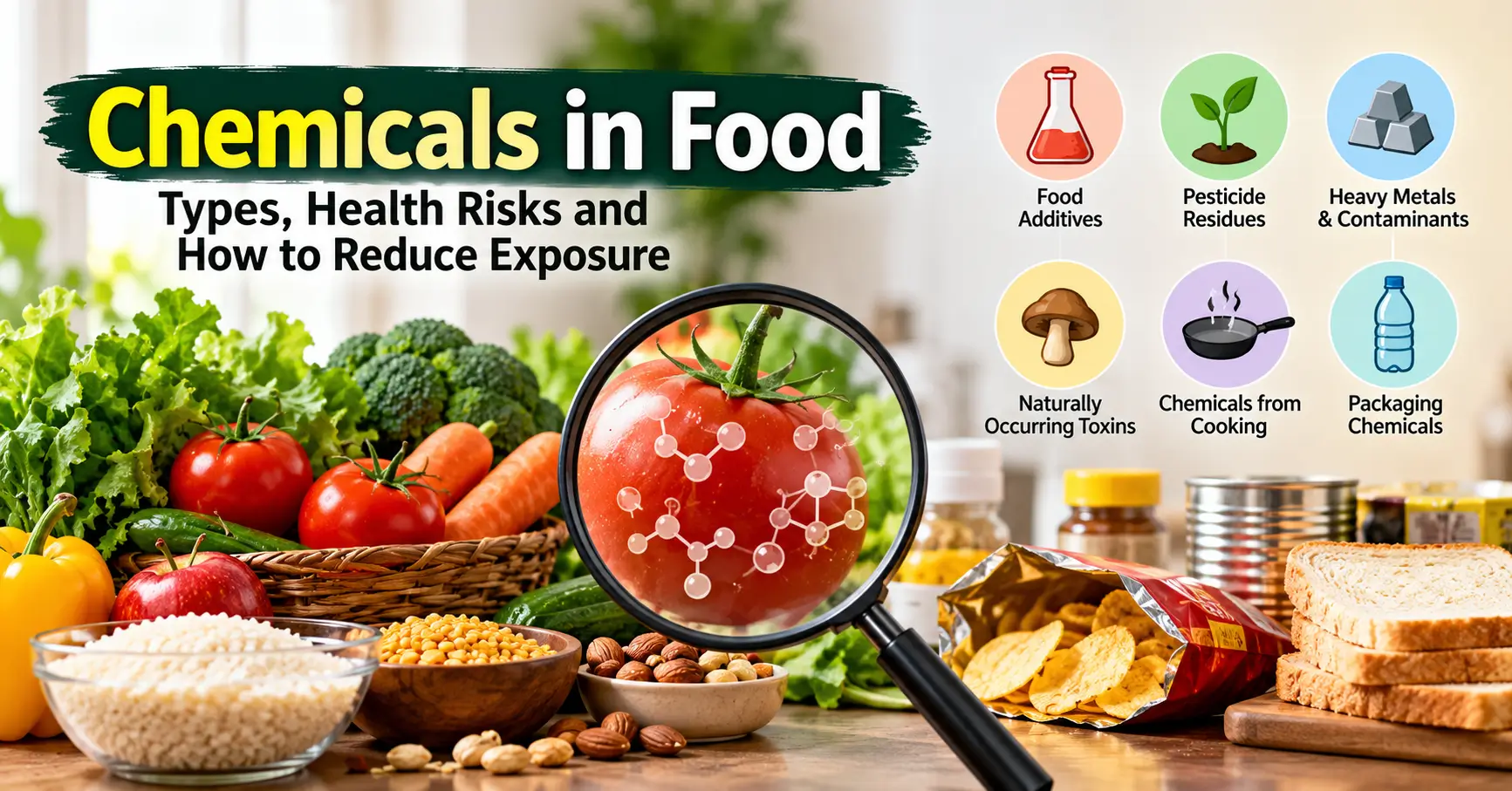
The phrase chemicals in food usually refers to several different things: permitted food additives, pesticide residues, environmental contaminants, substances formed during cooking and chemicals that may migrate from packaging. These categories have different sources and require different safety measures.
For Indian households, understanding these differences is more useful than trying to avoid every product with an unfamiliar ingredient name. The practical goal is to reduce avoidable exposure to harmful substances while maintaining a varied, nutritious diet.
What are chemicals in food?
Food chemicals can be intentionally added, naturally present or introduced unintentionally during growing, processing, cooking, transportation or storage.
For example, sodium chloride is ordinary table salt, ascorbic acid is vitamin C, and citric acid occurs naturally in citrus fruits and is also used in food production. Their names may sound technical, but a chemical name alone does not tell you whether something is dangerous.
The safety question is more specific: What is the substance, how much is present, how much will a person consume, and what does the scientific evidence show about its effects?
Six important types of chemicals found in food
1. Food additives
Food additives are substances deliberately used for technological purposes, such as preserving food, improving texture, maintaining colour or preventing ingredients from separating.
Common categories include:
- Preservatives: Help slow spoilage or inhibit the growth of certain microorganisms.
- Colours: Give or restore colour to particular foods.
- Antioxidants: Help slow oxidation, which can affect flavour, colour or quality.
- Emulsifiers and stabilisers: Help maintain texture and keep ingredients evenly distributed.
- Sweeteners: Provide sweetness, sometimes with less energy than conventional sugars.
Examples include ascorbic acid, citric acid and certain permitted preservatives. Their safety depends on the specific substance, permitted use, concentration and exposure.
An authorised additive used within its applicable food-safety limits should not automatically be treated as dangerous. Conversely, the fact that an ingredient is permitted for one food or use does not mean every possible use or amount is acceptable.
In India, FSSAI’s Food Products Standards and Food Additives Regulations set requirements for specified food categories and uses.
2. Pesticide residues
Pesticides are used in agriculture to control insects, weeds, fungi and other pests. Small residues may remain on or in food after treatment.
The risk depends on the pesticide, the residue level, how much food is consumed and the person’s overall exposure. Occupational exposure among people who apply pesticides can be substantially different from the lower exposure most consumers receive through food.
The World Health Organization (WHO) explains that maximum residue limits are used in food-safety systems to help ensure that pesticide residues remain within established standards.
For consumers, washing produce under clean running water and peeling where appropriate can reduce some residues. These methods cannot guarantee that every pesticide has been removed, particularly when substances have penetrated the food or are present internally.
Practical takeaway: Do not stop eating fruits and vegetables out of fear of pesticide residues. Wash produce properly and follow reliable food-safety guidance.
3. Heavy metals and environmental contaminants
Some chemical contaminants enter food through soil, water, air or industrial pollution. Important examples include lead, arsenic, cadmium and mercury.
These substances differ in their sources and effects:
- Lead: Exposure can affect the nervous system, with children being particularly vulnerable.
- Arsenic: Inorganic arsenic in contaminated food or water can contribute to serious long-term health risks.
- Cadmium: Long-term exposure can harm the kidneys and affect bone health.
- Mercury: Methylmercury exposure is particularly relevant to certain fish and can affect the developing nervous system.
The risk depends on the chemical form, concentration, exposure duration and food source. A laboratory finding of a contaminant does not, by itself, establish how much harm a person will experience.
In India, contamination can be relevant to specific food sources and local environmental conditions. Consumers should rely on credible monitoring, official advisories and appropriate testing rather than assume that all foods of a particular type are contaminated.
4. Naturally occurring toxins
Some foods contain substances that can be toxic under particular conditions, even without artificial additives.
Examples include:
- Aflatoxins: Toxins produced by certain moulds that may contaminate improperly stored crops, including groundnuts and maize.
- Cyanogenic compounds: Present in certain plants, including improperly processed cassava.
- Glycoalkaloids: Naturally occurring compounds in potatoes that can be elevated in green, damaged or sprouting potatoes.
These examples show why the distinction between natural and synthetic substances is not a reliable safety test. Natural origin does not automatically mean harmless, just as synthetic origin does not automatically mean dangerous.
Buy food from reliable sources, store grains and nuts in dry conditions, discard mouldy food and avoid eating green or heavily sprouted potatoes.
5. Chemicals formed during cooking and processing
Some substances can form when foods are heated, smoked, dried or processed.
For example, acrylamide can form in certain starchy foods during high-temperature cooking, including frying, roasting and baking. Polycyclic aromatic hydrocarbons can form during incomplete combustion and may contaminate some smoked or heavily charred foods.
These examples do not mean that all cooked food is dangerous. Cooking is also essential for making many foods safe to eat and improving digestibility.
A practical approach is to avoid routinely burning food, follow suitable cooking temperatures and use a varied diet rather than relying heavily on one type of highly browned or charred food.
6. Chemicals that may migrate from food packaging
Food packaging helps protect food from contamination and spoilage. However, under certain conditions, substances from packaging can migrate into food.
Migration can depend on the packaging material, the type of food, contact time and temperature. The conditions relevant to a fatty food stored for a long period may differ from those for a dry food stored briefly.
For everyday use:
- Follow the manufacturer’s microwave and heating instructions.
- Do not microwave food in containers that are not intended for microwave use.
- Avoid using visibly damaged or unsuitable containers for food storage.
- Follow the intended use of reusable bottles and food containers.
Do not assume that every plastic container is unsafe or that glass is always necessary. The appropriate choice depends on the material, its intended use and the conditions in which it is used.
Are chemicals in food harmful?
Some can be harmful, but the word chemical is not enough to determine risk.
Scientists assess food chemicals by examining their toxic effects, the amount to which people are exposed, the likelihood of harm at different exposure levels and the uncertainties in the available evidence.
Three concepts help explain the difference.
Hazard: The potential of a substance to cause harm under some conditions.
Exposure: How much of the substance reaches a person, through which route and over what period.
Risk: The likelihood and severity of harm under the actual exposure conditions.
For example, a substance may cause harm at a sufficiently high dose but pose a much smaller risk when exposure is low and within an established safety limit. Other substances, such as lead, warrant particularly careful control because even relatively low exposures can be concerning, especially for children.
Risk assessment is not a guarantee that every exposure is harmless. It is a way to use available evidence to establish protective standards and make informed decisions.
What food-safety limits actually mean
Regulatory limits are designed to control exposure and protect public health. Different limits serve different purposes: a pesticide maximum residue limit is not the same as a limit for a heavy metal or an authorised food additive.
A result above a legal limit requires appropriate assessment and regulatory action. A result below a limit does not mean that the substance has literally disappeared; it means the result should be interpreted in the context of the applicable standard and the exposure assessment.
In India, consult the current FSSAI regulations for the relevant substance and food category. Regulations can be amended, so old online lists may not reflect the latest requirements.
How to reduce avoidable chemical exposure in everyday life
You cannot eliminate all chemical exposure from food, and trying to do so is neither realistic nor necessary. The following habits address practical, preventable risks.
1. Wash fruits and vegetables properly
Wash produce under clean running water before cutting, peeling or eating it. Rub firm produce with your hands and use a clean produce brush where appropriate.
Washing can remove dirt and reduce some surface residues and microorganisms. It cannot guarantee complete pesticide removal or remove contaminants that have entered the food internally.
Do not use household bleach, detergents, dishwashing liquid or unapproved chemical mixtures to wash food.
2. Store food correctly
Keep grains, pulses, flour and nuts in clean, dry, well-maintained containers. Protect them from moisture and pests.
Discard food that is mouldy or shows signs of significant spoilage. Do not assume that removing visible mould makes the entire food safe, because some toxins may remain even when mould is no longer visible.
3. Choose a varied diet
Eating a variety of vegetables, fruits, grains, pulses and other suitable foods reduces dependence on a single food source and supports nutritional adequacy.
Variety does not guarantee the absence of contaminants, but it can help avoid excessive reliance on one product or source when a contamination issue is identified.
Do not remove entire nutritious food groups merely because of a general fear of chemicals.
4. Read packaged-food labels
Check the ingredient list, allergen information, expiry or best-before details and storage instructions. Familiarise yourself with the purpose of common additives instead of judging them only by their chemical names.
For packaged foods, also consider the overall nutritional profile, including added sugar, sodium and saturated fat. A food can comply with chemical safety requirements while still being a poor everyday nutritional choice if consumed frequently in large amounts.
5. Avoid unnecessary food heating in unsuitable containers
Use cookware and storage containers according to their intended purpose. Follow product instructions when heating food, especially in a microwave.
Discard containers that are cracked, badly damaged or no longer suitable for food contact.
6. Treat organic claims realistically
Organic production standards restrict certain agricultural inputs, but organic food is not automatically free of every pesticide residue or environmental contaminant.
Organic and conventionally grown produce can both contribute to a healthy diet. The decision to buy organic products should consider affordability, availability, dietary quality and the standards behind the claim.
7. Avoid unsupported detox products
There is no good reason to assume that a juice cleanse, detox tea or supplement will remove all food-related chemicals from the body.
The body processes and eliminates many substances through normal physiological mechanisms, including the liver and kidneys. These systems do not make every exposure harmless, but they also do not justify unverified detox claims.
If you suspect a genuine food contamination problem, identify the source and seek appropriate professional or regulatory advice rather than relying on a detox product.
Myth versus evidence: common beliefs about food chemicals
| Claim | What the evidence supports |
|---|---|
| All chemicals in food are dangerous | False. Chemicals include nutrients and ordinary food components; safety depends on the substance and exposure. |
| Natural foods are always safer | False. Natural toxins and environmental contaminants can also pose risks. |
| Washing removes every pesticide | False. Washing reduces some surface residues but cannot guarantee complete removal. |
| Organic food contains no chemical residues | Not guaranteed. Organic standards do not eliminate every possible contaminant. |
| Every food additive causes cancer | Unsupported as a general claim. Each substance requires its own evidence-based assessment. |
| A detox drink removes harmful chemicals | No reliable general evidence supports such a promise. |
| Food-safety limits mean a substance is completely absent | False. Limits control permitted concentrations or exposure; they do not necessarily require zero presence. |
When should you seek medical advice?
Most people do not need medical testing or supplements simply because they are concerned about chemicals in food.
Seek prompt medical advice if you develop symptoms after a suspected chemical exposure, particularly after eating food believed to be contaminated. Severe or rapidly worsening symptoms, breathing difficulty, collapse, confusion or repeated vomiting warrant urgent medical care.
If a specific contamination incident has been reported, follow the advice of the relevant food-safety authority. Children, pregnant people and individuals with particular medical conditions may require more specific advice depending on the substance and exposure.
Do not attempt to treat a suspected poisoning with home detox remedies or induce vomiting unless instructed by an appropriate medical professional.
What Indian consumers should remember
Food safety is a shared responsibility involving farmers, food manufacturers, regulators, retailers and consumers. Household habits matter, but consumers cannot identify every chemical contaminant by looking at a food.
For reliable information about permitted additives, contaminant limits and food-safety alerts, consult the Food Safety and Standards Authority of India (FSSAI). Its regulations cover food products, additives, contaminants, toxins and residues, and its official website lists amendments.
The most useful personal strategy is to buy food from reliable sources, wash and store it properly, avoid visibly spoiled food, use packaging and cookware appropriately, and maintain a balanced diet.
The bottom line: Do not judge food safety by whether a substance sounds chemical, natural or artificial. Judge it by the identity of the substance, the level of exposure and the quality of the scientific evidence. That approach helps protect health without creating unnecessary fear around everyday eating.
Frequently asked questions
1. What are the most common types of chemicals in food?
They include food additives, pesticide residues, environmental contaminants, naturally occurring toxins, substances formed during cooking and chemicals that may migrate from packaging. Their safety depends on the substance, exposure and applicable standards.
2. Are food preservatives harmful?
Not automatically. Some preservatives are authorised for specified uses and concentrations. Their safety must be assessed individually, and compliance with the applicable requirements matters.
3. How can I remove chemicals from fruits and vegetables?
Wash produce thoroughly under clean running water. Peeling can reduce some residues where appropriate, but neither method guarantees removal of all pesticides or contaminants. Avoid detergents and household cleaning chemicals on food.
4. Is organic food free from pesticides?
No. Organic standards restrict certain agricultural inputs, but they do not guarantee zero residues or freedom from environmental contaminants. Organic and conventionally grown produce can both be part of a healthy diet.
5. Can chemicals in food cause cancer?
Some specific substances can increase cancer risk under certain exposure conditions. That does not mean every additive or trace residue causes cancer. The substance, dose, duration of exposure and quality of the evidence all matter.
6. Does boiling food remove chemical contaminants?
Not universally. The effect depends on the contaminant and the food. Some substances may decrease under particular cooking conditions, while others remain or can become more concentrated as water evaporates. Do not rely on boiling as a universal decontamination method.
7. How can I check food-safety standards in India?
Use the official FSSAI website to consult current product standards, additive requirements and contaminants-and-residues regulations. Check the applicable food category and the latest amendments rather than relying on an old social media list.
8. Should I take detox supplements to remove chemicals from food?
There is no good evidence that general detox supplements can remove every chemical exposure. Avoid products promising guaranteed detoxification. If a specific exposure is suspected, seek appropriate medical or food-safety advice.