
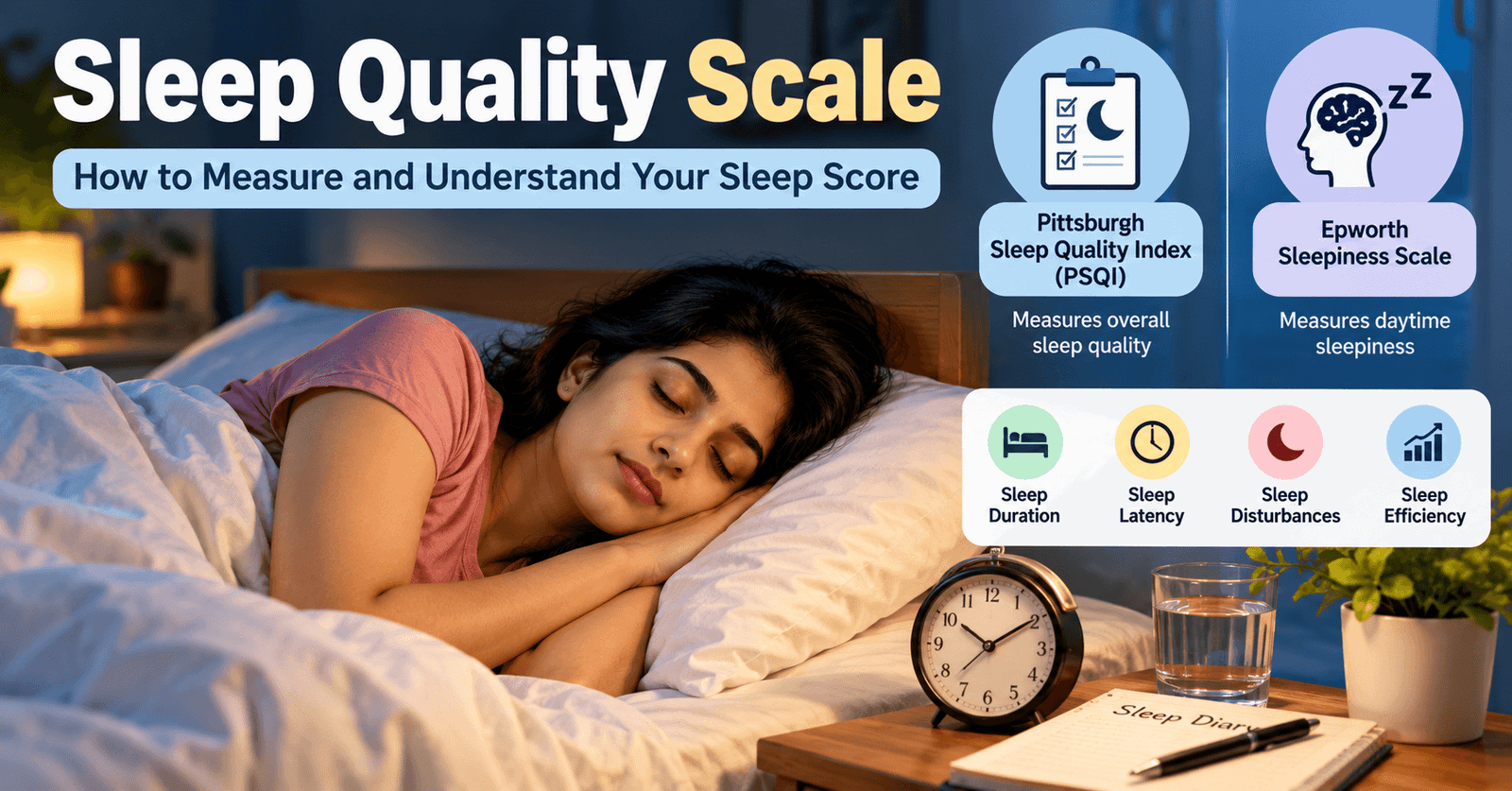

Sleeping for seven or eight hours does not necessarily mean you are getting good-quality sleep. You may spend enough time in bed but still wake up repeatedly, take a long time to fall asleep, or feel tired throughout the day.
A sleep quality scale helps assess these different aspects of sleep rather than focusing only on the number of hours you spend in bed.
One of the most widely used assessment tools is the Pittsburgh Sleep Quality Index (PSQI). It evaluates sleep patterns and disturbances over the previous month using seven components. Other tools, such as the Epworth Sleepiness Scale (ESS), assess daytime sleepiness rather than overall sleep quality.
Understanding which tool measures what is important. A high sleep score does not automatically mean you have a sleep disorder, and a seemingly normal score does not rule one out.
This guide explains how sleep quality assessment works, how to understand PSQI scores, what other assessment methods measure, and how to use the information to make better decisions about your sleep health.
Medical disclaimer: This article provides general educational information, not a diagnosis. Sleep questionnaires are screening and assessment tools. Persistent sleep difficulties, excessive daytime sleepiness or symptoms such as interrupted breathing during sleep require appropriate medical evaluation.
What Is a Sleep Quality Scale?
A sleep quality scale is a structured questionnaire or assessment method used to understand how well someone sleeps.
Instead of measuring sleep duration alone, these assessments may consider:
- How long it takes to fall asleep.
- How frequently you wake up during the night.
- How many hours you actually sleep.
- Whether you feel refreshed after waking.
- Whether sleep problems interfere with daytime activities.
- Whether you regularly need medication to sleep.
Some scales ask you to remember your sleep experiences over a specified period, while others assess how sleepy you feel in everyday situations.
There is no single universal sleep quality scale that measures every aspect of sleep health.
Different questionnaires have been developed for different purposes, and choosing the appropriate one depends on what you want to assess.
What Is the Pittsburgh Sleep Quality Index (PSQI)?
The Pittsburgh Sleep Quality Index is a commonly used self-report questionnaire developed by researchers at the University of Pittsburgh.
Published in 1989, it was designed to assess sleep quality and disturbances over a one-month period.
The original questionnaire contains 19 self-rated items that contribute to seven component scores. These components are combined into a global score representing reported sleep difficulties.
The PSQI is used in sleep research and clinical settings. It helps describe patterns of sleep disturbance, but it does not independently diagnose insomnia, sleep apnoea or other sleep disorders.
What does the PSQI measure?
The seven components are:
| Component | What it assesses |
|---|---|
| Subjective sleep quality | How you personally rate your sleep |
| Sleep latency | How long it takes to fall asleep |
| Sleep duration | How many hours you actually sleep |
| Habitual sleep efficiency | The proportion of time in bed spent sleeping |
| Sleep disturbances | Problems that interrupt sleep |
| Use of sleeping medication | Frequency of medication use to help sleep |
| Daytime dysfunction | Sleep-related difficulty staying awake or maintaining enthusiasm |
These components provide a broader picture than sleep duration alone.
For example, someone may report seven hours of sleep but experience frequent awakenings and considerable daytime tiredness. Looking at the individual components can help explain why the overall experience of sleep may be unsatisfactory.
How is the PSQI score calculated?
The PSQI uses seven component scores.
Each component receives a score from 0 to 3:
- 0 represents no reported difficulty or the best category for that component.
- 1 represents relatively mild difficulty.
- 2 represents more substantial difficulty.
- 3 represents the greatest difficulty or disturbance.
The seven component scores are added together.
The conventional interpretation is:
| Global PSQI score | General interpretation |
|---|---|
| 0–5 | Below the conventional poor-sleep threshold |
| 6–21 | Above the conventional threshold; further assessment may be useful |
A score greater than 5 was used in the original PSQI research to distinguish good and poor sleepers. However, it is not a universal diagnostic boundary for every population.
Important: A score of 5 or below does not guarantee healthy sleep, and a score above 5 does not establish a medical diagnosis.
Understanding Your Sleep Quality Score: Practical Examples
The following are hypothetical examples to explain how the seven components contribute to the global score. They are not actual patient results.
| Component | Person A | Person B |
|---|---|---|
| Subjective sleep quality | 0 | 2 |
| Sleep latency | 1 | 2 |
| Sleep duration | 0 | 2 |
| Sleep efficiency | 0 | 1 |
| Sleep disturbances | 1 | 2 |
| Sleeping medication | 0 | 0 |
| Daytime dysfunction | 0 | 2 |
| Total PSQI score | 2 | 11 |
Person A reports relatively few sleep difficulties across the assessed components.
Person B reports more frequent difficulties, including problems falling asleep, shorter sleep duration, disturbances and daytime effects.
The difference is useful because it shows that sleep quality is multidimensional. A single number can summarise the assessment, but the individual components help explain the underlying pattern.
What Is a Good Sleep Quality Score?
A good sleep score depends on the assessment tool being used.
For the PSQI, a global score of 5 or below is generally considered below the conventional poor-sleep threshold.
However, other scales use different scoring systems.
For example, the Epworth Sleepiness Scale measures daytime sleep propensity rather than overall sleep quality.
This distinction matters because someone may have:
- Reasonable sleep duration but excessive daytime sleepiness.
- Difficulty falling asleep but little daytime sleepiness.
- Frequent nighttime awakenings and poor subjective sleep quality.
- A normal questionnaire score despite symptoms requiring medical investigation.
Therefore, there is no single score that completely describes a person’s sleep health.
Why the PSQI threshold has limitations
The conventional threshold was established using particular research populations.
A systematic review published in 2015 examined the PSQI’s measurement properties across clinical and non-clinical populations. It found evidence supporting its usefulness, but also identified differences in how the tool performed across studies.
A newer critical review published online in June 2026 also highlighted concerns about interpreting the conventional cutoff as a definitive boundary. It discussed limitations involving the definition of sleep quality, the stability of scoring structures and the use of the global score as a substitute for diagnosing sleep disorders.
The practical conclusion is straightforward: use the PSQI as a structured description of reported sleep difficulties, not as a standalone medical verdict.
What Is the Epworth Sleepiness Scale (ESS)?
The Epworth Sleepiness Scale is another established tool used in sleep assessment.
However, it measures something different from the PSQI.
The ESS assesses a person’s usual likelihood of dozing off or falling asleep in eight everyday situations.
Each situation receives a score from 0 to 3:
| Score | Meaning |
|---|---|
| 0 | Would never doze |
| 1 | Slight chance of dozing |
| 2 | Moderate chance of dozing |
| 3 | High chance of dozing |
The eight responses are added together.
The total score ranges from 0 to 24. A higher score indicates greater reported daytime sleep propensity.
PSQI vs ESS: What is the difference?
| Feature | PSQI | ESS |
|---|---|---|
| Full name | Pittsburgh Sleep Quality Index | Epworth Sleepiness Scale |
| Main purpose | Assess sleep quality and disturbances | Assess daytime sleepiness |
| Assessment period | Previous month | Usual likelihood of dozing in everyday situations |
| Number of scored responses | 19 self-rated items | 8 situations |
| Score range | 0–21 | 0–24 |
| Higher score means | Greater sleep difficulties | Greater daytime sleep propensity |
| Main use | Sleep-quality assessment | Sleepiness assessment |
The two tools can complement each other, but they should not be treated as interchangeable.
The official ESS website also explains that the questionnaire is protected by licensing requirements. Use the authorised version when undertaking a formal assessment.
How Can You Measure Sleep Quality Without a Questionnaire?
A questionnaire is not the only way to understand your sleep.
A sleep diary is a practical method of recording your bedtime, waking time, nighttime interruptions and daytime alertness.
The National Heart, Lung, and Blood Institute (NHLBI), part of the US National Institutes of Health, recommends keeping a sleep diary for a few weeks when preparing to discuss sleep problems with a healthcare professional.
A simple sleep diary for everyday use
The following is an original tracking template for general self-observation. It is not a validated medical scale.
| What to record | Example |
|---|---|
| Bedtime | 10:30 PM |
| Estimated time to fall asleep | 25 minutes |
| Nighttime awakenings | 2 times |
| Final waking time | 6:30 AM |
| Estimated actual sleep | 7 hours |
| Morning feeling | Slightly tired |
| Daytime sleepiness | Moderate |
| Caffeine consumption | Tea at 5 PM |
| Exercise | 30-minute walk |
Keep the diary consistently for approximately two weeks if you are trying to identify a pattern.
The purpose is not to achieve a perfect score every night. It is to understand whether particular habits, schedules or symptoms repeatedly coincide with poor sleep.
How to interpret your sleep diary
Look for patterns rather than judging individual nights.
For example:
- Do you regularly take a long time to fall asleep?
- Do you wake up several times?
- Does your sleep schedule change substantially between working days and weekends?
- Do you regularly feel tired despite spending sufficient time in bed?
- Does afternoon or evening caffeine coincide with difficulty falling asleep?
If the same problems continue, share your diary with a healthcare professional.
What Is Sleep Efficiency and How Is It Calculated?
Sleep efficiency is the percentage of time spent in bed that you actually spend sleeping.
It is a useful measurement in sleep assessment, including the PSQI.
The calculation is:
Example calculation
Suppose you spend eight hours in bed but estimate that you sleep for seven hours.
87×100=87.5%
This means you spent 87.5% of your time in bed sleeping.
A lower value may indicate difficulty falling asleep, nighttime awakenings or other interruptions.
However, sleep efficiency should not be interpreted in isolation. It does not show whether you are getting sufficient sleep, whether your sleep timing is appropriate, or whether you have a sleep disorder.
Can Smartwatches and Mobile Apps Measure Sleep Quality?
Smartwatches, fitness bands and mobile applications have made sleep tracking more accessible.
Depending on the device, they may estimate:
- Total sleep duration.
- Bedtime and waking time.
- Nighttime movement.
- Heart rate.
- Estimated sleep stages.
- Periods of wakefulness.
These features can help people notice changes in their routines.
However, consumer sleep trackers do not directly measure all the biological signals used in a clinical sleep study.
For example, a typical wearable does not measure brain electrical activity in the same way as polysomnography.
The American Academy of Sleep Medicine has cautioned that consumer sleep technology should not replace medical evaluation or validated diagnostic testing for sleep disorders.
What can you reasonably use a sleep tracker for?
| Tracker feature | Practical use | Important limitation |
|---|---|---|
| Sleep duration | Observe approximate sleep timing | May misclassify quiet wakefulness as sleep |
| Bedtime consistency | Notice schedule changes | Does not establish sleep health |
| Heart rate | Observe trends | Cannot independently diagnose sleep disorders |
| Sleep stages | View estimated patterns | Stage estimates are not equivalent to clinical measurements |
| Sleep score | Track device-generated trends | Different brands use different algorithms |
My recommendation: Treat wearable data as supplementary information, not a medical report. If your tracker indicates good sleep but you regularly feel exhausted, do not ignore your symptoms.
Sleep Quality in Indian Adults: What Should You Consider?
Sleep patterns are influenced by lifestyle, working hours, environmental conditions and individual health.
For Indian readers, several practical considerations may be relevant.
Irregular work and study schedules
Students preparing for competitive examinations, professionals working late and people doing rotating shifts may have inconsistent sleep schedules.
A person might obtain sufficient sleep on some days but experience substantial changes in timing across the week.
A sleep diary can help reveal this pattern.
Heat and bedroom conditions
Hot nights, inadequate ventilation and uncomfortable sleeping environments can interfere with sleep continuity.
During India’s warmer months, maintaining a comfortable bedroom environment may be particularly relevant.
Evening tea and coffee
Tea and coffee contain caffeine, which can interfere with sleep in some people, especially when consumed later in the day.
Record your consumption rather than assuming that every person’s sensitivity is identical.
Language accessibility
The PSQI has been translated into multiple languages.
An Indian study published in the Journal of the Association of Physicians of India examined a Hindi version of the PSQI in 105 bilingual participants and reported acceptable internal consistency and test-retest reliability.
This is useful evidence of Hindi-language applicability, but it should not be interpreted as proof that every translation is equally suitable for every Indian population.
The choice of a validated language version matters when the questionnaire is used in formal research or clinical assessment.
How Much Sleep Do Adults Need?
Sleep quality and sleep quantity are related, but they are not identical.
An adult may spend enough time in bed and still experience fragmented or unrefreshing sleep.
The American Academy of Sleep Medicine and Sleep Research Society recommend that adults aged 18–60 years regularly obtain at least seven hours of sleep per night to support health. Individual requirements can vary.
| Sleep factor | What to consider |
|---|---|
| Duration | Are you regularly getting sufficient sleep? |
| Timing | Is your sleep schedule reasonably consistent? |
| Continuity | Are you frequently waking up? |
| Refreshment | Do you generally feel rested after waking? |
| Daytime function | Can you remain alert during normal activities? |
Do not use the seven-hour recommendation as a sleep-quality score. It is a duration recommendation, not a comprehensive assessment of sleep health.
What Can Cause Poor Sleep Quality?
Poor sleep can have several contributing factors.
Some are related to habits and the sleeping environment, while others may require medical assessment.
| Possible factor | How it may affect sleep |
|---|---|
| Stress and anxiety | May make it difficult to relax or fall asleep |
| Irregular sleep schedule | Can disrupt normal sleep timing |
| Late caffeine consumption | May interfere with sleep onset |
| Noise and uncomfortable temperatures | Can interrupt sleep |
| Chronic pain | May cause nighttime awakenings |
| Certain medications | May affect sleep patterns |
| Sleep apnoea | Can cause repeated breathing interruptions |
| Restless legs syndrome | Can create uncomfortable sensations and an urge to move the legs |
These are possible contributors, not diagnoses.
If sleep problems continue despite reasonable changes to your routine, discuss them with a healthcare professional.
When Should You Consult a Doctor About Your Sleep Score?
Do not wait for a particular questionnaire score if your symptoms are affecting your health or daily activities.
Consider seeking medical advice if you experience:
- Persistent difficulty falling asleep or staying asleep.
- Excessive daytime sleepiness.
- Loud, habitual snoring accompanied by breathing pauses.
- Waking up gasping or choking.
- Repeated morning headaches alongside other sleep-related symptoms.
- Difficulty concentrating because of poor sleep.
- Sleepiness that affects driving, work or other safety-sensitive activities.
If you are struggling to stay awake while driving, stop driving and arrange a safe alternative. Do not rely on a normal sleep questionnaire score to establish that driving is safe.
The NHLBI recommends discussing recurring sleep problems, unrefreshing sleep and daytime sleepiness with a healthcare professional. Depending on the symptoms, assessment may involve a medical history, sleep diary, examination or sleep study.
Common Mistakes When Using a Sleep Quality Scale
Treating the score as a diagnosis: A questionnaire can identify reported difficulties, but a clinical diagnosis requires appropriate assessment.
Confusing sleepiness with sleep quality: Feeling sleepy during the day and experiencing poor sleep are related but different issues. This is why the PSQI and ESS measure different things.
Ignoring individual components: A global score can conceal whether the main difficulty involves sleep duration, sleep onset or repeated awakenings.
Comparing different devices: Two smartwatches may calculate sleep scores using different algorithms. Their results are not necessarily comparable.
Changing questionnaire wording: Altering the official PSQI questions, recall period or scoring method can undermine the validity of the original assessment.
Ignoring persistent symptoms: A reassuring score should not override recurring symptoms such as breathing interruptions or dangerous daytime sleepiness.
Conclusion
A sleep quality scale can help you understand your sleep patterns, but the usefulness of the result depends on choosing the correct assessment tool.
The Pittsburgh Sleep Quality Index is widely used to evaluate sleep quality and disturbances over the previous month. Its global score ranges from 0 to 21, with higher scores indicating greater reported difficulties.
The Epworth Sleepiness Scale measures daytime sleep propensity, while a sleep diary helps identify everyday patterns that may not be obvious from a questionnaire.
For Indian adults, these tools can provide a structured starting point for understanding sleep health. However, no single score can establish whether your sleep is medically healthy or rule out a sleep disorder.
The most useful approach is to combine sleep-pattern observations, daytime functioning and appropriate medical assessment when needed.
FAQ
1. What is a sleep quality scale?
A sleep quality scale is a questionnaire or assessment method used to evaluate sleep duration, disturbances, sleep onset, nighttime awakenings and daytime effects. The Pittsburgh Sleep Quality Index is one widely used example.
2. What is a normal sleep quality score?
For the PSQI, a global score of 0–5 is conventionally considered below the poor-sleep threshold. A score above 5 suggests greater sleep difficulties, but it does not independently diagnose a sleep disorder.
3. What is the maximum PSQI score?
The maximum global PSQI score is 21. It is calculated by adding seven component scores, each ranging from 0 to 3. A higher score indicates greater reported sleep difficulties.
4. Is the PSQI a medical diagnostic test?
No. It is a self-report assessment tool used to evaluate sleep quality and disturbances. Diagnosing conditions such as insomnia or sleep apnoea requires appropriate clinical assessment.
5. What is the difference between PSQI and the Epworth Sleepiness Scale?
The PSQI measures sleep quality and disturbances over the previous month. The Epworth Sleepiness Scale measures the likelihood of dozing during eight everyday situations. They assess different aspects of sleep health.
6. Can a smartwatch accurately measure sleep quality?
Smartwatches can estimate sleep duration, movement and sleep stages. However, their measurements are not equivalent to clinical sleep studies and cannot independently diagnose sleep disorders.
7. How can I measure sleep quality at home?
You can maintain a sleep diary recording bedtime, waking time, estimated sleep duration, nighttime awakenings and daytime alertness. Validated questionnaires may provide additional structured information.
8. When should I seek medical advice about poor sleep?
Seek medical advice if you regularly struggle to sleep, feel excessively sleepy during the day, wake up gasping, or experience loud snoring with breathing interruptions. Do not delay evaluation simply because a questionnaire gives a reassuring score.