

A menstrual cycle does not have to arrive on exactly the same date every month to be healthy. But if your periods have become consistently much earlier, much later, unpredictable, unusually heavy, or absent, it is worth looking beyond the calendar.
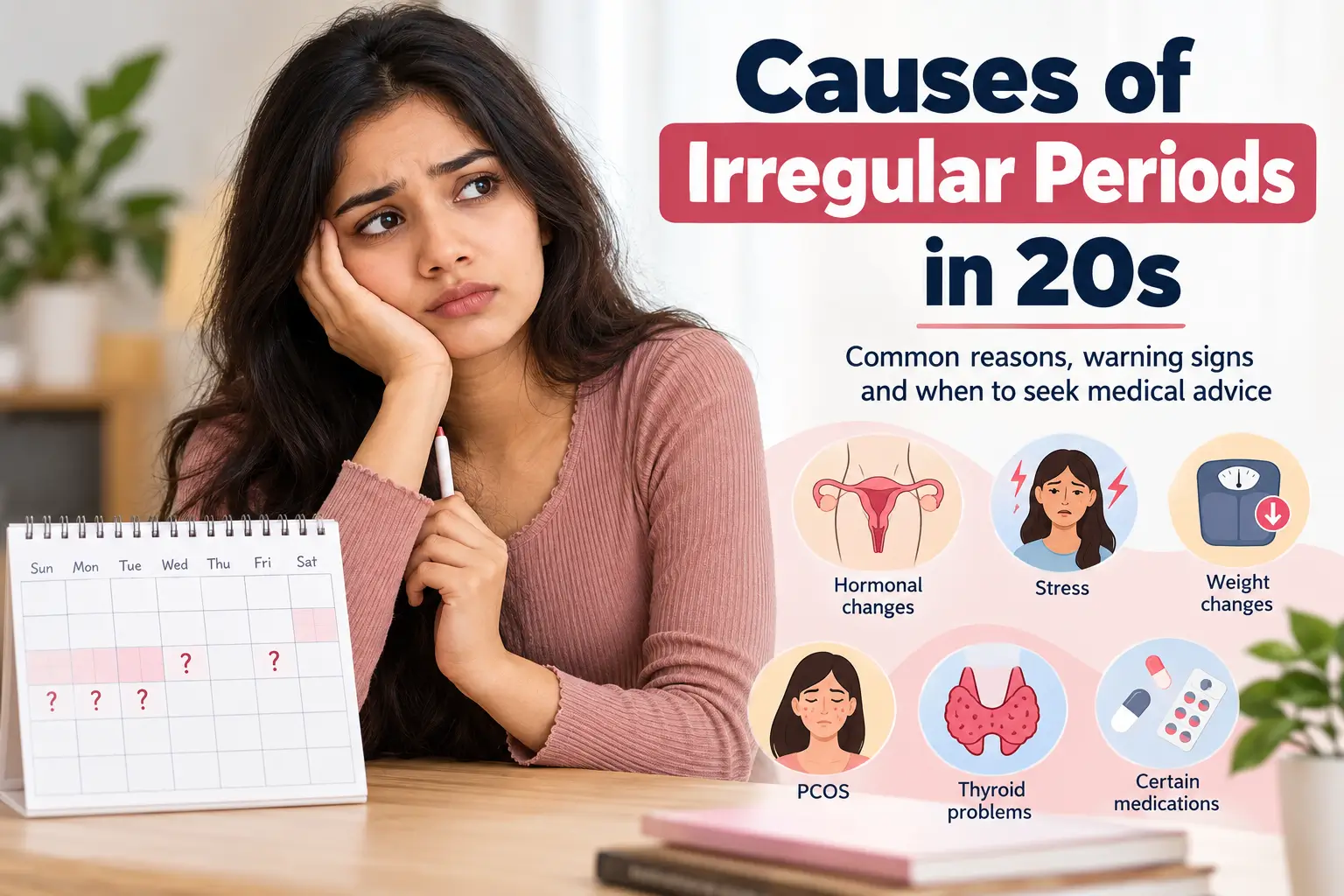
The causes of irregular periods in your 20s range from relatively temporary factors such as stress, changes in weight or intense exercise to conditions that need medical evaluation, including polycystic ovary syndrome (PCOS), thyroid disorders and elevated prolactin. Pregnancy should also be considered whenever it is biologically possible.
For adults more than three years after their first period, the 2023 international PCOS guideline defines irregular cycles as those occurring less than every 21 days, more than 35 days apart, or fewer than eight times a year. A single unusual cycle does not automatically mean that something is wrong. The pattern over time and accompanying symptoms matter.
Important: Irregular periods are a symptom, not a diagnosis. PCOS is one possible explanation, but it is not the explanation for every irregular cycle.
What counts as an irregular period?
It helps to distinguish an occasional variation from a persistent pattern.
For many adults, menstrual cycles commonly fall within roughly 21–35 days, although individual variation exists. A period itself commonly lasts up to seven days.
The cycle is counted from the first day of bleeding to the first day of the next period.
For someone several years beyond their first period, a pattern may be considered irregular when cycles repeatedly:
- occur less than 21 days apart
- occur more than 35 days apart
- occur fewer than eight times in a year
- occasionally stretch beyond 90 days
- become substantially different from the person’s established pattern
The 2023 international PCOS guideline uses these thresholds when assessing ovulatory dysfunction, but having an irregular cycle does not by itself diagnose PCOS.
There is another important distinction: cycle irregularity and abnormal bleeding are not exactly the same thing. Spotting between periods, bleeding after sex, very heavy bleeding or bleeding lasting longer than seven days may require a different evaluation.
The most common causes of irregular periods in your 20s
There is no single cause that explains every irregular cycle. The useful question is not simply, “Which hormone is imbalanced?” but rather, “What has changed, and what other symptoms are happening at the same time?”
1. Pregnancy
If pregnancy is possible, it should be considered before assuming that a late or missed period is caused by stress, PCOS or another hormonal problem.
A missed period can be an early sign of pregnancy. A pregnancy test is therefore often one of the first practical steps when someone who could become pregnant develops an unexpectedly late or absent period.
This remains relevant even when cycles are normally irregular.
Practical clue:
If you are sexually active and your period is unexpectedly late, testing for pregnancy is generally more useful than trying to identify a “hormonal imbalance” from symptoms alone.
2. Stress and major psychological strain
Stress can affect the brain-hormone system involved in ovulation.
Severe or prolonged stress can interfere with the hypothalamic-pituitary-ovarian system, potentially delaying or suppressing ovulation. When ovulation is disrupted, periods may become infrequent or disappear temporarily.
This can happen during periods of:
- significant academic or work pressure
- major emotional distress
- substantial sleep disruption
- difficult life events
- persistent anxiety
- major changes in daily routine
However, “stress” should not become a catch-all explanation.
If your periods remain irregular for months, it is reasonable to investigate other causes rather than assuming stress is responsible.
3. Significant weight loss or inadequate energy intake
The body needs adequate energy availability for normal reproductive function.
Rapid weight loss, restrictive eating, eating disorders or consuming too little energy relative to physical demands can interfere with the hormonal signals required for ovulation. Excessive exercise can contribute to the same problem, particularly when energy intake does not meet energy expenditure.
This is sometimes associated with functional hypothalamic amenorrhea, in which menstrual function is disrupted because the brain reduces reproductive hormonal signaling.
It is particularly worth considering when irregular or absent periods occur alongside:
- recent substantial weight loss
- restrictive dieting
- very intensive exercise
- low energy availability
- eating-disorder symptoms
- significant psychological stress
The Endocrine Society recommends treating the underlying energy imbalance rather than simply attempting to make bleeding occur with hormonal medication.
4. Weight gain or obesity
Weight changes can also affect menstrual function.
Higher body weight can be associated with menstrual irregularity, including through effects on ovulation and metabolic health. But it is important not to oversimplify this relationship.
Being overweight does not prove that PCOS is present, and being at a lower body weight does not rule PCOS out.
Someone with irregular periods should therefore not be told simply to “lose weight” without considering the underlying cause.
5. Polycystic ovary syndrome (PCOS)
PCOS is one of the most important causes to consider in a woman in her 20s with persistent irregular periods.
According to the World Health Organization, PCOS is a common hormonal disorder associated with irregular menstrual periods, abnormal ovulation, excess facial or body hair, acne and fertility problems.
Possible clues include:
- consistently long or skipped cycles
- excess facial or body hair
- persistent acne or oily skin
- scalp hair thinning
- difficulty becoming pregnant
- metabolic abnormalities
But PCOS does not look identical in every person.
A woman can have PCOS without obvious obesity, and the presence of acne or an occasional irregular period does not automatically mean PCOS.
How is PCOS diagnosed?
The diagnosis requires a broader assessment.
In adults, the international guideline considers combinations of:
- ovulatory dysfunction/irregular menstrual cycles
- clinical or biochemical hyperandrogenism
- polycystic ovarian morphology on ultrasound or, under current guidance, an appropriate alternative assessment such as AMH in adults
Other causes need to be considered and excluded where appropriate.
This is why an ultrasound showing “multiple follicles” should not automatically be interpreted as “you have PCOS.”
6. Thyroid disorders
Both an underactive thyroid (hypothyroidism) and an overactive thyroid (hyperthyroidism) can interfere with menstrual function.
Thyroid-related menstrual changes may occur alongside other symptoms, such as:
- unusual tiredness
- sensitivity to cold or heat
- changes in weight
- changes in heart rate
- changes in bowel habits
- changes in hair or skin
But symptoms are not reliable enough to diagnose a thyroid disorder by themselves.
The American Society for Reproductive Medicine notes that thyroid-stimulating hormone (TSH) testing is an important part of the evaluation of menstrual abnormalities because thyroid disorders can cause chronic anovulation or absent periods.
7. Elevated prolactin
Prolactin is a hormone involved in breast milk production. When prolactin levels are abnormally high outside appropriate circumstances, reproductive hormone signaling can be disrupted.
This can contribute to irregular or absent periods.
Possible clues include:
- irregular or absent periods
- unexpected breast-milk discharge when not breastfeeding
- headaches
- visual changes in some cases
Not everyone with elevated prolactin has all of these symptoms.
If the clinical picture suggests this possibility, a healthcare professional may order a prolactin blood test. Prolactin measurement is part of the initial evaluation of amenorrhea in appropriate patients.
8. Hormonal contraception
Hormonal contraception can alter bleeding patterns.
Depending on the method, a person may experience:
- lighter bleeding
- spotting
- irregular bleeding
- fewer periods
- no bleeding
Methods that can influence bleeding include hormonal pills, injections, implants and hormonal intrauterine systems.
This is important because bleeding while using hormonal contraception does not always represent a naturally occurring menstrual cycle.
If your pattern changed after starting, stopping or changing contraception, tell your healthcare professional exactly which method you use and when you started or stopped it.
9. Very intense exercise
Exercise itself is not a problem for menstrual health. In fact, regular physical activity is generally beneficial.
The concern is excessive training combined with inadequate energy availability, especially when accompanied by weight loss or restrictive eating.
This can suppress reproductive hormone signaling and lead to delayed or absent periods.
A useful distinction is:
Exercise is not automatically the cause. The combination of training load, nutrition, energy availability, body changes and individual physiology matters.
10. Eating disorders and restrictive dieting
Eating disorders can significantly affect menstrual function.
Conditions involving severe restriction, inadequate energy intake or substantial weight loss can suppress ovulation and menstrual cycles. This is medically important rather than merely a “period problem.” Prolonged hypothalamic suppression can also have consequences for bone health.
If irregular periods occur alongside fear of weight gain, severe food restriction, binge-purge behaviours or compulsive exercise, professional help is appropriate.
11. Certain medications
Some medicines can affect menstrual patterns.
The relevant medication list depends on the individual. Examples reported by the National Institute of Child Health and Human Development include some medicines used for epilepsy or mental-health conditions. Hormonal medications and contraceptives can also alter bleeding patterns.
Do not stop a prescribed medicine because your periods have changed.
Instead, tell the prescribing clinician about the menstrual change and ask whether the medication could contribute.
12. Other endocrine or metabolic conditions
Less common causes can include disorders affecting the adrenal glands, poorly controlled diabetes and other endocrine conditions.
For example, late-onset congenital adrenal hyperplasia and Cushing syndrome can affect reproductive hormone function. These are not the first explanation for every irregular period, but they may enter the differential diagnosis when the symptoms and examination point in that direction.
This is one reason self-diagnosing from an online list of symptoms can be misleading.
13. Primary ovarian insufficiency
Primary ovarian insufficiency (POI) occurs when ovarian function declines before age 40.
It is different from ordinary menstrual variation and should be evaluated medically.
Possible clues include:
- increasingly irregular periods
- prolonged gaps between periods
- hot flashes or night sweats
- vaginal dryness
- difficulty becoming pregnant
The presence of these symptoms does not establish POI, but persistent menstrual changes combined with menopausal-type symptoms deserve medical assessment.
14. Uterine or pelvic conditions
Not every period problem is caused by hormones.
Conditions affecting the uterus or pelvis can cause abnormal bleeding or pain. Examples include:
- fibroids
- endometrial polyps
- adenomyosis
- endometriosis
- pelvic infections
These conditions may be more strongly suspected when irregular bleeding occurs alongside heavy bleeding, pelvic pain, pain during sex or other symptoms.
A practical way to think about irregular periods
Instead of asking only “What causes irregular periods?”, look at the pattern.
| What you notice | Possible clues | What to do |
|---|---|---|
| Period suddenly late after sex | Pregnancy is possible | Consider a pregnancy test |
| Cycles repeatedly >35 days | Ovulation may be irregular; PCOS is one possibility | Discuss persistent pattern with a clinician |
| Irregular periods + facial hair/acne | Possible androgen excess/PCOS | Consider medical evaluation |
| Irregular periods + tiredness/temperature sensitivity | Thyroid disorder is one possibility | Ask about thyroid evaluation |
| Periods stopped after major weight loss or intense training | Low energy availability/hypothalamic suppression | Review nutrition, training and health with a professional |
| Irregular bleeding after starting contraception | Contraceptive-related bleeding is possible | Check the specific method and seek advice if persistent or concerning |
| Missed periods + breast discharge | Elevated prolactin is one possibility | Medical evaluation may include prolactin testing |
| Heavy bleeding + dizziness/fainting | Significant blood loss may be occurring | Prompt medical attention |
| Missed period + abdominal/pelvic pain + bleeding | Pregnancy complication, including ectopic pregnancy, must be considered | Urgent medical assessment |
This table is a starting framework, not a diagnostic tool.
Does having irregular periods mean you have PCOS?
No.
PCOS is important, particularly when irregular cycles are persistent, but irregular periods have many possible causes.
The distinction matters because treating every irregular cycle as PCOS can lead to unnecessary anxiety and potentially inappropriate testing or treatment.
Conversely, assuming that irregular periods are “just stress” can delay evaluation of PCOS, thyroid disease, hyperprolactinemia or another condition.
The 2023 international PCOS guideline specifically requires assessment within an appropriate diagnostic framework rather than diagnosing PCOS from menstrual irregularity alone.
When should you see a doctor about irregular periods?
Consider arranging a medical evaluation if:
- your previously regular periods have become persistently irregular
- cycles repeatedly occur less than 21 or more than 35 days apart
- you go around three months without a period and are not pregnant
- bleeding lasts longer than seven days
- you have bleeding between periods
- you bleed after sex
- periods have become unusually heavy
- irregular periods occur with significant pelvic pain
- you have new facial hair growth, severe acne or scalp hair thinning
- you have unexplained major weight change
- you have symptoms suggesting a thyroid problem
- you are having difficulty becoming pregnant
ACOG and NHS guidance both recommend evaluation when menstrual patterns become abnormal or change substantially.
When is irregular bleeding an emergency?
Seek urgent medical care if bleeding is very heavy and you are becoming dizzy, faint, weak or short of breath.
ACOG considers bleeding that soaks through a pad or tampon every hour as abnormal heavy bleeding, particularly when associated with symptoms such as dizziness or light-headedness.
There is another important situation: a missed period followed by unusual bleeding and abdominal or pelvic pain when pregnancy is possible.
This can be a warning sign of an ectopic pregnancy, which requires urgent assessment.
Severe or rapidly worsening pelvic pain should not simply be attributed to an “irregular period.”
What tests might a doctor consider?
There is no universal “irregular period test package.”
The evaluation depends on your age, menstrual history, symptoms, pregnancy possibility, medications, weight changes, exercise, examination and reproductive goals.
Depending on the situation, a clinician may consider:
Pregnancy testing
This is particularly relevant when pregnancy is possible and a period is late or absent.
Thyroid testing
TSH is commonly considered because thyroid disorders can disrupt menstrual function.
Prolactin
This may be appropriate when the menstrual pattern or symptoms suggest hyperprolactinemia.
Reproductive hormone testing
Depending on the clinical picture, testing may include hormones such as FSH and estradiol. The appropriate tests and timing depend on what condition the clinician is investigating.
Androgen assessment
When PCOS or another androgen-related disorder is suspected, clinicians may assess androgen levels and look for clinical signs of androgen excess.
Ultrasound
A pelvic ultrasound may be useful in selected situations, but it is not automatically necessary for every person with an irregular cycle.
The key point is that more tests do not automatically mean better care. The right tests are those that address plausible causes based on the person’s history and examination.
What should you track before an appointment?
A simple menstrual record can make a medical consultation much more useful.
For at least several cycles, record:
- first day of each period
- number of days of bleeding
- unusually heavy days
- spotting between periods
- significant pain
- medications and contraception
- major weight changes
- major changes in exercise
- significant stress or sleep disruption
- acne or increased facial/body hair
- unusual breast discharge
- pregnancy possibility
Period tracking is recommended as a practical way to identify patterns.
You do not need an expensive app. A calendar or simple note on your phone is enough.
What you should not do
Irregular periods can make people search for quick “hormone-balancing” solutions. Be cautious with claims that promise to fix your cycle through one supplement, detox, herb or restrictive diet.
Avoid:
- taking hormones without medical guidance
- starting supplements solely because they are marketed for “hormonal balance”
- crash dieting to regulate your cycle
- dramatically increasing exercise because you think it will fix PCOS
- stopping prescribed medication without speaking to the prescriber
- assuming every irregular period is PCOS
- assuming every irregular period is caused by stress
- delaying evaluation of persistent or worsening symptoms
The appropriate treatment depends on the cause.
A simple decision framework
If your period is irregular, ask yourself these five questions:
1. Could I be pregnant?
If yes, pregnancy testing may be the first practical step.
2. Has something changed recently?
Think about stress, weight, diet, exercise, sleep, contraception or medication.
3. Has the pattern persisted?
One unusual cycle is different from repeated irregular cycles.
4. Are there additional symptoms?
Acne, excess facial hair, hair thinning, breast discharge, thyroid-type symptoms, pelvic pain or unusual bleeding can change the evaluation.
5. Are there warning signs?
Very heavy bleeding, fainting/dizziness, severe pelvic pain or pregnancy-associated bleeding requires more urgent attention.
This framework does not replace medical assessment, but it can help you describe the problem clearly.
Can irregular periods affect fertility?
They can, depending on the cause.
A person with irregular cycles may not ovulate predictably, which can make conception more difficult because identifying the fertile window becomes harder. PCOS, hypothalamic suppression and several other conditions can affect ovulation.
Importantly, irregular periods do not automatically mean infertility.
If pregnancy is desired and cycles are persistently irregular, discussing the situation with a qualified healthcare professional is more useful than relying only on calendar-based predictions of ovulation.
The key takeaway
There are many possible causes of irregular periods in your 20s.
The common possibilities include pregnancy, stress, substantial weight change, inadequate energy intake, intense exercise, hormonal contraception, PCOS, thyroid disorders and elevated prolactin. Less common endocrine, ovarian, uterine and other medical conditions can also cause menstrual changes.
The most useful distinction is between an occasional variation and a persistent change in your usual menstrual pattern.
If your cycles repeatedly fall outside the expected range, disappear for months, become very heavy, or change alongside other symptoms, it is worth getting evaluated rather than trying to diagnose the cause yourself.
And while PCOS deserves attention in this age group, an irregular period is not synonymous with PCOS.
Disclaimer: This article is for general health education and is not a diagnosis or substitute for individualized medical care. Menstrual changes can have different causes, and appropriate testing depends on the individual. If you have persistent irregular periods, very heavy bleeding, severe pain, possible pregnancy, or other concerning symptoms, consult a qualified healthcare professional.
FAQ
1. Is it normal to have irregular periods in your 20s?
An occasional variation can happen, but persistent irregularity should not automatically be considered normal. For adults more than three years beyond their first period, cycles repeatedly shorter than 21 days or longer than 35 days are considered irregular under the international PCOS guideline.
2. What is the most common cause of irregular periods in your 20s?
There is no single cause that applies to everyone. PCOS is an important cause, but pregnancy, stress, significant weight or energy changes, intense exercise, hormonal contraception, thyroid disorders and other conditions can also cause irregular cycles.
3. Do irregular periods always mean PCOS?
No. PCOS requires a broader diagnostic assessment, and other causes need to be considered. Irregular periods alone do not establish a PCOS diagnosis.
4. Can stress make your period irregular?
Yes. Significant or prolonged stress can interfere with the hormonal system responsible for ovulation and may lead to delayed or absent periods. Persistent irregularity should still be evaluated rather than automatically blamed on stress.
5. Can thyroid problems cause irregular periods?
Yes. Both an underactive and overactive thyroid can interfere with normal reproductive hormone function and menstrual cycles. TSH testing is commonly considered during evaluation of menstrual abnormalities.
6. Should I take a pregnancy test if my period is late?
If pregnancy is biologically possible, it is reasonable to consider a pregnancy test rather than assuming that the delay is caused by stress or hormones.
7. When should irregular periods be checked by a doctor?
Seek medical evaluation for persistent irregular cycles, periods that repeatedly occur outside the expected range, prolonged absence of periods, unusually heavy bleeding, bleeding between periods, significant pelvic pain or other new symptoms.
8. Can irregular periods make it harder to become pregnant?
They can if the underlying cause disrupts ovulation. Irregular cycles can also make it more difficult to predict the fertile window. However, irregular periods do not automatically mean infertility.