
If you want to build muscle, protein matters—but simply eating as much protein as possible is not the goal.
Muscle growth is the result of several things working together: resistance training, adequate protein, enough overall energy, recovery and consistency. Protein supplies the amino acids your body uses to build and repair muscle tissue, while training provides the stimulus that tells the body to adapt.
For healthy adults doing resistance training, research suggests that increasing protein intake can provide additional gains in lean mass and strength, with benefits tending to level off around 1.6 g of protein per kilogram of body weight per day in the available evidence. That is a useful evidence-based reference point, not a mandatory target for every person.
Quick Answer
A practical muscle-gain diet should contain a protein source at most main meals, along with enough carbohydrates, fats, fruits and vegetables to meet your overall nutritional and energy needs.
For a person who regularly performs resistance training, a daily protein intake around 1.6 g/kg body weight is a reasonable evidence-based reference point. For example, someone weighing 60 kg would reach this amount at about 96 g protein per day. But individual needs can differ, and reaching 1.6 g/kg is not a requirement for everyone to make progress.
India’s ICMR-NIN recommends 0.83 g/kg/day as the protein RDA for healthy Indian adults. That figure is designed to cover basic nutritional requirements; it should not be confused with the higher intake sometimes used when discussing optimization of muscle gain during resistance training.
Disclaimer: This article provides general nutrition and fitness education, not individualized medical or dietetic advice. Protein requirements can change with body size, age, pregnancy, medical conditions, kidney function, training demands and other factors.
Protein Requirement vs Muscle-Gain Target: They Are Not the Same
One of the most common sources of confusion is the difference between a recommended dietary allowance and an intake studied for a particular performance or muscle-building goal.
ICMR-NIN’s 0.83 g/kg/day recommendation is intended for healthy Indian adults generally. Someone who weighs 70 kg would therefore have a basic protein RDA of about 58 g per day.
That does not mean 58 g is the optimal amount for maximizing muscle growth during a structured resistance-training program.
A large systematic review and meta-analysis of 49 studies involving 1,863 participants found that protein supplementation during prolonged resistance training improved measures including fat-free mass and strength. The analysis identified approximately 1.62 g/kg/day as the point beyond which additional protein did not produce further average gains in fat-free mass.
This does not mean:
“Everyone who goes to the gym needs exactly 1.6 g/kg.”
It means that, across the studied resistance-training populations, substantially increasing protein above that level did not appear to provide additional average muscle-mass benefit.
An illustrative calculation
| Body weight | 1.6 g/kg protein |
|---|---|
| 50 kg | 80 g/day |
| 60 kg | 96 g/day |
| 70 kg | 112 g/day |
| 80 kg | 128 g/day |
| 90 kg | 144 g/day |
These are planning examples, not prescriptions.
If you have obesity, a very high body weight, low body weight, a medical condition or a specialized athletic goal, simply multiplying current body weight by 1.6 may not be the most appropriate way to determine your protein target.
What Should a Protein-Rich Indian Diet Actually Look Like?
A muscle-building diet does not need to look like a bodybuilding meal plan.
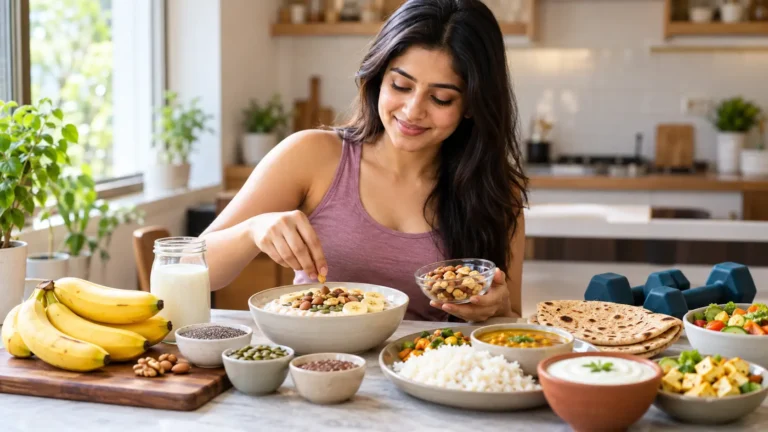
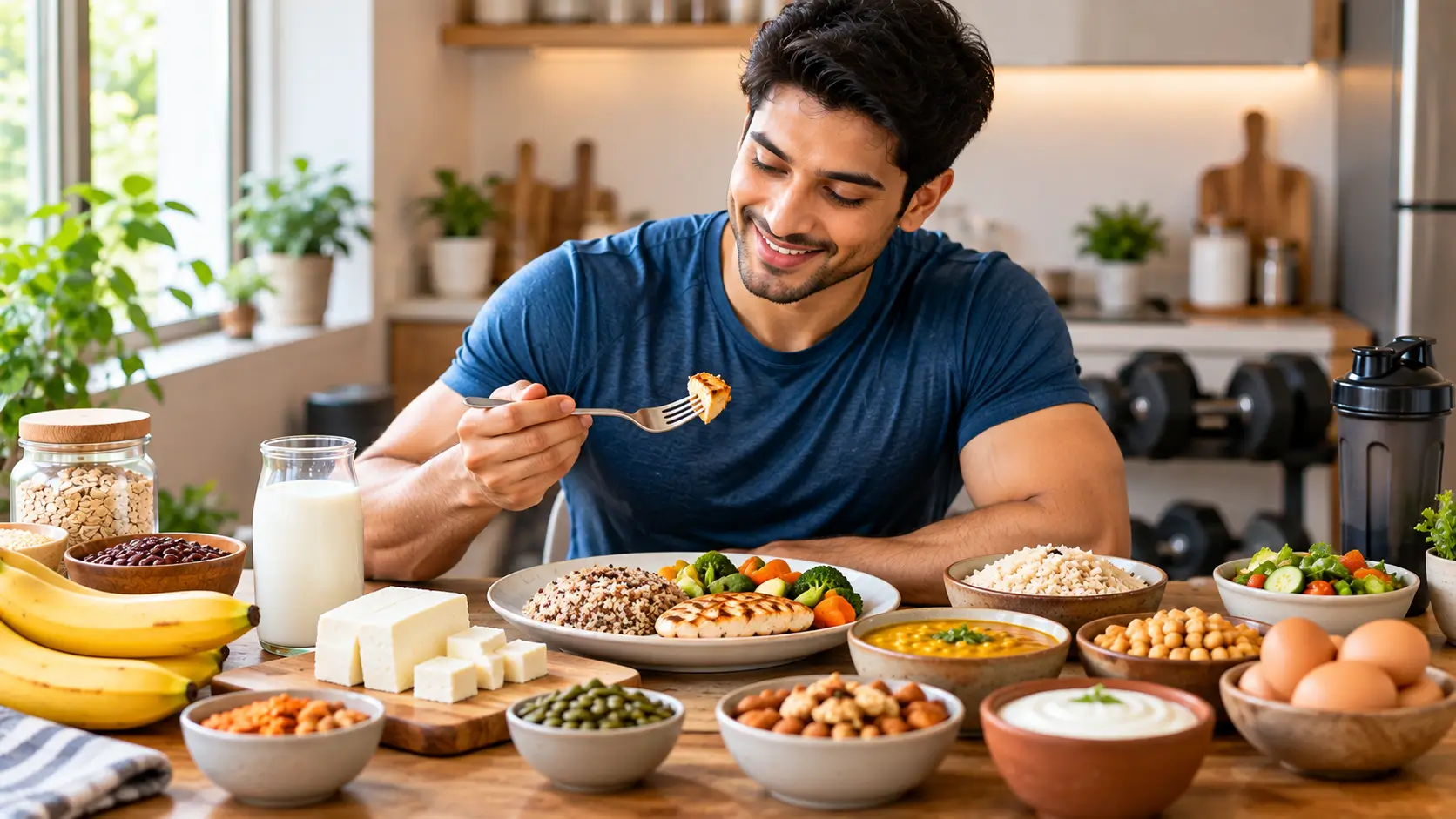
Indian diets already contain many useful protein sources:
| Food group | Examples |
|---|---|
| Pulses | Dal, moong, masoor, urad |
| Legumes | Rajma, chana, chickpeas, peas |
| Soy foods | Soy chunks, tofu, tempeh, soy milk |
| Dairy | Milk, curd, paneer |
| Eggs | Whole eggs, egg-based meals |
| Fish | Fish and other seafood |
| Meat | Chicken and other lean meat |
| Nuts/seeds | Peanuts, almonds, pumpkin seeds, sesame |
| Grains | Oats, wheat, rice and other grains |
ICMR-NIN’s dietary guidance emphasizes that protein can come from both plant and animal sources. It also highlights pulses, beans, soybeans, eggs, milk, meat, fish, nuts and seeds as protein sources and describes combinations of cereals and pulses as useful in vegetarian and vegan diets.
The practical lesson is simple: build meals around protein rather than trying to turn the entire diet into protein.
A Better Muscle-Gain Plate
Instead of asking, “What is the highest-protein food?”
Ask:
What does this meal need to support training and recovery?
A useful meal structure is:
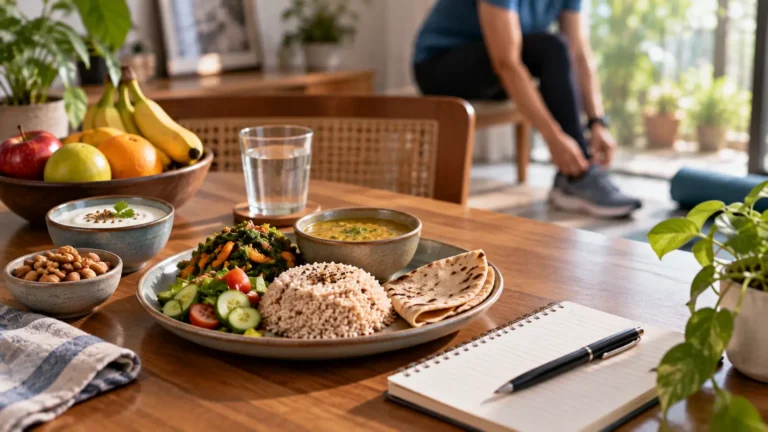
Protein source + carbohydrate source + vegetables/fruit + appropriate fat
For example:
Breakfast:
Oats + milk/curd + fruit + nuts
Lunch:
Rice or roti + dal/rajma + vegetables + curd
Snack:
Milk or curd + roasted chana/soy + fruit
Dinner:
Roti/rice + paneer/tofu/eggs/fish/chicken + vegetables
This approach matters because protein is only one component of a muscle-building diet. Carbohydrates can provide fuel for training, while dietary fats contribute energy and essential fatty acids.
Do You Need Protein at Every Meal?
You do not need to make every meal extremely high in protein.
However, spreading protein-containing foods across the day can be a practical way to reach your total intake without forcing a very large amount into dinner.
Evidence on protein distribution is less definitive than the evidence for total daily protein. A systematic review found some association between more even protein distribution and muscle mass, but concluded that evidence was insufficient to establish clear effects on muscle strength or protein turnover.
So there is no need to become obsessed with a precise “protein window.”
A better priority order is:
- Meet an appropriate total daily protein intake.
- Include a meaningful protein source in several meals.
- Make the overall diet adequate in energy and nutrients.
- Train consistently.
Plant Protein vs Animal Protein
You do not need meat or whey protein to build muscle.
Animal proteins such as milk, curd, eggs, fish and meat can provide all essential amino acids in useful amounts. Plant sources such as soy, beans, lentils, peas, nuts and seeds also contribute protein.
Recent research comparing plant and animal protein is more nuanced than the common claim that one category is automatically “better.”
A 2025 systematic review and meta-analysis of randomized trials found a small advantage for animal protein for muscle mass in some comparisons, particularly versus non-soy plant proteins, but no significant pooled difference in muscle strength. The authors also found no significant difference between soy and milk protein for muscle mass.
A separate long-term 2026 meta-analysis found no significant differences in body composition, strength or physical performance between plant- and animal-protein supplementation when adequate protein was consumed over time.
That means a vegetarian or vegan muscle-building diet should focus on adequate quantity, variety and practical food combinations, rather than assuming plant protein cannot support muscle development.
Five Practical Indian Protein Combinations
Rather than memorizing a huge list of foods, use combinations that fit ordinary meals.
1. Dal + rice
This is inexpensive, familiar and easy to scale.
Add curd or another protein source if your meal needs more protein.
2. Rajma + rice
Rajma provides protein along with carbohydrate, fiber and other nutrients. It works well as part of a balanced meal rather than as a standalone “muscle food.”
3. Paneer/tofu + roti
This combination works particularly well for vegetarian meals.
Choose the portion according to your overall energy and protein needs rather than assuming that more paneer is automatically better.
4. Eggs + roti or oats
Eggs provide a concentrated source of protein and can be used at breakfast or another meal.
5. Soy + grain + vegetables
Soy chunks, tofu or other soy foods can provide substantial protein while fitting vegetarian and vegan eating patterns.
What Does a High-Protein Day Actually Look Like?
Consider this illustrative structure, rather than a personalized prescription:
| Meal | Example |
|---|---|
| Breakfast | Oats + milk/curd + fruit + nuts |
| Lunch | Dal + rice/roti + vegetables + curd |
| Snack | Roasted chana + milk/soy milk |
| Dinner | Paneer/tofu/eggs/fish/chicken + roti/rice + vegetables |
The exact protein total depends on serving sizes.
That distinction matters because saying “eat paneer, dal and eggs” does not tell you how much protein the entire day actually contains.
If you have a specific protein target, check food labels where available and use a reliable Indian food-composition reference rather than guessing.
Can Protein Alone Build Muscle?
No.
This is probably the most important misconception to correct.
Protein provides the raw materials for muscle protein synthesis, but resistance training supplies the primary stimulus for muscular adaptation.
A systematic review and meta-analysis focused specifically on healthy adult women found that resistance training produced substantial improvements in muscular strength and a moderate effect on muscular hypertrophy.
Protein without an appropriate training stimulus is therefore not equivalent to a muscle-building program.
Think of muscle gain as a system:
Resistance training → stimulus
Protein → building materials
Carbohydrates and fats → energy and other nutritional roles
Sleep/recovery → time for adaptation
Consistency → repeated stimulus over time
Removing one component can make the overall plan less effective.
Do You Need Whey Protein?
Not necessarily.
Whey is a convenient protein source, not a requirement for muscle gain.
If someone can comfortably obtain enough protein from milk, curd, paneer, eggs, soy, dal, beans, fish, chicken and other foods, there may be no nutritional need to add whey simply because they started going to the gym.
Protein supplements can be useful when convenience makes it difficult to meet a protein target through food. Research supports protein supplementation as an option that can augment resistance-training adaptations, particularly when total protein intake would otherwise be inadequate.
But the sequence should be:
Diet first → identify the gap → use a supplement if genuinely useful.
Not:
Buy supplement → try to build the diet around it.
ICMR-NIN’s 2024 Dietary Guidelines also caution against assuming that protein supplements added to an already adequate balanced diet will automatically build more muscle.
What About Protein Timing?
You may have heard that you must consume protein within a very short period after training.
The evidence does not support treating this as a magical deadline.
A 2023 network meta-analysis of 116 trials found some benefits associated with post-exercise protein supplementation for muscle-related outcomes, but the broader evidence suggests that overall protein intake and adequate nutrition matter more than obsessing over a narrow timing window.
A practical approach is simply to have a protein-containing meal or snack around your training schedule when convenient.
There is no need to panic if you cannot drink a shake immediately after your final set.
Common Mistakes With High-Protein Diets
Mistake 1: Treating more protein as automatically better
Once protein intake is already adequate, continually adding more is unlikely to produce proportionally more muscle.
Mistake 2: Forgetting total calories
If you train hard but consistently under-eat, protein alone cannot solve the problem.
Mistake 3: Removing carbohydrates
Rice, roti, oats, potatoes, fruit and other carbohydrate-containing foods can fit into a muscle-building diet.
Mistake 4: Relying entirely on protein powder
A shake does not replace the broader nutritional value of a varied diet.
Mistake 5: Ignoring resistance training
A high-protein diet without an appropriate training stimulus is not a substitute for strength training.
Mistake 6: Copying another person’s protein target
A 50 kg beginner and a 90 kg strength athlete do not automatically have the same protein requirements.
Who Should Be Careful With a High-Protein Diet?
People with chronic kidney disease should not simply adopt a high-protein muscle-building diet without individualized guidance.
Kidney disease changes protein requirements depending on disease stage and whether a person is receiving dialysis. KDIGO recommends different protein strategies for people with CKD, while the National Kidney Foundation advises people with kidney disease to obtain individualized protein guidance.
Professional advice is also appropriate if you are:
- pregnant or breastfeeding
- significantly underweight or malnourished
- living with significant liver or kidney disease
- following a medically prescribed diet
- recovering from major illness or surgery
- concerned about restrictive or disordered eating
A higher protein target should not override a medically prescribed dietary plan.
The Practical Protein Checklist
Before changing your diet, ask:
1. Do I actually need more protein?
Estimate your current intake before assuming it is low.
2. Am I resistance training consistently?
Protein works alongside an appropriate training stimulus.
3. Am I eating enough overall?
Muscle building is not just a protein problem.
4. Can ordinary food meet my target?
For many people, it can.
5. Is my protein target appropriate for my body and health?
Do not copy another person’s number.
6. Am I neglecting carbohydrates, fats, fruit and vegetables?
A muscle-building diet still needs to be a balanced diet.
7. Do I have a medical condition that changes my protein needs?
If yes, obtain individualized guidance.
Practical Takeaway
A protein-rich diet for muscle gain is not simply a diet containing the largest possible amount of protein.
For a healthy adult who resistance trains, research suggests that around 1.6 g/kg/day is a useful evidence-based reference point for maximizing average muscle-related benefits, although individual requirements vary and lower intakes can still support progress.
In India, you can build a high-protein diet from ordinary foods such as dal, rajma, chana, soy, paneer, curd, milk, eggs, fish, chicken, nuts and seeds. ICMR-NIN guidance emphasizes dietary variety and combinations of protein-containing foods rather than dependence on supplements.
The bigger picture matters:
Adequate protein + progressive resistance training + sufficient energy + balanced nutrition + recovery = a sensible foundation for muscle gain.
Protein is important. It just does not have to become the entire diet.
FAQ
How much protein do I need for muscle gain?
For healthy adults performing resistance training, research suggests that around 1.6 g/kg/day is a useful reference point for maximizing average muscle-related benefits. It is not a universal prescription, and individual needs vary.
What are the best protein-rich foods for muscle gain in India?
Useful options include dal, rajma, chana, soy, paneer, curd, milk, eggs, fish, chicken, nuts and seeds. The best choices are the ones that help you consistently meet your protein needs within a balanced diet.
Can vegetarians build muscle without whey protein?
Yes. Vegetarian diets can provide substantial protein through dairy, soy, pulses, beans, legumes, nuts and seeds. A well-planned diet does not inherently require whey.
Is 80 g of protein enough for muscle gain?
It depends on body weight and training. For example, 80 g represents about 1.33 g/kg for a 60 kg person but only 0.89 g/kg for a 90 kg person. A fixed number therefore cannot be considered universally optimal.
Do I need protein immediately after a workout?
No narrow post-workout deadline needs to dominate your diet. Having protein around training can be convenient, but total daily intake and overall nutrition are more important than obsessing over a short “anabolic window.”
Can I build muscle by eating more protein without exercising?
Protein alone is not a substitute for resistance training. Muscle hypertrophy requires an appropriate training stimulus in addition to adequate nutrition.
Is a high-protein diet safe for everyone?
No. Protein requirements vary with health status. People with chronic kidney disease, in particular, should not independently adopt a high-protein diet without individualized guidance.
Is plant protein as good as animal protein for muscle gain?
The evidence is nuanced. Some analyses find a small advantage for animal protein for certain muscle-mass outcomes, particularly compared with non-soy plant proteins, while other long-term evidence finds no meaningful difference when adequate protein is consumed.