
Have you ever driven along a familiar road and reached your destination without consciously thinking about every turn? Or did you find yourself reacting emotionally to a situation before you had time to understand why?
These experiences illustrate an interesting feature of human psychology: not everything your brain processes enters your conscious awareness.
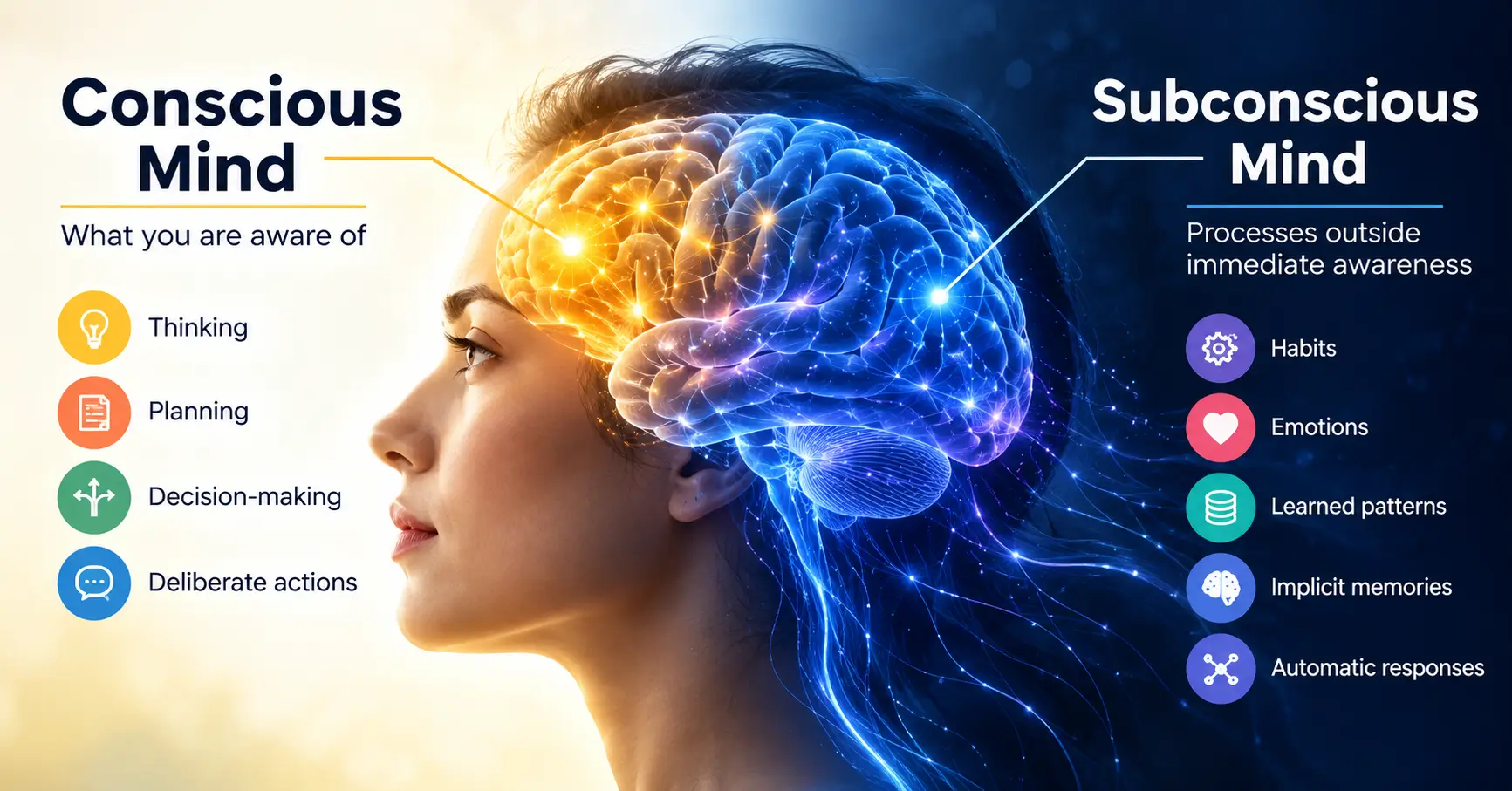
The conscious mind refers to the thoughts, feelings, perceptions and experiences you are aware of at a particular moment. The term subconscious mind is commonly used in everyday language to describe mental processes outside immediate awareness, including automatic responses, learned associations and certain memory processes.
However, psychology and neuroscience use more precise terms, such as unconscious processing, nonconscious cognition, implicit memory and automatic processing.
The conscious and subconscious mind are therefore better understood as simplified descriptions of different aspects of mental processing rather than two physically separate parts of the brain.
Understanding this distinction can help explain everyday habits, emotional reactions, attention, memory and decision-making without relying on exaggerated claims about the power of the subconscious.
Health and psychology information: This article is for general education. It does not diagnose psychological conditions or replace assessment or treatment from a qualified mental health professional.
What Is the Conscious Mind?
The conscious mind refers to the part of mental experience that you are aware of at a given moment.
When you read a sentence, solve a mathematics problem, decide what to eat or deliberately remember someone’s name, you are using conscious awareness.
Conscious experience includes more than logical thinking. It can also involve emotions, physical sensations, memories, imagination and awareness of your surroundings.
For example, imagine that you are sitting at your desk and preparing for an examination.
You may consciously:
- Read and understand a chapter.
- Decide which topic to study next.
- Calculate how much time remains.
- Notice that you are feeling tired.
- Remember information from a previous lesson.
- Choose to take a short break.
These experiences involve information that is available to your awareness.
Main characteristics of conscious thinking
1. Awareness
You can recognise and report what you are thinking, feeling or experiencing.
For example, you know that you are reading this article and can describe what you understand.
2. Deliberate attention
You can intentionally direct your attention towards something.
For example, when studying, you may decide to concentrate on a difficult paragraph instead of checking your phone.
3. Reasoning and planning
Conscious thought supports activities such as comparing alternatives, planning future actions and solving unfamiliar problems.
4. Self-reflection
You can examine your own thoughts and behaviour.
For example, after becoming irritated during a conversation, you might ask yourself why you reacted that way.
5. Working with information
Conscious awareness helps you hold and manipulate information temporarily.
For example, remembering a telephone number long enough to enter it involves working memory.
However, conscious attention has limitations. Trying to concentrate on several demanding tasks simultaneously can make performance more difficult.
Research into conscious processing also examines how attention, working memory and neural communication contribute to conscious awareness.
What Is the Subconscious Mind?
The subconscious mind is a familiar term used to describe mental activities that occur outside immediate conscious awareness.
In everyday conversation, people often use it to explain automatic habits, learned reactions, emotional associations and information that influences behaviour without deliberate thought.
In scientific psychology, however, researchers generally use more specific terms depending on the process being studied.
For example:
- Nonconscious processing: Information processing that is not available to conscious awareness or reporting.
- Implicit memory: Previous learning that influences behaviour without requiring deliberate recollection.
- Automatic processing: Mental activity that can occur with relatively little conscious effort or deliberate control.
- Unconscious cognition: Thinking, memory and other cognitive processes that are not ordinarily reportable.
The APA Dictionary of Psychology distinguishes nonconscious processing from related concepts such as preconscious and subconscious processes.
Everyday examples of subconscious or automatic processing
1. Performing familiar activities
You may know how to brush your teeth without consciously planning every movement.
The individual actions have become familiar through repeated practice.
2. Recognising familiar patterns
You may recognise a familiar song after hearing only a few notes, even before deliberately recalling its name.
3. Automatic emotional associations
A particular smell, location or sound may remind you of an earlier experience before you consciously identify the memory.
4. Habitual responses
You might automatically reach for your phone when you have a few spare minutes.
The behaviour may be triggered by a familiar situation rather than a fresh decision.
5. Implicit learning
You can sometimes learn patterns through experience without being able to explain exactly what you learned.
These examples demonstrate that mental activity does not always require deliberate awareness.
Importantly, not every automatic action should be labelled subconscious. Some are better understood as learned motor skills, reflexes or habitual responses.
Conscious vs Subconscious Mind: Key Differences
The following comparison uses the familiar terms while recognising that they are simplified descriptions rather than two separate brain structures.
| Feature | Conscious mind | Subconscious (everyday usage) |
|---|---|---|
| Basic meaning | Awareness of current experiences | Mental processing outside immediate awareness |
| Attention | Often involves deliberate attention | May operate without deliberate attention |
| Thinking | Deliberate reasoning and reflection | Automatic associations and learned responses |
| Memory | Deliberate recall and working memory | Some implicit memory influences |
| Behaviour | Intentional actions and decisions | Can influence habitual responses |
| Learning | Often involves conscious instruction | Some learning occurs without explicit awareness |
| Control | Supports deliberate control | Some processes occur automatically |
| Example | Choosing what to study | Automatically following a familiar routine |
The important distinction: conscious and nonconscious processes can interact. They do not operate as completely independent systems, and automatic processes do not always override deliberate decisions.
How Do the Conscious and Subconscious Minds Work Together?
Consider a simple example.
You decide that you want to start walking every morning.
Initially, the activity requires conscious planning. You decide what time to wake up, choose comfortable footwear and plan a route.
After repeating the activity in a consistent setting, certain parts of the routine may become more automatic.
Eventually, putting on your walking shoes after waking up may require less deliberate thought.
This does not mean that a separate subconscious mind has taken control. It means that learning and repeated behaviour can create associations between particular situations and actions.
Habit research describes how repeated behaviours in recurring contexts can become more automatic while still interacting with goal-directed decision-making.
A practical example: changing an unhealthy habit
Imagine someone who frequently checks social media whenever they feel bored.
The process might look like this:
How an automatic habit develops
- Trigger: The person finishes a task and has a few minutes of free time.
- Learned association Free time becomes associated with opening a social media application.
- Automatic response The person reaches for the phone without making a deliberate decision.
- Conscious awareness The person notices the behaviour and recognises that it is interfering with other activities.
- Alternative behaviour The person places the phone away from the desk and chooses another short activity.
This example illustrates how awareness and deliberate planning can help someone respond differently to a learned behavioural pattern.
It does not imply that every habit can be changed immediately or through willpower alone.
What Does Neuroscience Say About the Conscious and Subconscious Mind?
One of the most important findings in cognitive neuroscience is that the brain processes information even when a person is not consciously aware of that information.
For example, research has investigated how people respond to visual stimuli, words, emotional expressions and familiar patterns that they cannot always consciously identify.
A 2022 review published in Annual Review of Neuroscience, titled Neuroscientific Evidence for Processing Without Awareness, examined the extent to which the brain processes information without conscious awareness.
The researchers found evidence supporting some forms of nonconscious processing but also highlighted mixed findings and limitations in the research.
Three important scientific concepts
1. Automatic processing
Some mental activities can occur with limited conscious effort.
For example, an experienced reader usually recognises familiar words without deliberately analysing every letter.
2. Implicit memory
Previous experiences can influence current performance even when someone cannot consciously remember the original learning experience.
This is different from consciously remembering an event.
3. Neural networks and conscious awareness
Conscious awareness is associated with activity and communication across interacting brain networks.
One influential explanation is the Global Neuronal Workspace hypothesis.
According to this theoretical framework, information becomes consciously accessible when neural activity makes it available to multiple specialised brain processes.
This is an influential scientific model, not a final explanation accepted as resolving every question about consciousness.
Conscious processing versus processing without awareness
| Research concept | What it means | Example |
|---|---|---|
| Conscious perception | You are aware of a stimulus | Seeing and identifying a red traffic light |
| Nonconscious processing | Information is processed without ordinary conscious reporting | Certain responses to stimuli outside awareness |
| Explicit memory | You deliberately remember information | Recalling your school name |
| Implicit memory | Previous learning influences performance without deliberate recollection | Becoming familiar with a repeated pattern |
| Automaticity | An activity requires relatively little deliberate effort | Performing a well-practised routine |
The research does not support the idea that every thought or action originates in an invisible subconscious system. Different cognitive processes have different mechanisms.
Is the Subconscious Mind More Powerful Than the Conscious Mind?
There is no scientifically established measurement showing that the subconscious mind is universally more powerful than the conscious mind.
You may encounter claims that:
- The conscious mind controls only 10% of behaviour.
- The subconscious controls 90% of your life.
- Every experience is permanently stored in the subconscious.
- The subconscious can make any personal goal achievable.
- Repeating positive statements automatically changes deeply established beliefs.
These statements should not be treated as established scientific findings.
There is genuine evidence that mental processing can occur outside awareness and that automatic habits influence behaviour. However, that does not establish a fixed percentage of subconscious control.
The conscious and nonconscious processes have different functions.
For example, automatic responses can make familiar tasks more efficient, while conscious reasoning can help people respond to unfamiliar situations, evaluate alternatives and modify their behaviour.
Neither is universally more powerful in every situation.
Can You Control Your Subconscious Mind?
You cannot directly control every mental process that occurs outside awareness.
However, you can influence some of the factors that shape automatic behaviour, including habits, environmental cues, repeated experiences and learned associations.
This is an important distinction.
Rather than trying to control an invisible mental system, it is more useful to identify a behaviour, understand the situations that trigger it and make practical changes.
Practical ways to influence automatic habits
1. Identify the trigger
Notice what usually happens immediately before the behaviour.
For example, do you open your phone when you feel bored, stressed or distracted?
2. Change the environment
Make the desired behaviour easier and reduce unnecessary cues associated with unwanted habits.
For example, keep your phone outside your study area when you need to concentrate.
3. Repeat a realistic alternative
If you usually reach for your phone during a break, try taking a short walk or drinking water instead.
Repeated behaviour in consistent contexts can strengthen learned associations.
4. Use specific intentions
Instead of saying, “I will become more disciplined,” create a clear plan:
“When I finish lunch, I will walk for 10 minutes.”
This makes the intended behaviour more concrete.
5. Monitor your progress
Observe what works, what creates difficulty and whether the new behaviour is becoming easier.
Do not interpret occasional setbacks as evidence of personal failure.
Habit formation varies between individuals and behaviours. There is no universally guaranteed number of days required to establish a habit. Research describes habit formation as a process involving repetition, context and learning rather than a fixed timetable.
Conscious vs Subconscious Mind: Five Common Myths
| Common belief | What the evidence supports |
|---|---|
| The subconscious controls 90% of your life | No universally established percentage supports this claim |
| The subconscious remembers everything | Human memory is selective and does not provide a perfect recording of every experience |
| Positive thinking can change everything | Thoughts can influence behaviour, but they do not guarantee external outcomes |
| Every habit is subconscious | Habits, reflexes, learned skills and automatic processes are related but distinct concepts |
| You can reprogram your mind instantly | Learning and behavioural change generally require practice and may involve setbacks |
Myth 1: The subconscious mind remembers everything
Human memory is not a permanent video recording.
Remembering involves processes such as encoding, storage and retrieval. Memories can be incomplete or influenced by later information and experiences.
You should therefore avoid assuming that an experience must be permanently stored in an accessible subconscious archive.
Myth 2: Positive affirmations automatically change behaviour
Positive statements may help some people organise their intentions or reflect on their goals.
However, repeating a statement does not guarantee that deeply established beliefs, behaviours or emotional responses will change.
Practical action, context, learning and individual circumstances also matter.
Myth 3: Every automatic behaviour comes from the subconscious
Automatic behaviour has several possible explanations.
A familiar motor skill, a conditioned response, an established habit and a physiological reflex are not necessarily the same process.
Using precise terminology helps avoid confusing different scientific concepts.
When Should You Seek Professional Help?
Most everyday automatic thoughts and habits are normal features of human behaviour.
However, persistent or distressing psychological symptoms should not automatically be attributed to the subconscious mind.
Consider consulting a qualified psychologist, psychiatrist or other appropriate mental health professional if you experience:
- Persistent anxiety or excessive worry.
- Repeated intrusive thoughts that cause distress.
- Difficulty managing emotional reactions.
- Persistent sleep disturbances affecting daily functioning.
- Recurrent behavioural patterns that significantly interfere with work, relationships or everyday life.
- Distressing memories or experiences that are difficult to manage.
A professional can assess the symptoms, consider possible causes and discuss appropriate support.
If you or someone else is at immediate risk of self-harm or suicide, seek urgent help through local emergency services or the nearest emergency department.
A Practical Way to Understand Your Own Thinking
Instead of dividing every thought into conscious and subconscious categories, try observing how a particular behaviour develops.
The following framework can help:
The awareness–habit–response framework
Awareness
What am I thinking or feeling right now?
Trigger
What situation, emotion or experience preceded this response?
Automatic response
What did I do without much deliberate thought?
Deliberate choice
Is there another response that better supports my goal?
For example, suppose you automatically check your phone whenever you feel anxious about an unfinished task.
You can recognise the emotion, identify the trigger and experiment with a different response, such as breaking the task into smaller steps.
This framework is a practical self-observation tool, not a validated psychological diagnostic test or a treatment protocol.
Conclusion
The conscious and subconscious mind are useful everyday expressions for discussing different aspects of human mental activity.
The conscious mind describes experiences and thoughts that are available to awareness. What people commonly call the subconscious mind includes processes such as automatic responses, learned associations and certain forms of memory that may operate outside immediate awareness.
Psychology and neuroscience show that the brain can process information without conscious awareness, and that automatic habits can influence everyday behaviour.
However, the mind is not scientifically established as two separate compartments, and there is no reliable basis for claims that the subconscious controls a fixed percentage of human life.
Understanding how awareness, learning, memory and habits interact provides a more realistic way to understand human behaviour.
Rather than trying to unlock or control a mysterious subconscious power, focus on recognising your thoughts, understanding your behavioural patterns and making deliberate, practical changes.