
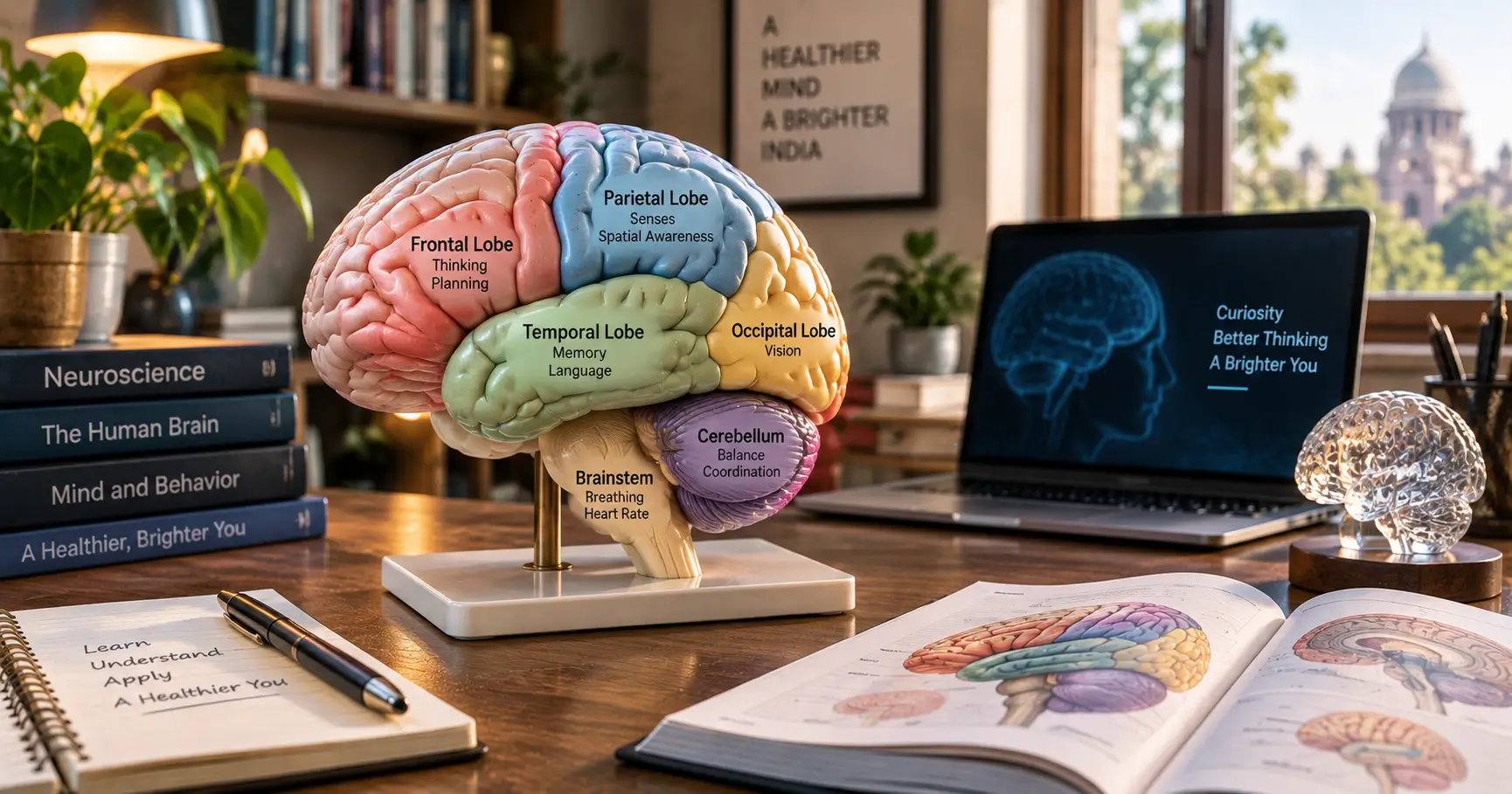

The human brain is a highly organized organ in which different regions perform specialized jobs while constantly working together. The major structures include the cerebrum, cerebellum, brainstem and diencephalon, while the cerebrum contains four commonly described lobes: the frontal, parietal, temporal and occipital lobes.
Understanding these parts makes it easier to see how the brain handles thinking, movement, memory, senses, balance and essential functions such as breathing and heart rate.
What are the main parts of the brain?
The brain can be broadly divided into the cerebrum, cerebellum, brainstem and diencephalon. These structures are interconnected rather than operating independently.
| Brain part | Main functions |
|---|---|
| Cerebrum | Thinking, memory, language, sensation and voluntary movement |
| Frontal lobe | Planning, decision-making, problem-solving and voluntary movement |
| Parietal lobe | Touch and other sensory processing, spatial information |
| Temporal lobe | Hearing, language-related processing, memory and emotion |
| Occipital lobe | Processing visual information |
| Cerebellum | Balance, coordination and refinement of movement |
| Brainstem | Breathing, heart rate and other vital functions |
| Thalamus | Relays sensory information to the cerebral cortex |
| Hypothalamus | Helps regulate hunger, thirst, temperature and hormonal/autonomic functions |
These are simplified descriptions. Many brain functions involve several regions working together rather than a single structure acting alone.
1. Cerebrum: the largest part of the brain
The cerebrum is the largest major component of the human brain. It is divided into right and left hemispheres connected by a thick bundle of nerve fibers called the corpus callosum.
The cerebrum is involved in conscious thought, sensory processing, voluntary movement, speech, memory, learning and emotional experiences. Different areas specialize in different tasks, but they communicate continuously.
Frontal lobe
Located behind the forehead, the frontal lobe contributes to planning, decision-making, problem-solving, complex thinking and voluntary movement. It also contains important regions involved in speech production.
Parietal lobe
The parietal lobe processes information related to touch and other body sensations. It also helps the brain interpret spatial information and understand where the body is positioned in relation to its surroundings.
Temporal lobe
The temporal lobe plays an important role in hearing and understanding sounds. It is also associated with memory, learning and aspects of emotion.
Occipital lobe
The occipital lobe, located toward the back of the brain, processes visual information received from the eyes. Damage to visual-processing areas can affect the ability to interpret what the eyes see.
2. Cerebellum: balance and coordination
The cerebellum sits toward the back of the brain beneath the cerebral hemispheres. Its major roles include coordinating movement, maintaining balance and helping produce smooth, controlled actions.
It does not simply “control movement” on its own. Instead, it works with other brain regions and sensory systems to refine movements and maintain posture.
3. Brainstem: essential automatic functions
The brainstem connects the brain with the spinal cord. It consists of the midbrain, pons and medulla.
The brainstem is essential for survival because it participates in regulating automatic functions such as breathing and heart rate. It also carries important information between the brain, spinal cord and other structures.
The medulla is particularly important for vital functions, while the pons and midbrain participate in communication pathways and several sensory and motor functions.
4. Thalamus and hypothalamus
The thalamus sits above the brainstem and acts as an important relay for sensory information traveling toward the cerebral cortex.
The hypothalamus, located below the thalamus, helps regulate functions such as hunger, thirst, body temperature and aspects of the autonomic nervous and endocrine systems. It also works closely with the pituitary gland to influence hormone regulation.
5. Hippocampus and other important structures
The hippocampus, located within the temporal lobe, is strongly associated with learning and memory. The amygdala is involved in emotional processing, while other structures such as the basal ganglia contribute to movement regulation.
The important point is that the brain does not work like a collection of isolated machines. Memory, emotion, movement, language and perception often depend on networks involving multiple areas.
Why understanding brain parts matters
Knowing the basic brain anatomy can make health and biology information easier to understand. It also explains why damage to different regions can produce very different effects.
For example, the occipital lobe is closely involved in visual processing, the cerebellum is important for coordination and balance, and the brainstem supports vital automatic functions. These relationships are well established in basic neuroscience, although real brain function is more interconnected than a simple one-part/one-function chart suggests.
Final takeaway
The cerebrum handles many higher-level cognitive and sensory functions, its four major lobes specialize in different types of processing, the cerebellum helps coordinate movement and balance, and the brainstem supports essential automatic functions. Structures such as the thalamus, hypothalamus and hippocampus add important roles in sensory processing, regulation and memory.
The brain’s real strength comes from these regions working together as an interconnected system rather than functioning separately.
FAQ
1. What are the main parts of the human brain?
The major parts are the cerebrum, cerebellum, brainstem and diencephalon. The cerebrum contains the frontal, parietal, temporal and occipital lobes.
2. Which part of the brain controls memory?
Memory involves multiple brain regions. The hippocampus is particularly important for learning and memory, while different parts of the cerebrum also contribute to storing and retrieving information.
3. Which part of the brain controls balance?
The cerebellum plays a major role in balance, posture and coordination of movement.
4. What does the brainstem do?
The brainstem connects the brain with the spinal cord and is involved in essential automatic functions such as breathing and heart rate. It includes the midbrain, pons and medulla.
5. What does the frontal lobe control?
The frontal lobe contributes to planning, decision-making, problem-solving, complex thinking and voluntary movement.
6. What does the occipital lobe do?
The occipital lobe primarily processes visual information. It helps the brain interpret information received from the eyes.
Disclaimer
This article is for general educational and health-information purposes only. It is not a substitute for professional medical advice, diagnosis or treatment. For symptoms or concerns involving the brain or nervous system, consult a qualified healthcare professional.


[…] weak eyesight remedies is not a medical diagnosis. Reduced or blurry vision can have several causes, including refractive errors such as myopia, hyperopia, astigmatism and […]
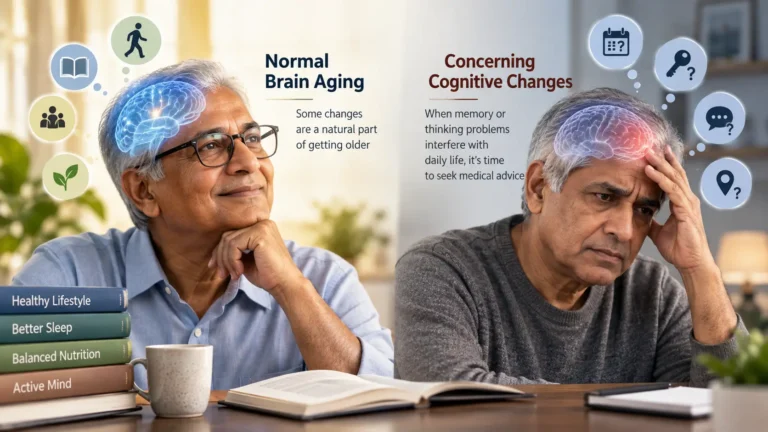
[…] more important question is not whether the brain changes with age—it does—but which changes are part of normal aging, which may signal a medical […]