
“Reverse breathing” sounds straightforward, but the term can mean two very different things.
In some traditional practices, particularly forms of Qigong and Tai Chi, reverse breathing or reverse abdominal breathing is a deliberate breathing pattern in which the lower abdomen gently moves inward during inhalation and outward during exhalation.
In clinical medicine, however, an apparently “reversed” chest-and-abdomen movement can describe paradoxical breathing, an abnormal breathing pattern that may occur with respiratory distress, airway obstruction, chest injury or diaphragm dysfunction.
Those two situations should not be confused.
This article focuses primarily on intentional reverse abdominal breathing as a mind-body practice, while also explaining when unusual reverse-looking breathing may be a medical warning sign.
Health note: This article is general health education, not a diagnosis or individualized breathing prescription. If you have unexplained breathlessness, chest pain, blue or grey lips, severe wheezing, confusion or suddenly abnormal breathing, seek urgent medical care rather than trying to correct the pattern yourself.
What is reverse breathing?
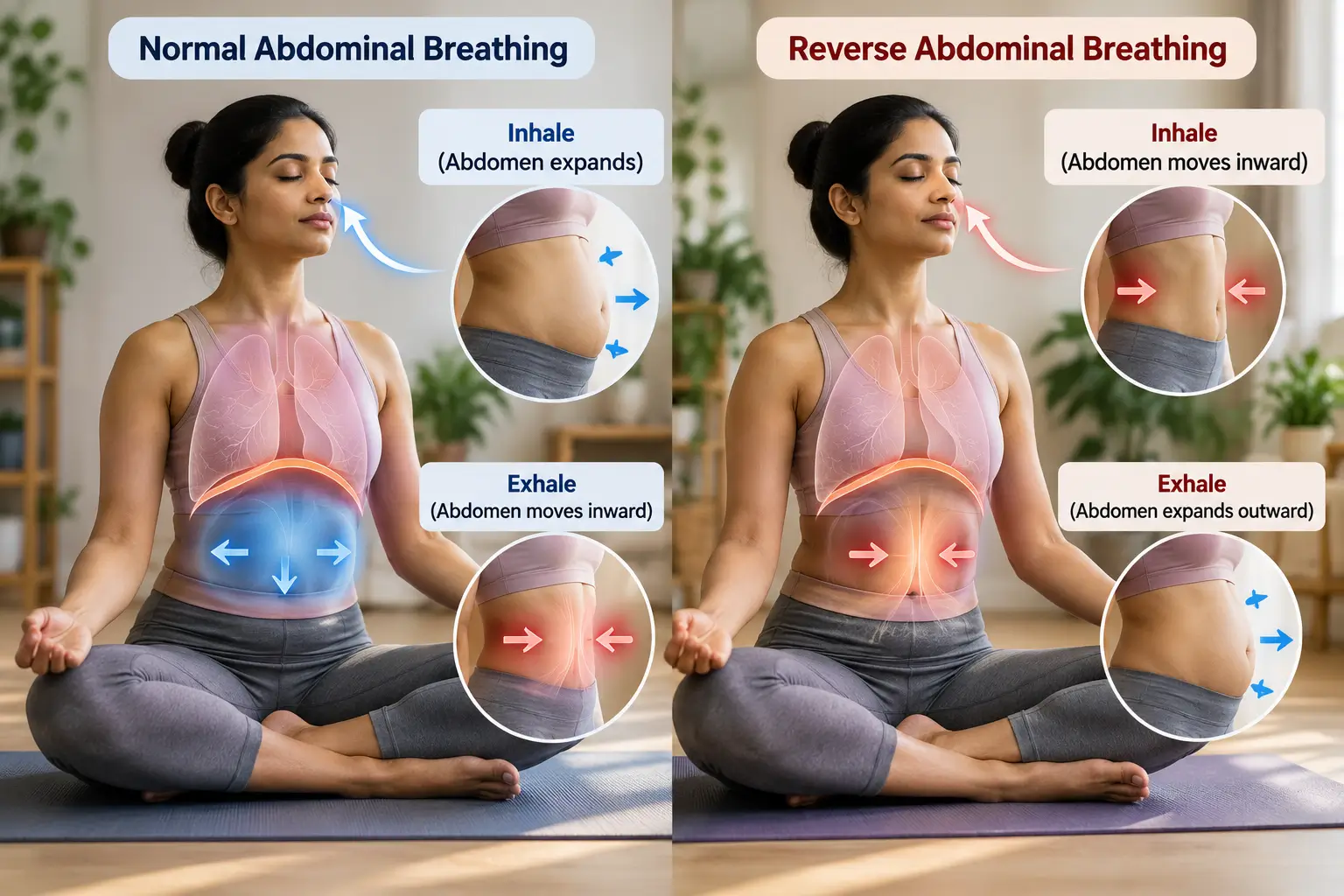
In the form commonly described as reverse abdominal breathing, the abdominal movement is intentionally opposite to the movement seen during relaxed abdominal or diaphragmatic breathing.
A simplified comparison looks like this:
| Breathing pattern | Inhalation | Exhalation |
|---|---|---|
| Relaxed abdominal/diaphragmatic breathing | Abdomen gently expands | Abdomen relaxes inward |
| Reverse abdominal breathing | Abdomen gently draws inward | Abdomen expands outward |
| Clinical paradoxical breathing | Chest and abdomen move abnormally out of phase | Pattern remains abnormal |
The exact technique varies between traditions.
In some Qigong and Tai Chi systems, reverse abdominal breathing is coordinated with posture, movement, vocalization or martial-arts actions. A 2025 biomechanics study, for example, examined reverse abdominal breathing specifically in experienced Tai Chi practitioners rather than in untrained members of the general population. [1]
So “reverse breathing” should not be treated as one standardized medical breathing exercise.
Reverse breathing vs normal abdominal breathing
The easiest way to understand the intentional technique is to compare it with ordinary relaxed abdominal breathing.
During normal diaphragmatic breathing, the diaphragm contracts and moves downward during inhalation. This contributes to expansion of the lower part of the chest and commonly accompanies outward movement of the abdomen.
With reverse abdominal breathing, the practitioner deliberately contracts the abdominal wall during inhalation.
During exhalation, the abdominal wall is allowed to release and move outward.
The breathing is therefore not simply “breathing backwards.”
It is a deliberate change in the coordination between breathing and abdominal muscle activity.
That distinction matters because forcing the abdomen inward does not automatically mean that the breathing is being performed correctly.
Why is reverse breathing used?
Reverse abdominal breathing has a long history in some traditional Chinese mind-body practices.
It is particularly associated with forms of Qigong and Tai Chi, where breathing is coordinated with movement and posture.
Traditional explanations may use concepts such as qi, energy circulation or internal cultivation.
Those concepts are part of the traditional framework in which the practice developed. They should not automatically be presented as established physiological mechanisms.
Modern research is instead examining measurable outcomes such as:
- Respiratory function
- Muscle activation
- Postural control
- Balance
- Physical performance
- Autonomic or cardiovascular responses
This difference between traditional explanation and modern biomedical evidence is important when evaluating claims about reverse breathing.
How to practice reverse abdominal breathing
There is no single universally standardized beginner protocol.
Different Qigong, Tai Chi and breathing systems teach slightly different versions.
A conservative way to understand the basic movement is:
Step 1: Sit comfortably
Choose a stable chair or a comfortable seated position.
Keep your spine relaxed rather than rigid.
Step 2: Observe your natural breathing
Before deliberately changing anything, take several normal breaths.
Notice what your abdomen and chest naturally do.
Step 3: Begin a gentle inhalation
Breathe in comfortably through the nose.
As you inhale, gently draw the lower abdomen inward.
Do not pull the stomach in as hard as possible.
The movement should remain comfortable.
Step 4: Exhale without forcing
Allow the abdomen to release and move outward as you breathe out.
The movement should be controlled rather than exaggerated.
Step 5: Keep breathing continuously
Do not turn the exercise into a competition to hold your breath or create maximum abdominal pressure.
A 2026 clinical Liuzijue protocol used slow, gentle inhalation and prolonged exhalation and monitored participants for symptoms during supervised training. [2]
Step 6: Stop if the breathing becomes strained
The goal is coordinated breathing, not abdominal tension for its own sake.
If you feel dizzy, unusually short of breath, develop chest discomfort or feel unwell, stop.
A simple beginner framework
For someone simply trying to understand the movement, the following sequence is more sensible than attempting an advanced Qigong routine:
Natural breathing → gentle abdominal contraction during inhalation → relaxed abdominal release during exhalation → return to normal breathing.
You do not need to add:
- Long breath holds
- Forceful inhalation
- Forceful abdominal contraction
- Rapid breathing
- Complex pelvic-floor maneuvers
- Advanced Qigong visualizations
Those are features of particular traditions, not requirements for understanding the basic breathing pattern.
What does reverse breathing actually do to the body?
The most defensible physiological explanation is that reverse abdominal breathing changes the coordination between respiratory movement and abdominal muscle activity.
The abdominal wall can participate in respiratory mechanics and trunk stabilization.
When the abdominal muscles contract, they can influence intra-abdominal pressure and trunk mechanics.
Researchers studying reverse abdominal breathing in Tai Chi have therefore been interested in whether the technique changes muscle recruitment and postural control.
But this does not mean that every popular claim about reverse breathing has been proven.
A useful way to separate the evidence is:
| Claim | What the evidence currently supports |
|---|---|
| It changes abdominal muscle activity | Supported by small physiological studies |
| It changes neuromuscular coordination during Tai Chi | Some evidence |
| It improves general fitness | Not established from reverse breathing alone |
| It strengthens the abdominal muscles like resistance training | Not established |
| It cures anxiety | Not established |
| It treats disease | Not established |
| It “detoxes” the body | No good clinical evidence |
| It increases “qi” in a measurable medical sense | Traditional claim, not established biomedical evidence |
That distinction is especially important for health websites.
What does the research say about reverse breathing?
1. A 2025 Tai Chi study found changes in muscle activation
A 2025 study published in Frontiers in Bioengineering and Biotechnology compared natural breathing with reverse abdominal breathing in 15 people aged 33–43 who had more than five years of Tai Chi experience.
The researchers found differences in lower-limb muscle strength, joint stiffness and muscle-synergy patterns during the tested Tai Chi movements.
The authors concluded that reverse abdominal breathing was associated with altered muscle recruitment and joint-control strategies.
But there is a major limitation:
The study had only 15 experienced Tai Chi practitioners.
It was also examining breathing in the context of Tai Chi movement rather than asking whether reverse breathing alone improves health in the general population. [1]
So it is interesting mechanistic evidence—not proof that everyone should use reverse breathing to become stronger or healthier.
2. A 2026 randomized trial studied Qigong after stroke
A newer randomized controlled trial investigated Liuzijue Qigong in 120 people recovering from stroke.
Liuzijue combines:
- Specific movements
- Vocalization
- Breathing regulation
- Reverse abdominal breathing
Participants received either standard rehabilitation or standard rehabilitation plus Liuzijue for three weeks.
The researchers reported greater improvements in forced vital capacity, peak expiratory flow and affected-side external-oblique muscle activation in the Liuzijue group.
However, the study did not show statistically significant between-group improvements in its measures of trunk control or balance.
More importantly, the intervention contained several components.
Therefore, it would be incorrect to say:
“Reverse breathing was proven to improve lung function after stroke.”
The study tested a multicomponent Qigong intervention containing reverse abdominal breathing, not reverse breathing as an isolated treatment. [2]
3. Evidence for breathing exercises is broader than evidence for reverse breathing
There is stronger research interest in breathing exercises generally than in reverse breathing specifically.
A systematic review of 58 clinical studies found that several types of voluntary regulated breathing were associated with improvements in stress or anxiety measures. However, the interventions varied substantially, and the review included slow breathing, diaphragmatic breathing, pranayama and other techniques.
The review also identified methodological limitations in many studies.
That means we can reasonably say:
Some forms of controlled breathing may help stress and anxiety.
We should not automatically upgrade that statement to:
Reverse breathing treats anxiety.
Those are different claims. [3]
The U.S. National Center for Complementary and Integrative Health similarly describes breathing exercises as one form of relaxation technique but advises against using relaxation practices as a substitute for conventional medical care. [4]
Is reverse breathing good for stress?
Possibly as part of a broader breathing or mind-body practice, but the evidence is not strong enough to claim that reverse breathing itself is an established treatment for stress or anxiety.
This distinction matters because many online pages attribute almost every positive effect of Qigong or pranayama to one specific breathing pattern.
In reality, a Qigong session may combine:
- Slow breathing
- Movement
- Attention
- Meditation
- Vocalization
- Postural control
- Social instruction
If participants feel calmer after such a session, it may not be possible to attribute the effect to reverse abdominal breathing alone.
Can reverse breathing strengthen the abs?
This claim needs careful wording.
Reverse abdominal breathing can recruit abdominal muscles.
The 2025 Tai Chi study found altered muscle activation and muscle-synergy patterns during reverse abdominal breathing. [1]
But muscle activation is not the same thing as muscle hypertrophy or strength training.
If your goal is to build stronger abdominal muscles, progressive resistance exercise provides a much more established route.
Reverse breathing may be useful as part of a movement or mind-body practice, but it should not replace conventional strength training simply because the abdomen contracts during the exercise.
Can reverse breathing improve lung capacity?
There is not enough evidence to make that claim for reverse breathing alone.
Some Qigong interventions that include reverse abdominal breathing have reported improvements in respiratory measures.
For example, the 2026 Liuzijue trial found greater improvements in FVC and peak expiratory flow compared with standard rehabilitation after stroke. [2]
But Liuzijue is a complete intervention, not merely reverse breathing.
That means the result cannot be isolated to the breathing pattern.
For people with chronic lung disease, established respiratory rehabilitation and condition-specific breathing techniques should take priority over experimenting with advanced breathing practices.
The American Lung Association, for example, describes diaphragmatic or belly breathing as a technique that can help some people with asthma or COPD manage breathlessness. [5]
Reverse breathing is not the same as diaphragmatic breathing
This distinction is worth remembering.
Diaphragmatic breathing
Often called belly breathing.
The aim is generally to encourage comfortable diaphragmatic breathing, with the abdomen moving outward during inhalation.
Reverse abdominal breathing
The practitioner deliberately draws the abdomen inward during inhalation and allows it to expand during exhalation.
Paradoxical breathing
An abnormal clinical breathing pattern in which the chest and abdomen move in an unusual or opposing manner.
These terms may look similar in search results but describe different things.
Reverse breathing vs paradoxical breathing
This is probably the most important safety distinction in the entire article.
| Feature | Intentional reverse abdominal breathing | Clinical paradoxical breathing |
|---|---|---|
| Usually intentional? | Yes | No |
| Context | Qigong, Tai Chi and some breathing traditions | Medical/respiratory setting |
| Abdominal movement | Deliberately coordinated with breathing | May move opposite to expected mechanics |
| Typical purpose | Mind-body practice or movement coordination | Not a treatment; it is a clinical sign |
| Should you force it? | No | No |
| Breathlessness expected? | No | May occur |
| Medical assessment needed? | Not routinely for healthy people simply learning the concept | May be necessary, especially with distress |
Medical sources describe paradoxical breathing as an abnormal pattern that can occur with airway obstruction, severe respiratory distress, diaphragm dysfunction and certain chest injuries. [6][7]
When “reverse breathing” may be a medical warning sign
Suppose you are not deliberately practicing a breathing technique.
Instead, you notice that:
- Your chest seems to pull inward when you breathe in.
- Your abdomen moves abnormally.
- You are struggling to breathe.
- The pattern appeared suddenly.
- You recently suffered chest trauma.
- You have significant weakness or a known neuromuscular condition.
That is not the situation described by a Qigong breathing exercise.
Paradoxical breathing can occur with serious respiratory problems and should not be “trained away” at home.
Seek urgent medical care if abnormal breathing is accompanied by:
- Severe or rapidly worsening shortness of breath
- Blue or grey lips or face
- Confusion
- Fainting
- Severe chest pain
- Major chest trauma
- Inability to speak normally because of breathlessness
- A rapidly deteriorating breathing pattern
Paradoxical breathing is considered a clinically important abnormal respiratory pattern, particularly when associated with respiratory distress or airway problems. [6][7]
Common myths about reverse breathing
Myth 1: Reverse breathing is always healthier than normal breathing
Not established.
It is a specialized breathing pattern used in certain practices. There is no good evidence that healthy adults need to replace ordinary relaxed breathing with it.
Myth 2: Reverse breathing burns belly fat
No good evidence supports this claim.
Contracting the abdominal muscles while breathing does not mean that abdominal fat is being selectively burned.
Spot reduction is not an established mechanism of fat loss.
Myth 3: Reverse breathing detoxes the organs
Not established.
Traditional practices may describe internal effects using concepts such as qi or organ massage, but those claims should not be presented as proven medical effects.
Myth 4: Reverse breathing can replace treatment for anxiety
No.
Breathing exercises may be useful as a complementary stress-management practice, but they are not a substitute for appropriate treatment of an anxiety disorder.
Myth 5: More abdominal contraction means better results
No.
Forceful contraction can turn a gentle coordination exercise into a straining exercise.
The goal is controlled breathing, not maximum abdominal tension.
Who should be cautious?
There is not enough high-quality evidence to create a universal medical contraindication list specifically for reverse breathing.
That itself is an important limitation.
If you have a condition in which changing breathing mechanics or deliberately increasing abdominal pressure could matter—such as significant heart or lung disease, a neuromuscular disorder, recent chest or abdominal surgery, pregnancy, or another condition for which your clinician has given breathing restrictions—discuss the technique with an appropriately qualified professional before practicing it.
Do not use an online breathing tutorial as a substitute for respiratory rehabilitation or medical advice.
What should you do if you feel dizzy while practicing?
Stop the exercise and return to normal, comfortable breathing.
Do not try to “push through” dizziness.
In the 2026 supervised Liuzijue trial, training was stopped when participants developed symptoms such as dizziness, chest pain or postural instability. [2]
If symptoms are severe, persistent or occur outside the exercise, seek medical evaluation.
Can beginners learn reverse breathing?
They can learn the basic concept, but reverse breathing is not necessarily the best first breathing exercise for everyone.
If your main goal is simply:
- Relaxation
- Learning breath awareness
- Managing occasional stress
- Becoming aware of diaphragmatic movement
a simpler, comfortable breathing practice may be easier to learn.
The National Center for Complementary and Integrative Health describes slow breathing and diaphragmatic breathing among commonly used relaxation approaches. [4]
Reverse abdominal breathing makes more sense when it is being taught as part of a specific Qigong, Tai Chi or other movement tradition and the instructor can correct technique.
A practical decision guide
Ask yourself why you want to try reverse breathing.
| Your goal | More appropriate starting point |
|---|---|
| Learn basic breath awareness | Comfortable natural breathing |
| Relaxation/stress management | Slow, comfortable breathing or established relaxation techniques |
| Learn Tai Chi | Follow the breathing method taught within the specific Tai Chi system |
| Learn Qigong | Work with an appropriately trained instructor |
| Improve COPD-related breath control | Follow a respiratory professional’s recommended techniques |
| Treat unexplained breathlessness | Medical assessment |
| Correct abnormal breathing you noticed yourself | Professional assessment before attempting advanced breathing exercises |
| Build abdominal strength | Progressive resistance exercise |
This is a better approach than assuming one breathing method is universally superior.
What the evidence does—and does not—tell us
| Question | Evidence position |
|---|---|
| Is reverse abdominal breathing a real traditional practice? | Yes |
| Is it used in Qigong/Tai Chi? | Yes |
| Does it change abdominal and neuromuscular activity? | Evidence exists, but studies are small/context-specific |
| Does it improve general health in everyone? | Insufficient evidence |
| Does it treat anxiety? | Not established specifically for reverse breathing |
| Does it burn abdominal fat? | No convincing evidence |
| Does it detox the body? | Not established |
| Can Qigong programs containing reverse breathing improve some outcomes? | Some evidence, including recent trials, but interventions are multicomponent |
| Is paradoxical breathing a medical problem? | It can be, particularly when associated with respiratory distress or other abnormalities |
The overall evidence level for reverse breathing itself as a standalone health intervention remains limited.
That is not the same as saying the practice is useless.
It means we should keep the claims proportional to the evidence.
The safest way to think about reverse breathing
Reverse breathing is best understood as a specialized breathing coordination technique, not a miracle health intervention.
If you encounter it in a Qigong or Tai Chi class, it can be one component of a broader mind-body practice.
If you are interested in its possible effects on muscle coordination, posture or respiratory function, research is emerging—but much of it involves specific populations and multicomponent interventions.
And if your breathing appears “reversed” without you intentionally doing it, especially with breathlessness or chest symptoms, that is a completely different situation.
The first question should not be:
“How can I practice reverse breathing?”
It should be:
“Am I deliberately performing a breathing technique, or is my breathing pattern abnormal?”
That distinction is more important than any claimed benefit.
Key takeaways
- Reverse abdominal breathing intentionally draws the abdomen inward during inhalation and allows it to expand during exhalation.
- It is used in some forms of Qigong and Tai Chi.
- Research specifically on reverse breathing is still relatively limited.
- A 2025 study found changes in muscle activation and coordination in experienced Tai Chi practitioners, but it involved only 15 participants. [1]
- A 2026 randomized trial found respiratory improvements from a Liuzijue Qigong program after stroke, but reverse breathing was only one component of the intervention. [2]
- Broader breathing research supports possible benefits from some controlled breathing practices, particularly for stress-related outcomes, but those findings should not automatically be attributed to reverse breathing. [3][4]
- Reverse breathing should not be marketed as a proven treatment for anxiety, obesity, digestive disease or other medical conditions.
- Paradoxical breathing is different and can be a sign of respiratory or mechanical problems.
- Stop a breathing exercise if you develop dizziness, chest pain, marked breathlessness or other concerning symptoms.
- People with relevant medical conditions should obtain individualized advice before adopting specialized breathing techniques.
FAQ
1. What is reverse breathing?
In the intentional reverse abdominal breathing technique, the abdomen gently moves inward during inhalation and outward during exhalation. It is used in some Qigong and Tai Chi traditions.
2. Is reverse breathing the same as paradoxical breathing?
No. Intentional reverse abdominal breathing is a practiced technique. Paradoxical breathing is a clinical term describing abnormal chest/abdominal movement and can indicate a medical problem.
3. What are the benefits of reverse breathing?
Research specifically on reverse breathing is limited. Studies have investigated muscle activation, coordination and respiratory outcomes within Tai Chi or Qigong programs, but there is not enough evidence to claim that reverse breathing alone treats disease or provides universal health benefits.
4. Can reverse breathing reduce anxiety?
Controlled breathing in general may help with stress and anxiety, but evidence specifically proving reverse breathing as an anxiety treatment is insufficient.
5. Can reverse breathing reduce belly fat?
There is no convincing evidence that reverse breathing selectively burns abdominal fat. Abdominal muscle contraction during breathing should not be confused with fat loss.
6. Is reverse breathing safe?
A gentle breathing practice may be reasonable for a healthy person, but reverse breathing is a specialized technique and evidence on its standalone safety is limited. Do not force the abdomen, hold your breath or continue through dizziness, chest pain or significant breathlessness.
7. Why does my stomach move inward when I breathe in?
If you are deliberately practicing reverse abdominal breathing, that movement may be intentional. If it happens involuntarily—especially with chest movement in the opposite direction, breathlessness or other symptoms—it may represent an abnormal breathing pattern and should be medically assessed.
8. Should I practice reverse breathing if I have a medical condition?
Do not assume that an online breathing technique is appropriate for a medical condition. If you have significant heart or lung disease, a neuromuscular disorder, recent surgery, pregnancy or another condition affecting breathing or abdominal pressure, obtain individualized advice before starting specialized breathing exercises.