
Some yoga practices look deceptively simple.
Yog Mudra is one of them. The posture involves sitting, placing the hands behind the back and gently folding the torso forward. Yet the combination of posture, breathing, concentration and controlled movement makes the practice more than a simple stretch.
In traditional yoga education, Yog Mudra is recognized as a specific yogic practice. The Ministry of Ayush’s Morarji Desai National Institute of Yoga includes it among established yoga practices.
But there is an important distinction to understand before practicing it: traditional yoga texts and modern health research do not always describe benefits in the same way.
So, what exactly does Yog Mudra involve, and how can you practice it safely?
What Is Yog Mudra?
Yog Mudra, also called Yog Mudrasana in some sources, is a seated forward-bending yoga practice traditionally performed from a meditative seated position.
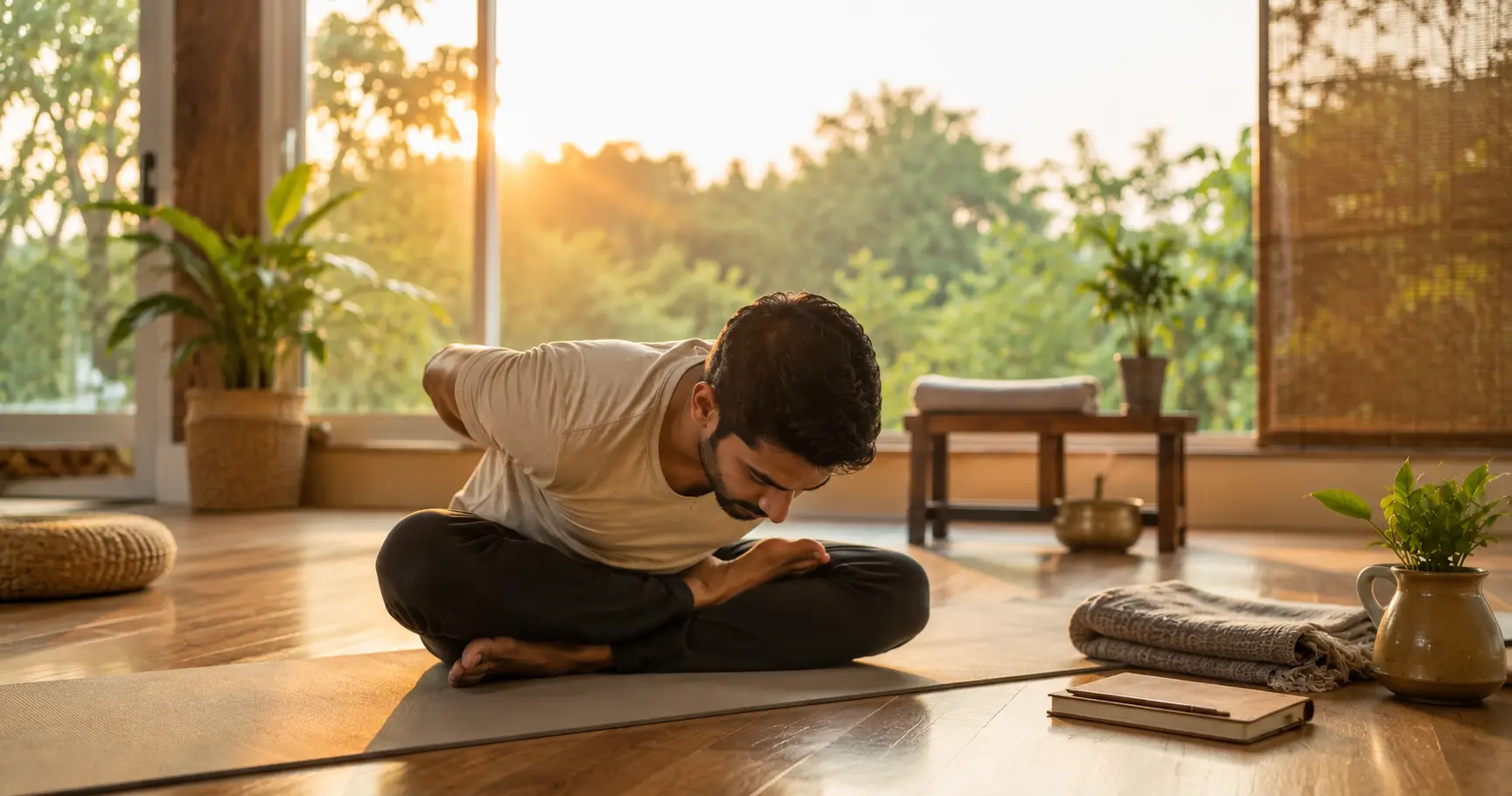
A common version involves sitting in Padmasana or another comfortable seated position, taking the arms behind the body, holding one wrist with the opposite hand and slowly bending forward while coordinating the movement with breathing. Government educational material describes a version in which the practitioner sits in Padmasana, exhales and bends forward until the forehead approaches or touches the floor.
Some yoga-training curricula also list Yog Mudra in Vajrasana, showing that variations exist between teaching traditions.
This is important because there is no single universal version practiced by every yoga school.
Yog Mudra vs hand mudras
The word “mudra” can create confusion.
In yoga, mudra can refer to symbolic gestures made with the hands, while Yog Mudra is also used as the name of a seated posture.
This article focuses on Yog Mudra asana, the forward-bending posture.
That distinction can prevent beginners from searching for a hand position when they actually want the physical yoga pose.
Yog Mudra Benefits: What Can You Reasonably Expect?
Traditional yoga sources associate Yog Mudra with several physical and mental benefits.
Commonly described benefits include:
- Improved spinal flexibility
- Gentle stretching of the back and hips
- Greater body awareness
- Relaxation
- Support for mindful breathing
- A calm, inward-focused practice
- Gentle movement of the abdominal region
A yoga handbook from Habuild describes Yog Mudra as a forward-bending practice and associates it with spinal flexibility, abdominal massage and relaxation.
However, claims such as “detoxifies the body,” “cures disease” or “guarantees better digestion” should not be presented as established medical facts.
The bigger benefit may be the practice itself
Yog Mudra combines several elements that can be useful in a yoga routine:
slow movement + controlled breathing + attention + gentle stretching
That combination can encourage relaxation and body awareness.
The benefit is therefore not necessarily one dramatic physiological effect.
Instead, Yog Mudra can become one small component of a broader yoga and mindfulness practice.
How to Do Yog Mudra Correctly
Beginners should prioritize comfort and control over depth.
You should never force your forehead toward the floor simply because another practitioner can reach it.
Step 1: Choose a comfortable seated position
Traditionally, Yog Mudra may begin in Padmasana.
If Padmasana is uncomfortable or inaccessible, a qualified instructor can help you choose an appropriate seated variation.
Keep your spine comfortably upright before beginning.
Step 2: Position your arms
Take both arms behind your back.
One common version involves holding the wrist of one hand with the opposite hand. Government educational material describes holding the wrist behind the back before moving into the forward bend.
Do not pull aggressively on the wrist.
Your shoulders should remain as relaxed as possible.
Step 3: Prepare your breathing
Take several slow, comfortable breaths.
Avoid deliberately holding your breath unless you have been specifically trained to do so by a qualified yoga instructor.
The goal is controlled, comfortable breathing.
Step 4: Exhale and fold forward
As you breathe out, slowly hinge forward from the hips.
Move gradually.
Do not collapse suddenly through the lower back.
Step 5: Go only as far as comfortable
Depending on your flexibility, your forehead may move toward the floor—or it may remain much higher.
Both are acceptable starting points.
The correct Yog Mudra is not the deepest Yog Mudra.
A controlled movement with steady breathing is more useful than forcing range of motion.
Step 6: Stay briefly
Remain in the position for a comfortable period while breathing naturally.
Beginners can start with a short hold rather than attempting a long duration.
Step 7: Return slowly
Use a controlled movement to return to your starting position.
Avoid jerking the torso upward.
Take a few normal breaths before repeating or finishing the practice.
A Beginner-Friendly Yog Mudra Routine
If you’re new to the practice, try this simple structure:
| Stage | Suggested approach |
| Preparation | Sit comfortably for 1–2 minutes |
| Breathing | Take 4–5 slow breaths |
| Forward bend | Move gradually during exhalation |
| Hold | Stay briefly without forcing |
| Return | Come back slowly while breathing normally |
| Recovery | Sit quietly for several breaths |
This is a starting framework, not a universal prescription.
Your appropriate duration depends on flexibility, experience, physical condition and the version taught by your instructor.
What Muscles and Areas Does Yog Mudra Stretch?
Although Yog Mudra is traditionally described in energetic and holistic terms, its physical movement can be understood more simply.
The forward fold may involve:
- Hamstrings
- Hip muscles
- Lower back
- Upper back
- Shoulders
- Abdominal region
The exact sensation depends on the seated position and individual flexibility.
If you feel a sharp or shooting sensation rather than a mild stretch, stop.
Stretching should not be painful.
Yog Mudra and Digestion
One of the most common traditional claims surrounding Yog Mudra is that it supports digestion.
Some yoga sources describe forward-bending practices as stimulating or massaging the abdominal region.
However, this should be described carefully.
There is not enough high-quality evidence to conclude that Yog Mudra alone can treat constipation, indigestion or a digestive disease.
A healthier way to frame the potential benefit is that the posture creates gentle movement and abdominal compression, while the slow breathing and relaxation component may make the practice feel calming.
If digestive symptoms are persistent, painful or severe, they deserve proper medical assessment.
Yog Mudra for Relaxation and Mental Calm
Yog Mudra is often practiced as an inward-focused posture.
The body folds forward, visual stimulation decreases and attention can shift toward breathing and bodily sensations.
That may make it useful as part of a relaxation routine.
Research on yoga more broadly suggests that yoga-based practices can have beneficial effects on several aspects of mental and physical well-being, although results vary depending on the intervention and study population.
Importantly, evidence for yoga as a whole should not automatically be interpreted as proof that Yog Mudra alone produces the same effect.
That distinction is important for trustworthy health content.
Yog Mudra and Flexibility
Flexibility is one area where the movement itself provides a straightforward explanation.
Repeated, controlled practice can help you become more familiar with the range of motion required for the posture.
But flexibility develops gradually.
A beginner who cannot fold deeply today may notice improved comfort over time with consistent, appropriate mobility work.
Do not compare your range of motion with someone who has practiced yoga for years.
A useful rule
Improve your own range, not someone else’s.
If your hands cannot comfortably reach the position behind your back, use a modification rather than forcing your shoulders into an uncomfortable position.
Common Mistakes Beginners Make
1. Forcing the forehead to the floor
This is one of the most common mistakes.
The purpose is not to win a flexibility competition.
Move only within a comfortable range.
2. Holding the breath
Some practitioners unconsciously stop breathing while trying to deepen the posture.
Instead, keep the breath smooth and natural.
3. Pulling the wrist aggressively
The hands behind the back should not create unnecessary shoulder or wrist strain.
Use a gentler grip.
4. Rounding aggressively through the lower back
The movement should be controlled rather than a sudden collapse forward.
5. Practicing after severe discomfort begins
Pain is not a sign that the posture is “working better.”
Stop if you experience sharp pain, dizziness, numbness or unusual discomfort.
6. Copying advanced practitioners
Yoga is highly individual.
A posture that is comfortable for one person may be inappropriate for another.
Who Should Be Careful With Yog Mudra?
Yog Mudra involves a forward bend and can place demands on the spine, hips, knees, shoulders and blood-pressure regulation, depending on how it is performed.
Some yoga teaching sources specifically advise caution or avoidance for people with conditions such as high blood pressure and during pregnancy.
Other instructional sources also advise caution for people with significant back, neck, shoulder or knee problems.
Speak with a qualified professional first if you have:
- Significant back or neck problems
- A recent spinal or joint injury
- Serious knee or hip limitations
- Shoulder or wrist injuries
- Uncontrolled high blood pressure
- Significant cardiovascular disease
- Pregnancy
- Recent surgery
- Severe dizziness or balance problems
For pregnancy in particular, do not assume that a posture is safe simply because it is described as a traditional yoga practice.
Pregnancy changes what movements may be appropriate.
Yog Mudra: Myths vs Facts
| Myth | More Accurate View |
| Yog Mudra cures digestive diseases | There is insufficient evidence to make that claim |
| You must touch your forehead to the floor | Beginners can practice within their comfortable range |
| More stretching means more benefit | Excessive stretching can increase injury risk |
| Yog Mudra alone provides all the benefits of yoga | It is one practice within a much broader yoga system |
| You should hold your breath while bending | Comfortable breathing is generally preferable unless specifically instructed otherwise |
| Everyone should practice it | Individual health, flexibility and experience matter |
| Yoga replaces medical treatment | Yoga can complement healthy living but should not replace appropriate medical care |
What Does Science Say About Yoga Mudras?
This is where online content often becomes misleading.
Some articles state that hand mudras or Yog Mudra can “cure” particular diseases or directly control specific organs.
Those claims go beyond what current evidence can establish.
A published review discussing yoga mudras describes traditional concepts such as the five elements and energy flow, but those explanations belong to the traditional yogic framework rather than established biomedical physiology.
Similarly, research on yoga, breathing and meditation may support broader benefits without proving that one specific mudra is responsible.
A scientifically responsible article should therefore distinguish traditional interpretation from clinical evidence.
A Simple 10-Minute Yog Mudra Practice
If you are healthy, comfortable with the basic seated position and have no contraindications, you can build the practice gradually.
Minute 1–2: Settle
Sit comfortably.
Relax your shoulders and observe your breathing.
Minute 3–4: Prepare
Move your arms behind your back and establish a comfortable hand position.
Take several slow breaths.
Minute 5–7: Practice
Exhale and slowly fold forward.
Do not force the movement.
Keep breathing comfortably.
Minute 8: Return
Come back to an upright position slowly.
Allow your breathing to return to normal.
Minute 9–10: Observe
Sit quietly.
Notice your breathing, posture and physical sensations.
This final pause is useful because it turns the practice from a simple stretch into a more mindful experience.
How Often Should You Practice Yog Mudra?
There is no universally established evidence-based schedule that applies to everyone.
Traditional yoga routines vary considerably.
For beginners, short, comfortable sessions performed consistently are generally more sensible than attempting long holds immediately.
You can gradually increase your familiarity with the posture as your mobility and technique improve.
If you attend yoga classes, ask your instructor to check your alignment rather than relying entirely on written instructions.
A Mini Case Example: Beginner vs Experienced Practitioner
Consider two people practicing Yog Mudra.
Person A has tight hips and hamstrings and has never practiced yoga.
They fold forward only halfway and cannot comfortably maintain the hand position behind the back.
For this person, forcing the full posture would be counterproductive.
Person B has practiced yoga for several years and can comfortably perform the seated position.
They can work on smoother breathing and controlled movement rather than trying to force additional depth.
The lesson is simple:
The same pose can require completely different levels of effort from different people.
How to Make Yog Mudra More Comfortable
Try these practical adjustments:
- Use a folded blanket under the hips if the seated position feels restrictive.
- Warm up the hips and hamstrings first.
- Keep the shoulders relaxed.
- Do not pull aggressively on the arms.
- Move slowly during the forward bend.
- Stop before pain begins.
- Practice on a stable, non-slip surface.
- Learn the posture from a qualified yoga instructor if you’re unsure.
These small changes can make the practice more sustainable.
Yog Mudra vs Other Yoga Practices
Yog Mudra is often confused with several other practices.
| Practice | Main movement or focus |
| Yog Mudra | Seated forward bend with a traditional hand/arm position |
| Paschimottanasana | Seated forward bend with legs extended |
| Padmasana | Seated cross-legged posture with the feet placed on opposite thighs |
| Vajrasana | Kneeling seated posture |
| Chin Mudra | Hand gesture commonly used during meditation |
| Gyan Mudra | Hand gesture traditionally associated with meditation and awareness |
This distinction is especially useful for beginners searching online because “Yoga Mudra” and “Yog Mudra” can refer to different practices depending on the source.
Key Takeaways
Yog Mudra is a traditional seated yoga practice that combines a forward bend, a specific arm position and mindful breathing.
Its potential practical benefits include:
- Gentle flexibility work
- Body awareness
- Relaxation
- Controlled movement
- Integration with meditation and breathing practice
However, it should not be marketed as a guaranteed treatment for digestive disorders, hypertension, pain or other medical conditions.
The most important part of practicing Yog Mudra is technique without force.
Start slowly, respect your body’s range of motion and stop if something feels painful or unusual.
If you have a medical condition, are pregnant, have recently undergone surgery or are recovering from an injury, seek appropriate professional advice before adding the posture to your routine.
The deeper value of Yog Mudra may be its simplicity: slow down, breathe, move with awareness and listen to the body.
FAQ
What is Yog Mudra?
Yog Mudra is a traditional seated yoga practice involving a forward bend, a specific arm position behind the body and controlled breathing. It is also called Yog Mudrasana in some yoga traditions.
What are the benefits of Yog Mudra?
Yog Mudra is traditionally associated with relaxation, body awareness, flexibility and gentle movement of the back and abdominal region. It should not be presented as a guaranteed treatment for disease.
How do you perform Yog Mudra?
Sit comfortably, position the arms behind your back, hold one wrist with the opposite hand, breathe comfortably and slowly fold forward during an exhalation. Return to the starting position gradually.
Can beginners do Yog Mudra?
Yes, healthy beginners can learn a modified version, but they should not force the forward bend or attempt advanced positions immediately. A qualified yoga instructor can help with alignment and modifications.
Is Yog Mudra safe during pregnancy?
Pregnancy requires individualized guidance. Because Yog Mudra involves a forward bend and a specific seated position, pregnant people should not assume the standard version is appropriate and should seek guidance from their healthcare professional and a qualified prenatal yoga instructor.
Does Yog Mudra improve digestion?
Traditional yoga sources associate the practice with abdominal and digestive benefits, but strong clinical evidence that Yog Mudra alone treats digestive disorders is lacking. Persistent digestive symptoms should be medically evaluated.
Conclusion
Yog Mudra may look simple, but its value lies in the combination of controlled movement, breathing and awareness.
For beginners, the priority should not be reaching the floor or copying an advanced practitioner. It should be learning the posture gradually and keeping the movement comfortable.
The key points are:
- Learn the correct technique.
- Move slowly rather than forcing the stretch.
- Keep breathing naturally.
- Use modifications when necessary.
- Respect injuries, pregnancy and medical conditions.
- Treat traditional health claims as traditional claims unless strong evidence supports them.
If you are new to yoga, begin with a short, comfortable practice and focus on how your body responds.
The goal of Yog Mudra is not to push your body further than it can safely go. It is to bring movement, breath and awareness together.
That makes it a practical addition to a broader, consistent yoga and mindfulness routine.
Disclaimer
Disclaimer: This article is provided for educational and informational purposes and does not constitute medical advice. Yog Mudra is a traditional yoga practice, and claims made within traditional yoga or wellness systems should not automatically be interpreted as scientifically proven medical effects.
Yoga may be inappropriate for some people depending on their health, flexibility, pregnancy status, injuries or medical conditions. Stop the practice if you experience pain, dizziness, numbness, breathing difficulty or other unusual symptoms. People with medical conditions, recent injuries or surgery, or those who are pregnant should consult an appropriate healthcare professional before beginning a new yoga practice.
Do not use Yog Mudra or any other yoga practice as a substitute for diagnosis or treatment from a qualified healthcare professional.