
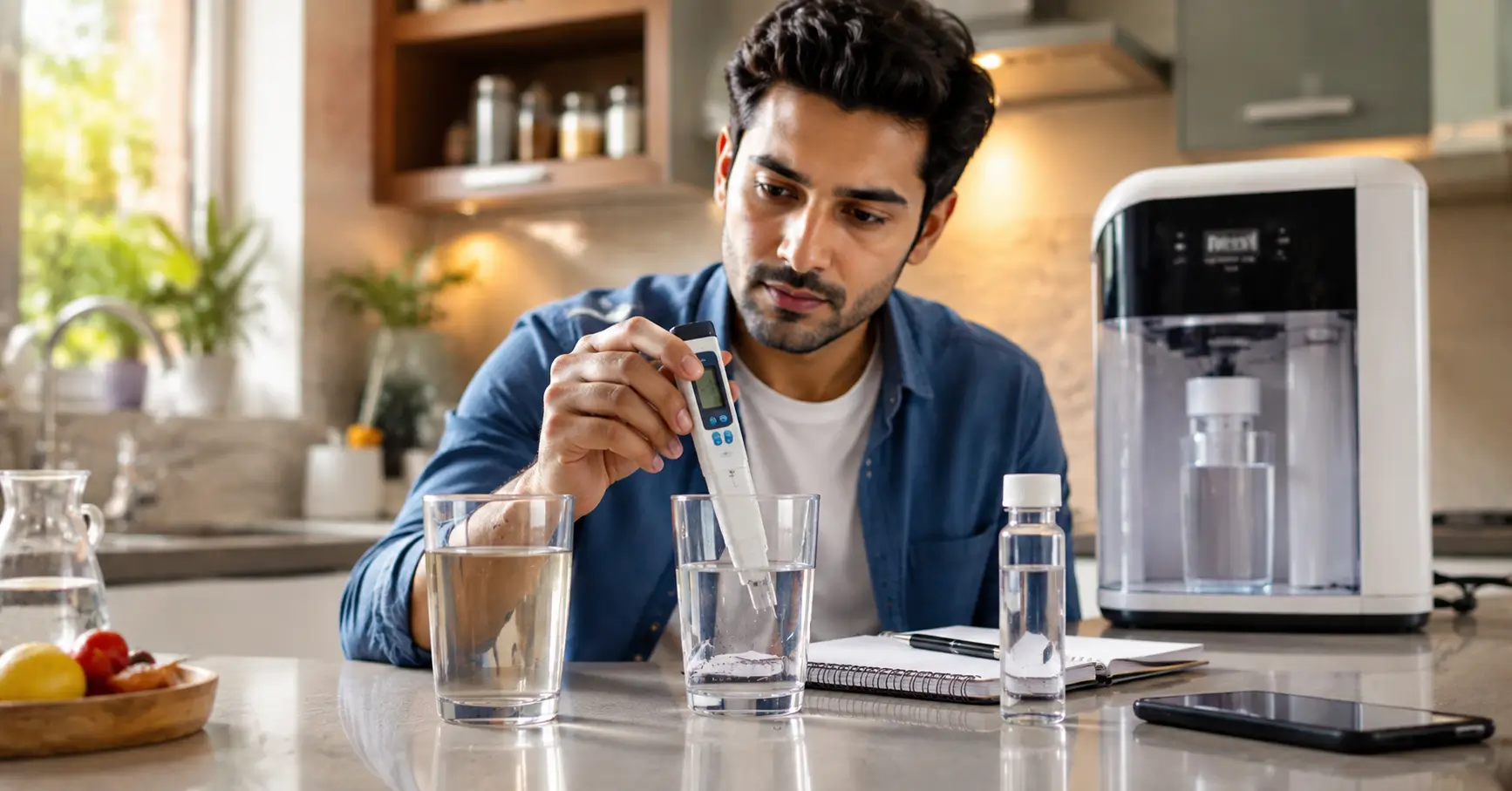

Your water purifier shows 25, 150, 300 or even 500 ppm—but which number is actually good?
The answer is more complicated than many purifier websites suggest. The ideal TDS for drinking water is often presented as one magic number, yet TDS is only a measurement of dissolved material in water. It does not identify whether those dissolved substances are beneficial minerals, unwanted salts or potentially harmful contaminants.
For Indian households, there is another important reference point: BIS IS 10500:2012 lists 500 mg/L as the acceptable TDS limit and 2,000 mg/L as the permissible limit when an alternate source is unavailable.
So what should your TDS meter actually show? Let’s break it down.
What is TDS in drinking water?
TDS stands for Total Dissolved Solids.
It represents dissolved inorganic salts and small amounts of organic matter present in water. Common dissolved components can include calcium, magnesium, sodium, potassium, bicarbonate, chloride and sulfate.
TDS is generally expressed in mg/L or ppm.
For practical household use, the two units are approximately equivalent numerically:
1,000 mg/L = about 1,000 ppm.
A handheld TDS meter typically estimates the concentration indirectly by measuring electrical conductivity and converting it into a TDS value. WHO notes that the conversion factor can vary according to the type of water.
That means your meter provides a useful screening measurement, but it is not a complete laboratory water-quality test.
Ideal TDS for drinking water: what number should you aim for?
Here is the crucial distinction.
There is no single WHO health-based TDS number that means water is automatically safe or unsafe.
WHO’s TDS information discusses TDS mainly in relation to taste and palatability. Its assessment describes water below 300 mg/L as having excellent palatability, 300–600 mg/L as good, 600–900 mg/L as fair, 900–1,200 mg/L as poor and above 1,200 mg/L as generally unacceptable from a taste perspective. Extremely low TDS can also produce a flat taste.
For Indian households, 150–300 ppm can be used as a practical taste-oriented target, rather than treating it as a medically established “perfect” range.
That distinction matters.
A practical TDS interpretation table
| TDS reading | What it generally indicates | What to do |
|---|---|---|
| Below 50 ppm | Very low dissolved solids | Check source and treatment system; don’t assume it is automatically healthier |
| 50–150 ppm | Low TDS | Often palatable; assess the complete water quality |
| 150–300 ppm | Moderate TDS | Often a pleasant range for drinking water |
| 300–500 ppm | Higher but within BIS acceptable TDS limit | Check taste and other water-quality parameters |
| 500–1,000 ppm | Above BIS acceptable limit | Investigate the source and consider appropriate treatment |
| 1,000–2,000 ppm | Very high dissolved solids | Needs careful assessment and treatment/source evaluation |
| Above 2,000 ppm | Above BIS permissible limit where no alternate source exists | Do not rely on a TDS meter alone; obtain professional water testing |
The BIS standard specifies 500 mg/L as the acceptable limit and 2,000 mg/L as the permissible limit in the absence of an alternate source.
Is 150–300 TDS the “perfect” level?
Not officially.
This is one of the biggest myths surrounding drinking water.
A TDS reading of 200 ppm does not automatically mean the water is healthier than water at 400 ppm. TDS is a combined measurement. It does not tell you which individual substances make up the total.
For example, two water samples could have the same TDS but very different chemical compositions.
One could contain mostly calcium and bicarbonate, while another could contain substantial sodium or other dissolved substances.
Therefore, TDS should be treated as one water-quality parameter, not a complete safety score.
What does BIS say about TDS?
India’s Bureau of Indian Standards specifies drinking-water requirements through IS 10500:2012, Drinking Water — Specification. BIS itself identifies IS 10500:2012 as the relevant drinking-water standard.
For TDS, the standard provides two important values:
- Acceptable limit: 500 mg/L
- Permissible limit in the absence of an alternate source: 2,000 mg/L
The distinction is important.
The 2,000 mg/L figure should not be interpreted as “2,000 TDS is ideal drinking water.”
It represents a permissible limit under a specific circumstance where an alternate source is unavailable.
Does WHO recommend a specific TDS limit?
This is where online articles often become misleading.
WHO does not treat TDS as a standalone health-based guideline value.
Its drinking-water material discusses TDS largely in terms of acceptability and taste. The WHO assessment notes that TDS itself has no recent established evidence base supporting a specific health-based guideline value and emphasizes the contribution of dissolved substances to water’s palatability.
WHO’s latest Guidelines for Drinking-water Quality, published in its updated fourth-edition framework in June 2026, emphasizes a broader risk-management approach to drinking-water safety rather than relying on a single number.
That is an important lesson:
Safe water requires more than checking TDS.
Is low TDS water safe?
Low TDS is not automatically dangerous.
A reading below 50 ppm simply means the water contains relatively little dissolved material.
Some people dislike very low-TDS water because it can taste flat. WHO specifically notes that extremely low concentrations of TDS can produce an insipid taste.
But the common claim that low-TDS water automatically “causes mineral deficiency” is too simplistic.
Most essential minerals in a typical diet come from food, not drinking water.
So you should not choose a purifier setting based solely on the belief that a higher TDS number automatically means more health benefits.
Is high TDS water safe?
A high TDS reading deserves attention, but it still doesn’t tell you exactly what is wrong.
High TDS may come from naturally occurring minerals and salts. It can also reflect undesirable substances depending on the water source.
This is why “high TDS = toxic water” is another oversimplification.
At the same time, very high TDS can make water unpleasant to drink and may be associated with scaling or other water-quality concerns. WHO’s palatability data show a clear decline in acceptability as TDS rises.
If your household consistently records a very high reading, the sensible next step is laboratory testing, not simply turning an RO purifier to maximum filtration.
What does a TDS meter actually tell you?
A TDS meter is useful for screening and monitoring.
For example, suppose your untreated borewell water measures 1,200 ppm and your RO output measures 100 ppm.
That tells you the purifier is substantially reducing dissolved solids.
But the meter cannot tell you:
- Whether E. coli is present
- How much fluoride is present
- Whether arsenic is present
- Whether nitrate is elevated
- Whether lead is present
- Whether specific pesticides are present
- Whether the water has microbiological contamination
BIS’s drinking-water specification covers numerous physical, chemical and microbiological parameters beyond TDS.
Think of a TDS meter as a dashboard light
It is useful, but it isn’t the entire diagnostic system.
If the number suddenly changes, investigate.
If the number looks normal, that does not prove the water is completely safe.
A simple example: two homes, two TDS readings
Imagine two Indian homes.
Home A: TDS = 180 ppm.
Home B: TDS = 420 ppm.
It would be tempting to declare Home A’s water “healthy” and Home B’s water “bad.”
That conclusion would be premature.
Home B’s water may still comply with the BIS acceptable TDS limit. Meanwhile, Home A’s water could have a problem with a contaminant that TDS does not identify.
This is why professional water testing examines individual parameters instead of relying exclusively on one number.
When should you consider RO filtration?
RO should not be selected merely because someone says “RO makes TDS perfect.”
The appropriate treatment depends on the source and the contaminants that need to be removed.
A household may be dealing with:
- High dissolved solids
- Hardness
- Fluoride
- Nitrate
- Iron
- Microbial contamination
- Arsenic
- Other location-specific contaminants
Different treatment technologies address different problems.
RO
Reverse osmosis can significantly reduce dissolved salts and many dissolved contaminants.
It can therefore be useful where source-water testing indicates that RO is appropriate.
UV
Ultraviolet treatment is designed primarily for microbial inactivation.
It does not function like RO for reducing dissolved salts.
UF
Ultrafiltration can help with particles and certain microorganisms, depending on the membrane and system design.
The important rule
Choose the treatment based on the water-quality problem—not simply on a target TDS number.
How to check your drinking water correctly
If you want to know whether your water is suitable for regular consumption, follow this sequence.
Step 1: Measure the source water
Test the water entering your home before and after treatment.
This gives you a useful baseline.
Step 2: Record the TDS
Use a properly maintained TDS meter for a quick reading.
If readings suddenly change, investigate the cause.
Step 3: Don’t stop at TDS
For a meaningful assessment, test relevant chemical and microbiological parameters through a competent laboratory.
BIS’s IS 10500 framework includes testing across multiple categories rather than TDS alone.
Step 4: Identify the water source
Borewell, municipal supply, tanker water and surface water can present different quality concerns.
The source determines which additional tests are sensible.
Step 5: Choose treatment accordingly
Only after understanding the water should you decide whether you need RO, UV, UF, filtration, disinfection or another treatment approach.
Common mistakes people make with TDS
Mistake 1: Chasing the lowest possible number
Lower isn’t automatically better.
The goal is appropriate water quality, not the smallest TDS number your purifier can produce.
Mistake 2: Treating 300 ppm as a universal health threshold
A 300 ppm reading is not a magic dividing line between safe and unsafe water.
Mistake 3: Assuming 500 ppm means dangerous water
BIS identifies 500 mg/L as its acceptable TDS limit, not as a toxicity threshold.
Mistake 4: Using TDS to judge bacterial safety
TDS meters cannot replace microbiological testing.
Mistake 5: Buying RO without testing the source
RO can be appropriate in some situations but unnecessary in others.
The correct technology depends on the actual water-quality problem.
TDS myths vs facts
| Myth | Fact |
|---|---|
| 0 TDS is the healthiest water | Not necessarily. Very low TDS can affect taste, and TDS isn’t a complete safety measure. |
| 300 TDS is the perfect number | It is better viewed as a practical moderate range, not an official health threshold. |
| 500 TDS means contaminated water | No. BIS lists 500 mg/L as the acceptable TDS limit. |
| High TDS always means toxic water | No. TDS does not identify the individual dissolved substances. |
| A TDS meter proves water is safe | No. Microbiological and chemical testing may still be necessary. |
| RO should reduce every home’s TDS | Treatment should be selected according to the source-water quality. |
What is the best TDS for RO water?
For RO-treated household water, many consumer guides describe roughly 50–150 ppm or 150–300 ppm as practical targets for taste.
But there is no universal WHO rule saying that every RO purifier should produce exactly one TDS value.
The correct output depends on the source water, purifier design and the quality of the treated water.
The better question is:
“Is the treated water meeting the relevant drinking-water requirements?”
rather than:
“Can I make my TDS number exactly 100?”
Key takeaways
- TDS means Total Dissolved Solids.
- TDS is measured in mg/L or ppm.
- WHO does not provide a health-based guideline value for TDS itself.
- BIS IS 10500:2012 specifies 500 mg/L as the acceptable TDS limit.
- BIS allows 2,000 mg/L in the absence of an alternate source under the standard’s permissible-limit framework.
- 150–300 ppm can be used as a practical taste-oriented range, but it should not be marketed as a universal medical “perfect TDS.”
- A TDS meter cannot detect every important contaminant.
- Water treatment should be chosen based on source-water testing, not TDS alone.
The most important point is simple: don’t chase a number—understand your water.
A TDS reading can tell you something useful, but it cannot tell the whole story. If you’re concerned about your household’s drinking water, use the TDS reading as a starting point and consider appropriate laboratory testing for a complete picture.
FAQ
What is the ideal TDS for drinking water?
There is no single universally mandated “ideal” TDS number. For taste, 150–300 ppm is often used as a practical moderate range, while BIS specifies 500 mg/L as the acceptable TDS limit under IS 10500:2012.
Is 300 TDS good for drinking water?
A TDS of 300 mg/L is within the BIS acceptable limit and is generally associated with good palatability according to WHO’s TDS assessment. However, TDS alone cannot establish overall water safety.
Is 500 TDS safe for drinking water?
BIS lists 500 mg/L as the acceptable TDS limit in IS 10500:2012. However, a TDS reading alone cannot determine whether water is free from bacteria, heavy metals or other contaminants.
Is low TDS water bad for health?
Not necessarily. Very low TDS water can have a flat taste, but TDS itself is not a direct measure of nutritional quality or overall safety. WHO notes that extremely low TDS can affect palatability.
What TDS is best for RO water?
Many household guides use roughly 50–300 ppm as a practical target for RO-treated water, but there is no universal requirement that every RO system produce the same TDS. The appropriate setting depends on source-water quality and treatment performance.
Does a TDS meter tell whether water is safe?
No. A TDS meter estimates dissolved solids but does not identify individual contaminants or reliably establish microbiological safety. A complete assessment may require laboratory testing for chemical and microbiological parameters.
Conclusion
The biggest misconception about drinking water is that one TDS number can tell you everything.
It cannot.
For Indian households, 500 mg/L is the BIS acceptable TDS limit under IS 10500:2012, while 2,000 mg/L is the permissible limit in the absence of an alternate source. WHO, meanwhile, treats TDS primarily in relation to taste and palatability rather than assigning it a standalone health-based guideline value.
So if your TDS meter reads 150, 200 or 300 ppm, don’t panic—and don’t automatically assume that the lowest possible number is best.
Instead, ask the more important question:
What is actually dissolved in the water, and does the complete water-quality test meet the relevant standards?
Use your TDS meter as a screening tool, not a complete safety certificate. Test the source when necessary, choose filtration based on actual water quality, and prioritize verified drinking-water standards over marketing claims.
The goal isn’t perfect TDS. The goal is safe, appropriate and good-quality drinking water.
Disclaimer
Disclaimer: This article is intended for general educational and informational purposes and should not be treated as medical, laboratory or water-treatment advice for a specific household. TDS is only one parameter of drinking-water quality and cannot by itself establish whether water is safe to consume. Water quality can vary substantially according to the source, location, season and distribution system. For concerns about drinking-water safety, especially where groundwater, borewell or tanker water is used, consider appropriate laboratory testing and consult qualified water-quality professionals. BIS standards and WHO guidance should be checked for the latest applicable requirements.