
You know that feeling when the day has been too loud, your thoughts are racing, and even a few minutes of silence do not seem to help?
For many people, the first instinct is to reach for headphones.
But does relaxing music for stress relief actually change how the body and mind respond to stress, or does it simply distract you for a while?
The answer is more interesting than either extreme. Research suggests that music-based interventions can reduce some measures of psychological and physiological stress, but the results depend on the person, the music, the situation and how the music is used. A major systematic review and meta-analysis examined 104 randomized controlled trials involving 9,617 participants and found significant overall effects on both psychological and physiological stress outcomes.
So, instead of searching endlessly for a mythical “perfect” relaxing song, it makes more sense to understand what makes music calming and how to build a listening routine that works for you.
How relaxing music may affect stress
Stress is not simply a feeling in your head.
When you perceive a threat, pressure or challenge, your nervous system can increase alertness. Your heart rate, breathing and muscle tension may change as your body prepares to respond.
Music can influence this state through several pathways.
Music can influence emotional arousal
Fast, intense or unpredictable music can increase stimulation, while slower and more predictable music may feel less demanding for some listeners.
That does not mean slow music is universally relaxing.
Your personal association with a song matters too. A slow song connected to a painful memory may be more stressful than an energetic song you associate with a happy event.
Music can redirect attention
Stress often creates repetitive thinking.
A familiar melody can provide an alternative focus, giving your attention something structured to follow.
This may be especially useful during short periods of everyday stress, such as commuting after a difficult workday or winding down after studying.
Music may influence physiological stress responses
Research has examined measures including heart rate, blood pressure and stress-related hormones.
The large systematic review mentioned above found significant effects across physiological and psychological stress outcomes, with particularly notable effects for heart rate.
However, that does not mean every relaxing playlist will automatically lower your stress.
The evidence supports music as a potentially useful stress-management tool—not a guaranteed treatment.
What type of music is best for stress relief?
There is no single genre that works for everyone.
Research suggests that factors such as tempo, musical structure, personal preference and who chooses the music can influence outcomes. A systematic review of music listening and stress recovery in healthy individuals found that effects varied according to musical genre, tempo, who selected the music and the specific stress outcome being measured.
That gives you a useful starting point.
Instead of asking, “What is the scientifically best song?”
Ask:
“What music consistently makes me feel less activated?”
1. Slow instrumental music
Soft piano, gentle strings and other instrumental arrangements can create a relatively low-distraction environment.
They can work particularly well when you want to read, journal, meditate or simply sit quietly.
2. Ambient music
Ambient tracks often use sustained tones, subtle textures and limited rhythmic changes.
This can make them useful for background listening when you do not want lyrics competing for your attention.
3. Classical music
Classical music is frequently associated with relaxation, but the genre is extremely broad.
A gentle adagio and a dramatic orchestral movement can create completely different emotional responses.
Choose pieces based on how they make you feel rather than assuming that every classical composition is relaxing.
4. Nature sounds
Rain, flowing water, ocean waves and forest ambience are popular choices for relaxation.
Strictly speaking, these are not always “music,” but they can be incorporated into calming soundscapes.
For some people, natural sounds provide a stronger sense of calm than melodies.
5. Meditation and mindfulness music
Meditation tracks often combine slow music, drones, bells or other unobtrusive sounds.
They can be useful when the goal is not simply entertainment but creating a consistent environment for breathing exercises or mindfulness.
6. Personally meaningful music
This category is easy to underestimate.
A familiar song that reminds you of a safe place, a favorite person or a peaceful period in your life can have a powerful emotional effect.
Personal preference may matter more than following a universal “relaxation playlist.”
7. Low-intensity acoustic music
Soft guitar, piano or acoustic arrangements can work well when you want something melodic without excessive stimulation.
The ideal choice is usually music that you can hear without feeling compelled to actively follow every beat or lyric.
Why slower music is not automatically better
A common online recommendation is to find music with a particular “perfect” tempo.
That sounds scientific, but it is too simplistic.
People respond differently to tempo. A song that feels soothing to one person can feel boring or uncomfortable to another.
The research supports this complexity. Studies examining music and stress recovery have found that musical characteristics and listener-related factors can moderate the response.
So rather than obsessing over a specific number of beats per minute, try this practical test:
- Start with music that feels slightly slower than your normal listening.
- Keep the volume comfortable.
- Listen for several minutes without multitasking.
- Notice your breathing and muscle tension.
- Keep tracks that make you feel calmer.
- Remove tracks that increase emotional stimulation.
Over time, you can build a personal stress-relief playlist based on your actual response.
How to use relaxing music for stress relief
The biggest mistake is treating relaxing music like a magic button.
Instead, use it as part of a short routine.
The 10-minute reset
Try this after work, during a study break or whenever you notice rising tension.
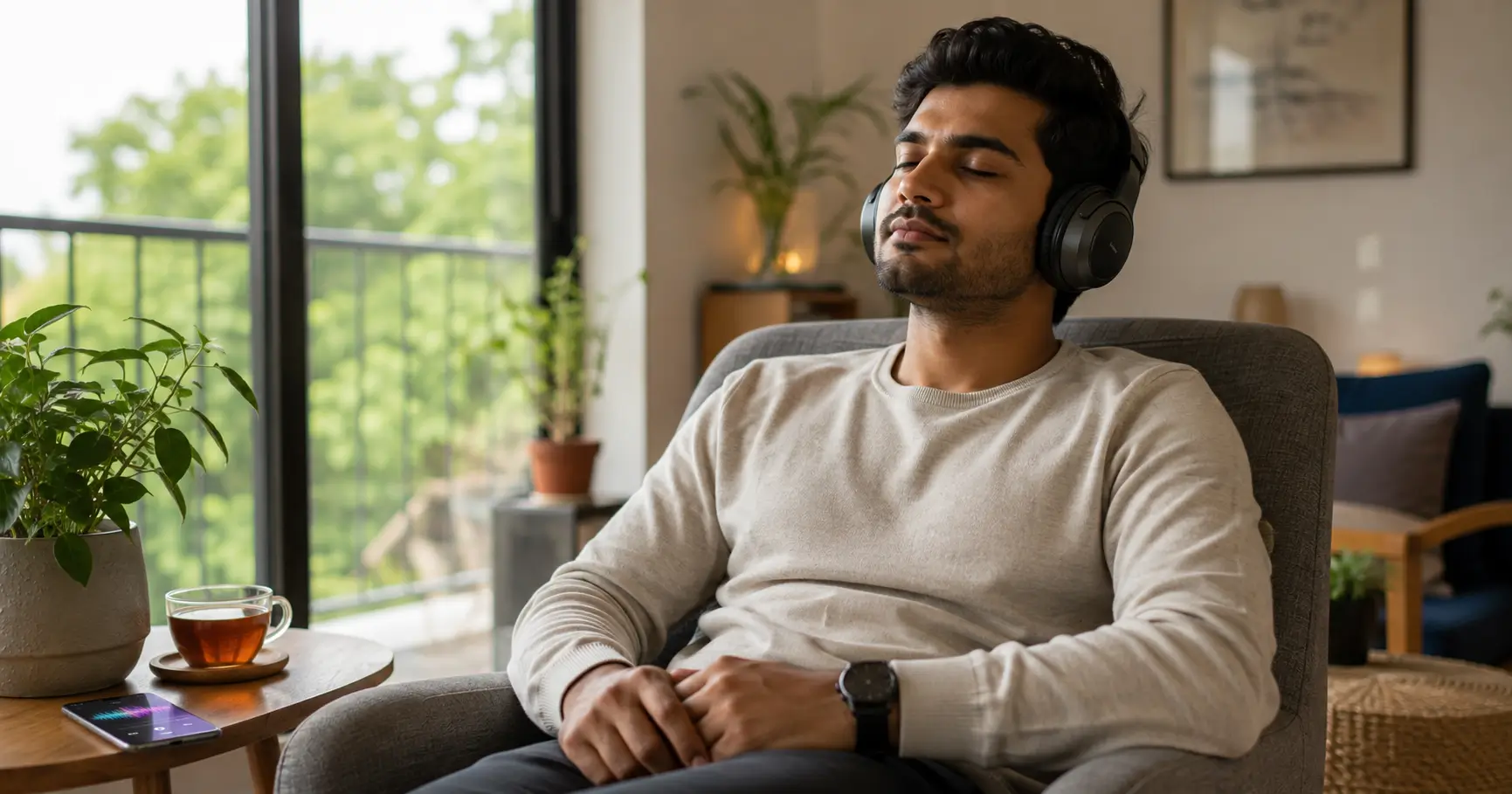
Minute 1–2: Sit somewhere comfortable and put your phone on silent.
Minute 3–5: Play one familiar, low-intensity track.
Minute 6–8: Slow your breathing naturally. Avoid forcing unusually deep breaths.
Minute 9–10: Continue listening without checking notifications.
The goal is not to “force” yourself to become calm.
The goal is to reduce stimulation long enough for your attention to shift away from whatever was driving the stress.
A simple evening routine
Music can also become a useful transition between daytime activity and rest.
Try:
- Dimmer lighting
- Comfortable volume
- Slow instrumental or ambient music
- Fewer notifications
- Gentle stretching
- Five to fifteen minutes of quiet listening
The consistency matters.
If the same playlist becomes associated with winding down, the routine itself can become a useful behavioral cue.
What does research say about music therapy?
This distinction is important.
Listening to relaxing music is not automatically music therapy.
Music therapy is a structured intervention delivered by a qualified music therapist for specific therapeutic goals.
A 2025 systematic review and meta-analysis examined 51 studies and 93 effect sizes involving more than 3,000 participants. It found a medium overall effect of music therapy on anxiety outcomes, particularly self-reported anxiety, while physiological effects were smaller and not statistically significant.
Another systematic review and meta-analysis of music therapy for stress included 47 studies and found an overall medium-to-large effect on stress-related outcomes.
These findings are encouraging, but they should not be interpreted as proof that simply pressing play on any relaxation playlist produces the same therapeutic effect.
Music therapy and casual music listening are related, but they are not interchangeable.
A real-world example: the after-work reset
Imagine someone finishing an eight-hour workday with dozens of unfinished tasks still running through their mind.
They sit down and immediately start scrolling through social media.
The brain receives more information, more notifications and more emotional stimulation.
Now consider a different routine.
They put their phone away, play a familiar instrumental playlist and sit quietly for ten minutes.
The music does not solve the workload.
But it creates a deliberate transition between work mode and recovery mode.
That behavioral shift may be one of the most practical ways to use music for everyday stress.
Can music help with anxiety?
Music may help some people experience lower anxiety, but it should not be presented as a standalone treatment for an anxiety disorder.
Research on music therapy is encouraging. The 2025 meta-analysis found a medium overall effect on anxiety outcomes across 51 studies.
However, clinical anxiety can be complex.
If anxiety is persistent, severe, interferes with daily life or comes with symptoms such as panic or thoughts of self-harm, professional support is more appropriate than relying on a playlist.
Music can be a supportive coping strategy, not a replacement for appropriate healthcare.
What about music before sleep?
Many people use calming music as part of a bedtime routine.
The potential benefit may come partly from reducing stimulation and creating a predictable transition into rest.
Choose tracks that are:
- Familiar
- Quiet
- Consistent
- Low in sudden volume changes
- Unlikely to trigger strong emotional reactions
Avoid turning bedtime into an active music-search session.
If you spend 20 minutes scrolling through playlists looking for the “perfect” sleep track, the search itself may become stimulating.
Common mistakes to avoid
Mistake 1: Choosing music because the internet calls it “scientific”
A playlist title is not evidence.
Look at the actual research rather than relying on claims such as “this frequency removes stress.”
Mistake 2: Playing music too loudly
Relaxation should not require uncomfortable volume levels.
If you are using headphones, keep the volume moderate and give your ears regular breaks.
Mistake 3: Selecting emotionally intense songs
A song can be beautiful and still be a poor choice for stress relief.
If it reminds you of an upsetting event, increases sadness or makes you more alert, choose something else.
Mistake 4: Multitasking constantly
Playing calming music while answering messages, watching videos and working through notifications may reduce the quiet attention that makes the routine useful.
Mistake 5: Expecting immediate results
Stress reduction is not always dramatic.
You may simply notice that your shoulders feel less tense, your thoughts are less repetitive or your breathing feels more comfortable.
Those small changes can still be useful.
Myths vs facts
| Myth | Fact |
|---|---|
| Any slow song reduces stress | Personal preference and context influence the response |
| Classical music is always the best | Classical music includes many different emotional styles |
| Relaxing music cures anxiety | Music may support relaxation but is not a universal treatment |
| A special frequency guarantees healing | Strong claims require strong evidence |
| Louder music creates deeper relaxation | Excessive volume can be uncomfortable and harmful to hearing |
| Music therapy is just listening to music | Professional music therapy is a structured therapeutic intervention |
| Everyone should use the same relaxation playlist | Individual response matters |
How to build your own stress-relief playlist
You do not need 100 songs.
Start with 10.
Step 1: Choose three familiar tracks
Pick songs that already make you feel comfortable.
Step 2: Add three instrumental tracks
Choose gentle piano, acoustic or ambient music.
Step 3: Add two nature-based tracks
Rain, ocean or forest sounds can provide variety.
Step 4: Add two personal favorites
These should create positive or peaceful associations.
Step 5: Test the playlist
Use it for one week during the same type of stressful period.
After each session, ask:
Do I feel more settled, unchanged or more stimulated?
Keep the tracks that consistently help.
When relaxing music may not be enough
Music is a low-cost and accessible relaxation tool, but it cannot solve every form of stress.
Consider additional support if stress:
- Continues for weeks
- Interferes with sleep or work
- Causes frequent panic
- Produces persistent physical symptoms
- Makes everyday responsibilities difficult
- Leads to hopelessness or thoughts of self-harm
In these situations, speak with a qualified healthcare or mental-health professional.
Music can still be part of your routine, but it should not become a reason to postpone appropriate care.
The bottom line on relaxing music for stress relief
The science does not support the idea that one magical song or frequency can eliminate stress.
It does support a more useful conclusion: music-based interventions can help reduce stress and anxiety for some people, while the effect varies according to the listener, intervention, musical characteristics and situation.
The best relaxing music is therefore not necessarily the track with the most impressive label.
It is the music that helps you slow down, redirect attention and create a genuine pause in an otherwise demanding day.
Start with ten quiet minutes.
Choose music you actually enjoy.
Lower the stimulation around you.
And pay attention to how your mind and body respond.
That is a much more useful experiment than searching for a supposedly perfect “stress-relief frequency.”
FAQ
Does relaxing music actually reduce stress?
Research suggests that music-based interventions can reduce psychological and some physiological measures of stress, although effects vary by person, music type and situation.
What type of music is best for stress relief?
There is no universally best genre. Slow instrumental, ambient, classical, nature-based and personally meaningful music can all be useful depending on individual preference and context.
How long should I listen to relaxing music for stress relief?
There is no scientifically established universal duration. A practical starting point is 10–15 minutes of uninterrupted listening, while paying attention to how your body and mood respond.
Is music good for anxiety?
Music-based interventions, particularly structured music therapy, have shown promising effects on anxiety. A 2025 meta-analysis found a medium overall effect on anxiety outcomes, but music should not replace appropriate professional treatment for persistent anxiety.
Is classical music the best music for relaxation?
Not necessarily. Classical music contains a wide range of tempos and emotional styles. The most useful music is generally music that you personally find calming and non-stimulating.
Can I listen to relaxing music before sleep?
Yes. Calm music can be incorporated into a consistent bedtime routine. Choose comfortable volume levels and tracks without sudden changes that make you more alert.
Conclusion
Relaxing music is not a magic cure for stress, but research gives us a good reason to take it seriously as a simple relaxation tool.
The strongest takeaway is that there is no single perfect stress-relief song. Your response depends on the music, your personal preferences, the situation and the way you listen.
For a practical starting point, choose a small playlist of familiar, gentle tracks and give yourself 10–15 minutes without notifications or multitasking. Notice whether your breathing, attention and sense of tension change.
Music works best when it becomes part of a broader approach to wellbeing—not when it is expected to solve every source of stress.
Start with one quiet playlist, one uninterrupted break and a few minutes of genuine mental space. Your goal is not to find the “perfect” music. It is to find what genuinely helps you slow down.
Disclaimer: This article is provided for general educational and informational purposes only and does not constitute medical, psychological or therapeutic advice. Research on music, stress and anxiety continues to evolve, and individual responses can vary. Relaxing music and music-based activities should not be considered a substitute for professional diagnosis or treatment. If stress or anxiety is persistent, severe, interferes with daily life, or is accompanied by concerning symptoms, consult a qualified healthcare or mental-health professional. If you are experiencing an immediate mental-health crisis or thoughts of self-harm, seek urgent professional or emergency assistance in your location.