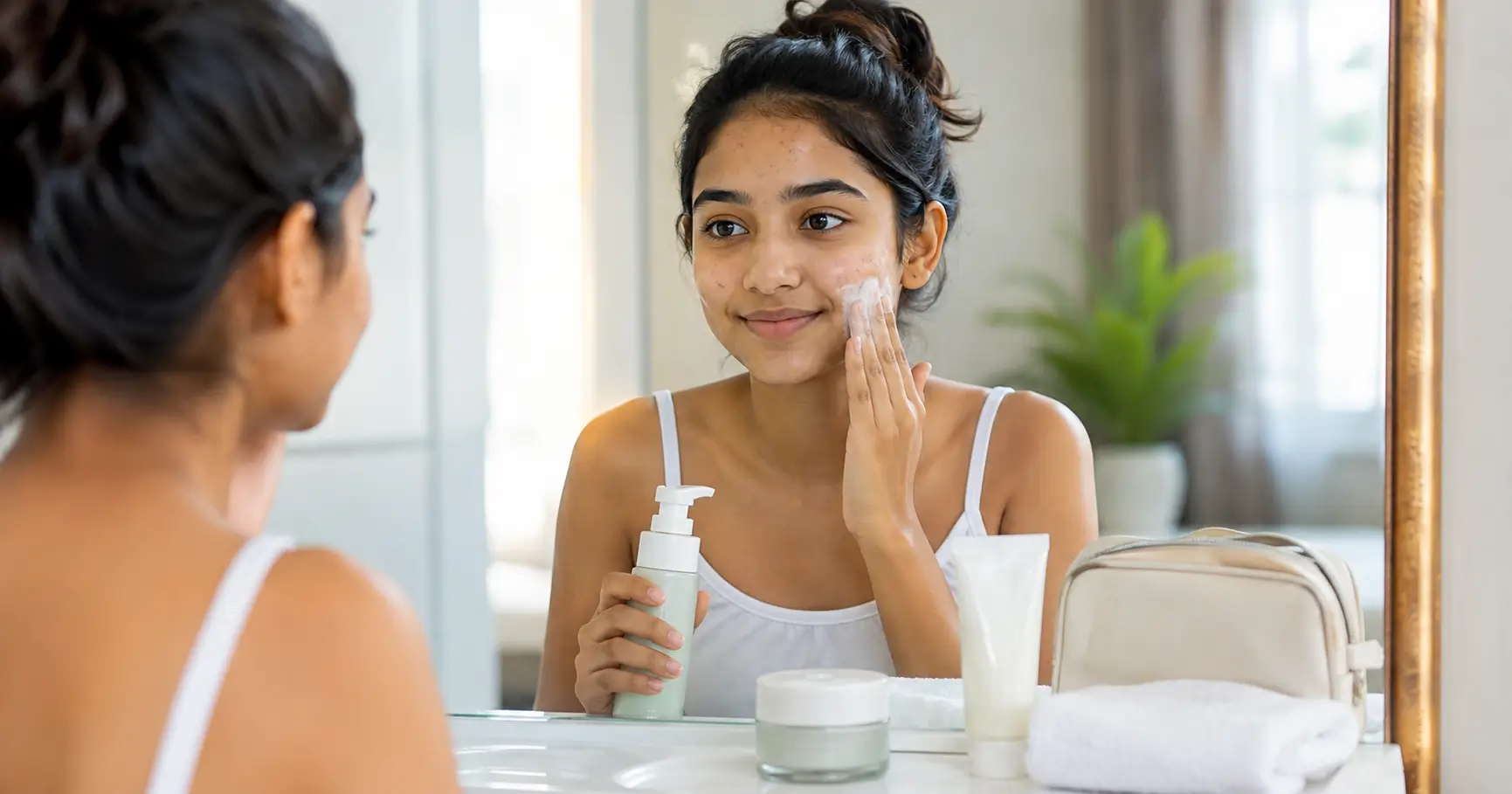

Teenage skin can change almost overnight.
One month, the skin may feel normal. The next, the forehead becomes oily, small bumps appear around the nose, or an unexpected breakout shows up before an important day.
That can make a teenager reach for scrubs, toners, masks, serums and whatever product is trending online.
But here’s the surprising part: teenage skin usually doesn’t need a complicated routine.
A good skin care routine for teenage girl should focus first on protecting the skin barrier, controlling excess oil when necessary, preventing unnecessary irritation and using sunscreen consistently.
Hormonal changes during puberty can increase sebum production and contribute to clogged pores and acne.
The goal isn’t “perfect” skin.
The goal is healthy, comfortable and well-protected skin.
What should a teenage skincare routine include?
For most teenagers, a basic routine can be built around three essential categories:
- Gentle cleanser
- Moisturizer
- Broad-spectrum sunscreen
The American Academy of Dermatology recommends this simple foundation for younger skin and emphasizes that adding too many products or harsh ingredients can cause irritation.
If acne becomes a concern, an appropriate acne-fighting ingredient may be added based on the severity of the problem and the teenager’s skin tolerance.
The important principle is start simple, then add only what is needed.
Why fewer products can be better
Social media often makes skincare look like a 10-step ritual.
That doesn’t mean a teenager needs ten products.
Harsh scrubbing, excessive cleansing and unnecessary active ingredients can irritate the skin. Dermatologists recommend gentle cleansing rather than aggressive exfoliation for acne-prone skin.
A simple routine is also easier to maintain.
And consistency matters more than having an impressive bathroom shelf.
Skin care routine for teenage girl: morning steps
A practical morning routine can take only a few minutes.
Step 1: Cleanse gently
Use a gentle, non-abrasive cleanser.
Apply it with clean fingertips and rinse with lukewarm water. Avoid vigorously rubbing the face with a towel, cleansing brush or scrub.
For oily or acne-prone skin, a cleanser formulated for that concern may be useful.
For dry or sensitive skin, a gentler hydrating cleanser may be more comfortable.
Dermatologists generally recommend avoiding aggressive washing because irritation can make acne-prone skin harder to manage.
Step 2: Apply moisturizer
Moisturizer isn’t only for dry skin.
Even oily teenage skin can become irritated or dehydrated, especially when acne treatments are being used.
Look for a lightweight product that is non-comedogenic, meaning it is less likely to clog pores.
If the skin feels tight or uncomfortable after cleansing, that’s a useful signal that the routine may be too drying.
Step 3: Use sunscreen
This is the step many teenagers are tempted to skip.
Don’t.
Use a broad-spectrum sunscreen with SPF 30 or higher, particularly when spending time outdoors.
Sun protection matters throughout life, and excessive UV exposure during childhood and adolescence can contribute to long-term skin damage. WHO recommends sun-protection measures when UV exposure is significant, including sunscreen on exposed skin that cannot be protected by clothing or shade.
Sunscreen is especially important when acne treatments make the skin more sensitive to sunlight.
What should the nighttime routine look like?
Nighttime skincare can be even simpler.
Step 1: Remove makeup and sunscreen
If makeup has been worn, remove it gently before cleansing.
Don’t sleep with makeup simply because you’re tired.
Cosmetics aren’t automatically responsible for acne. Oil-free, non-comedogenic products are generally less likely to contribute to clogged pores.
Step 2: Cleanse
Wash the face gently.
There’s no benefit in repeatedly scrubbing the skin until it feels “squeaky clean.”
In fact, excessive washing can irritate acne-prone skin.
Step 3: Moisturize
Apply moisturizer while the skin is comfortable and clean.
This becomes particularly important if an acne treatment causes dryness.
That’s the basic nighttime routine.
Cleanse → moisturize.
Add an acne treatment only when there is a clear reason to do so.
How should the routine change for oily or acne-prone skin?
This is where many teenagers make their biggest mistake.
They see oil and assume the solution is to remove every trace of it.
But aggressive cleansing can irritate the skin and potentially make the routine harder to tolerate.
During puberty, hormonal changes can increase sebum production. Excess oil can combine with dead skin cells and contribute to blocked follicles and acne.
For mild breakouts
A routine may include:
- Gentle cleanser
- Lightweight non-comedogenic moisturizer
- Broad-spectrum sunscreen
- One appropriate acne-fighting ingredient if needed
Salicylic acid can help with clogged pores, while benzoyl peroxide is an established acne treatment.
However, both can cause dryness or irritation, so introducing them gradually and following product directions matters. The AAD specifically notes salicylic acid and benzoyl peroxide as acne-fighting ingredients that may be useful for teenagers.
Don’t add five acne products at once
This is an important rule.
If a teenager suddenly starts:
- salicylic acid
- benzoyl peroxide
- exfoliating toner
- scrub
- clay mask
- retinoid
all at the same time, it becomes difficult to know what is helping—and irritation becomes much more likely.
Introduce one new active product at a time.
If the skin becomes persistently painful, extremely dry, swollen or irritated, stop the irritating product and seek professional advice.
What about dry or sensitive teenage skin?
Not every teenager has oily skin.
If the skin feels dry, tight, itchy or easily irritated, the routine should become even more gentle.
A simple approach
Morning
- Gentle cleanser or water, depending on skin needs
- Fragrance-free moisturizer
- Broad-spectrum sunscreen
Night
- Gentle cleanser
- Moisturizer
Avoid harsh scrubs and heavily fragranced products if they trigger irritation.
The AAD recommends fragrance-free products for younger skin because added fragrance can contribute to irritation or allergic reactions.
Does teenage skin need serums?
Usually, not as a starting point.
A serum isn’t automatically better than a cleanser, moisturizer or sunscreen.
Teenagers sometimes see influencers using multiple brightening, exfoliating or anti-aging serums and assume they need the same routine.
They don’t.
If there is a specific skin concern, a dermatologist may recommend a particular active ingredient.
But for everyday teenage skincare, the foundation remains much simpler.
Healthy skin does not require a shelf full of products.
What skincare ingredients should teenagers be careful with?
The issue isn’t that every active ingredient is “bad.”
The issue is using the wrong ingredient, too frequently, or without a reason.
Be cautious with:
- Strong exfoliating acids
- Physical face scrubs
- Multiple acne treatments at once
- Highly fragranced products
- Strong anti-aging routines
- Unnecessary retinoid use without appropriate guidance
- DIY acidic or irritating treatments
Some acne medications are medically appropriate for teenagers, but that doesn’t mean every teenager should independently build a prescription-strength routine.
Mayo Clinic notes that acne treatments can cause dryness, redness and irritation, while improvement can take several weeks or longer.
7 teenage skincare mistakes to avoid
1. Washing the face too often
More washing doesn’t automatically mean cleaner skin.
Gentle cleansing is preferable to repeatedly stripping the skin.
2. Scrubbing pimples
Scrubbing doesn’t remove acne at its source.
It can irritate inflamed skin.
3. Popping pimples
This is one of the hardest habits to stop.
Picking or squeezing acne can increase inflammation and contribute to scarring or lingering discoloration.
4. Copying an influencer’s routine
Someone else’s skin isn’t your skin.
Different skin types and conditions require different approaches.
5. Skipping moisturizer because of oily skin
Oily skin can still become irritated and uncomfortable.
A suitable lightweight moisturizer may help support the skin barrier.
6. Forgetting sunscreen
This can become especially important when treating acne.
7. Changing products every few days
Skincare isn’t a race.
Acne treatments often require consistent use over weeks before meaningful improvement becomes apparent. Mayo Clinic notes that nonprescription acne treatments may take two to three months of daily use to show their full benefit.
Myths vs facts about teenage skincare
| Myth | Fact |
|---|---|
| Oily skin doesn’t need moisturizer | Oily skin can still benefit from a suitable non-comedogenic moisturizer. |
| Scrubbing removes acne | Scrubbing can irritate acne-prone skin. |
| More products mean better skin | A simple, consistent routine is often easier to tolerate and maintain. |
| Acne means the face is dirty | Acne is a complex inflammatory condition influenced by hormones, oil production, clogged follicles and other factors. |
| Sunscreen is only for summer | UV exposure occurs throughout the year, and sun protection is an important long-term habit. |
| Every teen needs anti-aging products | Teenagers generally don’t need an anti-aging routine. |
A simple teenage skincare routine by skin type
| Skin type | Cleanser | Moisturizer | Sunscreen | Extra care |
|---|---|---|---|---|
| Normal | Gentle | Lightweight | SPF 30+ broad-spectrum | Usually unnecessary |
| Oily | Gentle/oil-control | Lightweight, non-comedogenic | Lightweight, non-comedogenic | Consider acne treatment if needed |
| Dry | Hydrating | Richer moisturizer | Moisturizing sunscreen | Avoid harsh exfoliation |
| Sensitive | Fragrance-free gentle cleanser | Fragrance-free | Gentle broad-spectrum SPF | Introduce products slowly |
| Acne-prone | Gentle or appropriate acne cleanser | Non-comedogenic | Non-comedogenic | Consider evidence-based acne treatment |
This table is a starting framework, not a diagnosis. Skin conditions that are persistent, painful or difficult to control deserve professional evaluation.
When should a teenager see a dermatologist?
Not every pimple requires a dermatologist.
But professional help is worthwhile when acne is:
- Painful or deep
- Leaving scars
- Leaving significant dark marks
- Spreading despite basic care
- Affecting confidence or emotional wellbeing
- Not improving after consistent appropriate treatment
- Becoming severe or persistent
Acne can cause emotional distress as well as physical changes, and early appropriate treatment can reduce the risk of complications.
A dermatologist can also determine whether the problem is actually acne or another skin condition.
A realistic 3-step routine for beginners
If a teenage girl has never followed a skincare routine before, don’t start with ten products.
Start here:
Morning
Cleanse → Moisturize → Sunscreen
Night
Cleanse → Moisturize
If acne develops
Add one appropriate acne treatment rather than completely rebuilding the routine.
This approach is inexpensive, simple and much easier to maintain.
And that may be the biggest skincare lesson of all: consistency usually beats complexity.
FAQ
What is a good skin care routine for a teenage girl?
A simple routine usually includes a gentle cleanser, suitable moisturizer and broad-spectrum SPF 30+ sunscreen. If acne is present, an appropriate acne treatment can be added based on the skin’s needs.
How many skincare products does a teenage girl need?
Most teenagers do not need a 10-step routine. Starting with three essentials—cleanser, moisturizer and sunscreen—is usually more sensible than using many active products.
Should teenage girls use moisturizer if they have oily skin?
Yes. Oily skin can still become irritated or dehydrated. A lightweight, non-comedogenic moisturizer can help support the skin barrier without unnecessarily adding heavy oils.
What is the best skincare routine for teenage acne?
Start with gentle cleansing, a non-comedogenic moisturizer and daily sunscreen. For acne, ingredients such as salicylic acid or benzoyl peroxide may be useful, but they should be introduced carefully because they can cause dryness or irritation.
Should teenagers use face scrubs?
Generally, harsh physical scrubs are not necessary and can irritate acne-prone skin. Dermatologists recommend gentle, non-abrasive cleansing instead.
When should a teenager see a dermatologist for acne?
Consider professional care when acne is painful, severe, persistent, scarring, leaving significant marks or affecting emotional wellbeing, or when appropriate over-the-counter care isn’t producing improvement.
Conclusion
A teenage skincare routine doesn’t need to be complicated to be effective.
The strongest starting point is surprisingly simple: cleanse gently, moisturize appropriately and protect the skin from the sun every day.
If acne appears, don’t respond by attacking the skin with more scrubs, acids and products. Introduce appropriate treatment carefully and give it enough time to work.
Most importantly, remember that teenage acne is common and isn’t a sign of poor hygiene or personal failure. Hormonal changes during puberty can play a major role in breakouts.
The best skincare routine is the one that fits the teenager’s skin, lifestyle and actual needs—and one she can consistently follow.
Start small. Stay gentle. Be consistent. And get professional help when the skin needs more than a basic routine.
Disclaimer
Disclaimer: This article is intended for general educational and informational purposes only and does not constitute medical advice, diagnosis or treatment. Teenage skin can vary significantly, and skincare or acne treatments that work for one person may not be appropriate for another. Persistent, painful, severe or scarring acne should be evaluated by a qualified dermatologist or healthcare professional. Always follow the instructions on skincare and acne-treatment products and seek professional guidance if significant irritation, swelling or an allergic reaction occurs.