
You do not need a gym membership to become more physically active. A small amount of floor space and a few simple movements can be enough to build a useful home exercise routine.
For most adults, a well-rounded fitness routine should include both aerobic activity and muscle-strengthening exercise. WHO recommends 150–300 minutes of moderate-intensity aerobic activity each week, or 75–150 minutes of vigorous activity, along with muscle-strengthening activity involving the major muscle groups on at least two days a week.
The key is not to make every workout exhausting. A better starting point is to choose movements you can perform with good control, begin at an appropriate level and gradually increase the challenge.
Quick Answer
Fitness exercises at home can include squats, sit-to-stands, incline push-ups, lunges, glute bridges, calf raises, planks, bird dogs, marching and step-ups.
You can perform many of these exercises without equipment. If you later want more resistance, simple equipment such as resistance bands or dumbbells can expand your options.
The goal is to combine strength, aerobic activity, mobility and regular movement rather than chasing the hardest workout possible.
Why Home Exercise Can Be Enough
A gym is one place to exercise, not the definition of exercise.
ICMR-NIN’s Dietary Guidelines for Indians 2024 describe physical activity as including structured exercise as well as everyday activities. The guidelines also describe endurance, strength, balance and flexibility as important categories of physical activity.
That makes home exercise particularly practical for people who have limited time, work at a desk or simply prefer exercising in a familiar environment.
You can also split activity across the week rather than trying to complete everything in one session.
12 Fitness Exercises You Can Do at Home
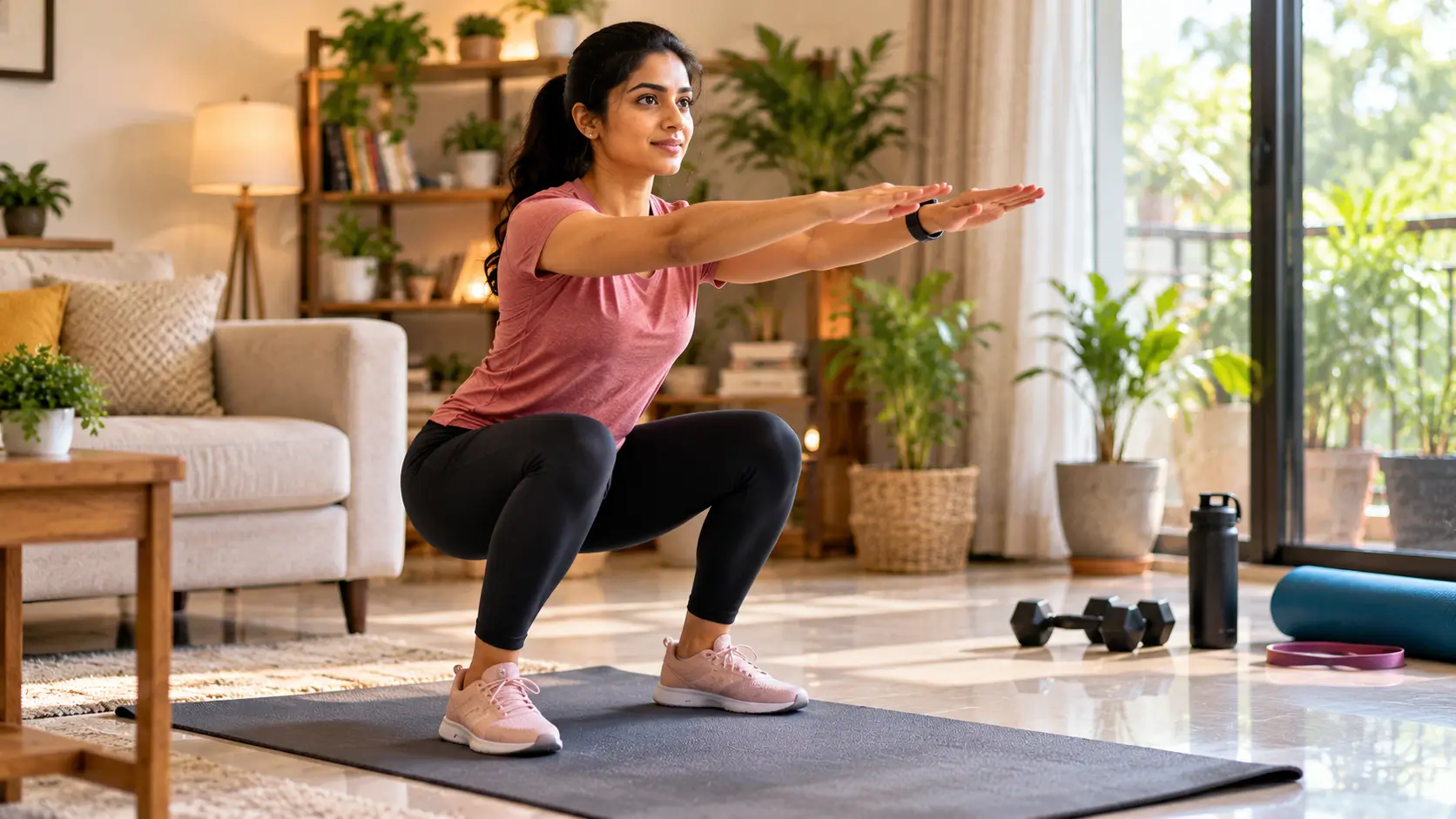
1. Squats
Squats train the muscles around your hips and legs.
Stand with your feet approximately hip- to shoulder-width apart. Push your hips back and bend your knees while keeping your chest reasonably upright. Lower only as far as you can control comfortably, then return to standing.
Beginner option: Use a chair behind you and practise controlled sit-to-stand movements.
2. Sit-to-Stand
This is one of the simplest ways to practise lower-body strength.
Sit on a stable chair with your feet flat on the floor. Lean slightly forward and stand using your legs. Slowly lower yourself back down.
It is particularly useful for beginners who are not yet comfortable with full squats.
3. Incline Push-Ups
Push-ups train the chest, shoulders, arms and trunk.
Instead of beginning on the floor, place your hands on a stable elevated surface such as a sturdy countertop or other secure support. Keep your body controlled as you lower and push away.
As you become stronger, you can gradually use a lower surface before progressing to floor push-ups.
4. Reverse Lunges
Stand upright and step one foot backward. Lower your body under control and then push through the front foot to return to standing.
Reverse lunges can challenge the legs while also requiring balance and coordination.
Beginner option: Hold a stable support and use a smaller range of motion.
5. Glute Bridges
Lie on your back with your knees bent and feet on the floor.
Press through your feet and lift your hips until your torso and thighs form a comfortable line. Lower slowly.
The movement trains the muscles around the hips and back of the legs.
6. Calf Raises
Stand near a wall or another stable support if needed.
Rise onto your toes, pause briefly and lower your heels under control.
This simple movement can be performed almost anywhere and can be progressed by increasing repetitions or eventually performing the movement with more resistance.
7. Hip Hinge
The hip hinge teaches you to move from the hips rather than repeatedly bending through the lower back.
Stand with your feet comfortably apart. Keep your spine neutral and gently push your hips backward while allowing your knees to bend slightly. Return to standing.
This movement pattern is useful because it forms the foundation of exercises such as deadlifts.
8. Bird Dog
Start on your hands and knees.
Slowly extend one arm and the opposite leg while keeping your torso stable. Return to the starting position and switch sides.
The objective is controlled movement rather than lifting your limbs as high as possible.
9. Plank
A plank challenges the muscles of the trunk.
Begin with a modified version if necessary, such as a plank from the knees or an elevated surface. Keep your body controlled and avoid holding the position once your technique begins to deteriorate.
You do not need extremely long plank holds for the exercise to be useful.
10. Marching in Place
Marching raises your activity level without requiring much space.
Stand tall and alternate lifting your knees while moving your arms naturally.
Increase the pace gradually if comfortable. You can also use marching as a low-impact alternative to jumping exercises.
11. Step-Ups
Use a stable, non-slippery step or platform.
Step up with one foot, bring the other foot up and then step down under control. Alternate legs.
The height should be appropriate for your ability. Do not use an unstable chair or furniture as a makeshift exercise platform.
12. Low-Impact Jumping Jacks
For a higher-energy option, step one foot out to the side while raising your arms, then return to the starting position and alternate sides.
This provides a lower-impact alternative to traditional jumping jacks.
If jumping feels comfortable and appropriate for your fitness level, traditional jumping jacks can be considered later.
A Simple Beginner Home Workout
You do not need to perform all 12 exercises in one session.
A simple starting routine could be:
- March in place — 2 minutes
- Sit-to-stand — 8–12 repetitions
- Incline push-ups — 6–10 repetitions
- Glute bridges — 8–12 repetitions
- Reverse lunges — 6–8 per side
- Bird dog — 6–8 per side
- Calf raises — 10–15 repetitions
- Easy marching — 2–5 minutes
Rest between exercises whenever needed.
If you are new to exercise, start with one round. As your fitness improves, you can gradually add another round or increase the difficulty.
This is a general educational framework, not an individualized exercise prescription.
How Often Should You Exercise?
WHO recommends adults accumulate at least 150 minutes of moderate-intensity aerobic activity or 75 minutes of vigorous activity each week, with muscle-strengthening activity on at least two days.
That does not mean you have to complete a 150-minute home workout.
You can combine different activities across the week.
For example:
- Monday: Home strength routine
- Tuesday: Brisk walking
- Wednesday: Home strength routine
- Thursday: Easy walking or another enjoyable activity
- Friday: Home strength routine
- Saturday: Longer walk, cycling or another aerobic activity
- Sunday: Rest or light movement
The exact schedule can vary according to your availability, fitness level and goals.
How to Progress Safely
Progress does not always mean exercising for longer.
You can make an exercise more challenging by:
- increasing repetitions gradually
- adding another set
- slowing down the movement
- increasing the range of motion when appropriate
- moving from an easier variation to a harder one
- adding resistance bands or weights
- improving movement control
ICMR-NIN recommends increasing exercise intensity and duration gradually, particularly for people who have been sedentary.
A useful rule is simple: increase the challenge only when you can perform the current variation with reasonable control.
Common Home Workout Mistakes
Starting too hard
Trying to copy an advanced online workout can create unnecessary fatigue and increase the chance of poor technique.
Ignoring technique
More repetitions are not automatically better if movement quality is deteriorating.
Exercising only one part of the body
A balanced routine should include movements that challenge the legs, upper body and trunk.
Believing soreness is the goal
Muscle soreness is not a reliable measure of whether a workout was successful.
Progressing too quickly
Your muscles, joints and connective tissues need time to adapt to increased training demands.
Using unsafe furniture
Do not perform step-ups, incline push-ups or other exercises on unstable furniture.
When to Seek Professional Advice
People with a chronic medical condition, significant injury, persistent pain, recent surgery, major mobility limitations or other health concerns may need individualized guidance before starting or substantially increasing exercise.
Pregnancy and the period after childbirth may also require exercise modifications depending on the individual’s circumstances.
If exercise causes concerning symptoms such as chest pain, fainting, severe shortness of breath or another significant symptom, stop the activity and seek appropriate medical attention.
The NHS similarly advises people with health problems, injuries, symptoms or recent major health events to obtain appropriate professional advice before attempting certain exercise programmes.
Practical Takeaway
Fitness exercises at home do not need to be complicated.
Start with basic movements such as squats or sit-to-stands, incline push-ups, lunges, glute bridges, calf raises, bird dogs and planks. Add simple aerobic movement such as marching, walking, dancing or step-ups.
The most useful routine is one that matches your current ability and that you can perform consistently.
Over time, gradually increase the challenge rather than trying to make every session exhausting.
For general health, think beyond a single workout. The bigger goal is to build a week that includes regular aerobic activity, muscle strengthening and enough movement to reduce prolonged inactivity.
Bottom Line
You can build meaningful fitness at home without a gym.
The foundation is straightforward: move regularly, strengthen the major muscle groups, include aerobic activity, practise good technique and progress gradually.
You do not need the most intense workout available. You need a routine that is appropriate for your current fitness level and sustainable enough to become part of your life.
Disclaimer: This article provides general health and fitness education and does not replace individualized medical advice, diagnosis or treatment. Exercise needs vary according to fitness level, age, medical conditions, injuries, pregnancy status and other factors. If you have a chronic condition, significant injury, persistent pain, recent surgery or other health concerns, seek appropriate professional guidance before starting or substantially changing an exercise programme.
FAQ / PEOPLE ALSO ASK / LLM QUESTIONS
Can I get fit by exercising at home?
Yes. Home exercise can contribute substantially to fitness when it includes appropriate aerobic activity and muscle-strengthening work. The results depend on the type, intensity, frequency and consistency of activity.
What are the best fitness exercises at home for beginners?
Useful starting movements include sit-to-stands, squats, incline push-ups, glute bridges, calf raises, marching, bird dogs and modified planks. Beginners should choose variations they can perform with good control.
Can I exercise at home without equipment?
Yes. Bodyweight exercises can provide resistance, and activities such as marching, walking and dancing can provide aerobic activity. ICMR-NIN specifically includes exercises such as push-ups and squats among muscle-strengthening activities.
How many days a week should I exercise?
WHO recommends muscle-strengthening activity on at least two days per week, alongside regular aerobic activity. The weekly schedule can be divided according to individual availability and fitness.
Is 20 minutes of exercise enough?
Twenty minutes can be a useful starting point, particularly for someone currently inactive, but there is no universal duration that is sufficient for everyone. Total weekly activity, intensity and fitness goals matter.
Are home workouts good for weight loss?
Physical activity can contribute to weight management, but a specific home workout cannot guarantee weight loss. Nutrition, total activity, sleep and individual factors also influence body weight.
Should I exercise every day?
Not necessarily. Regular movement is valuable, but structured training should allow appropriate recovery. A weekly combination of aerobic activity, strengthening and easier movement can be more practical than trying to perform hard workouts every day.
Can I exercise if I have a medical condition?
Some people with chronic conditions can and should remain physically active, but the appropriate activity may need modification. If you have a significant medical condition, injury or other concern, seek individualized guidance.