
You do not need a warehouse-sized gym to get a demanding full-body workout.
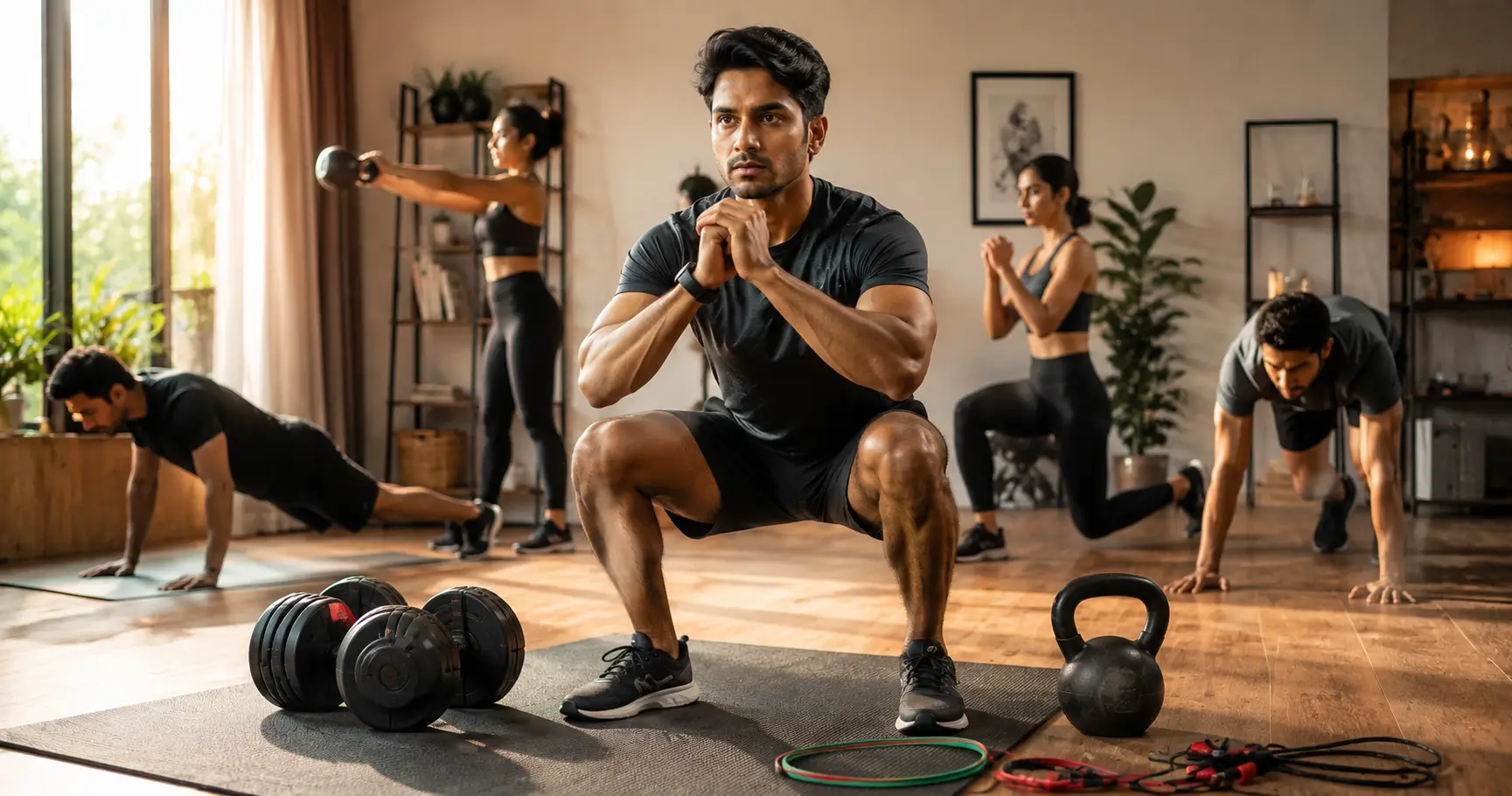
In fact, many CrossFit exercises at home can be performed with nothing more than your bodyweight, some floor space and a willingness to move. Add a pair of dumbbells or a kettlebell, and your exercise options expand considerably.
But there is an important distinction: doing CrossFit-style movements at home is not the same as blindly copying an advanced workout.
CrossFit describes its training as constantly varied functional movements performed at an intensity appropriate to the individual, and its official guidance emphasizes scaling workouts to a person’s ability.
That principle should guide your home routine.
What are CrossFit exercises at home?
CrossFit exercises at home are functional movements commonly used in CrossFit-style training that can be adapted to a home environment.
They can include bodyweight movements such as squats, push-ups, lunges and burpees, along with equipment-based movements such as kettlebell swings, dumbbell exercises and jump-rope work.
The goal is not to make every workout as intense as possible.
The goal is to perform useful movements with good technique, appropriate intensity and sensible progression.
CrossFit’s official at-home resources specifically provide movements and workouts that can be performed outside a traditional gym.
15 CrossFit exercises you can do at home
The following list moves from simple bodyweight exercises toward more demanding movements.
Choose variations that match your current ability rather than attempting the most difficult version immediately.
| Exercise | Main focus | Equipment |
|---|---|---|
| Air squats | Legs and hips | None |
| Push-ups | Chest, shoulders, arms | None |
| Reverse lunges | Legs and balance | None |
| Glute bridges | Glutes and hips | None |
| Plank | Core | None |
| Mountain climbers | Conditioning and core | None |
| Burpees | Full-body conditioning | None |
| Jumping jacks | Cardio | None |
| Bear crawls | Full body and coordination | None |
| Sit-ups | Core | None |
| Dumbbell thrusters | Full body | Dumbbells |
| Kettlebell swings | Hips and conditioning | Kettlebell |
| Goblet squats | Legs and core | Kettlebell/dumbbell |
| Dumbbell deadlifts | Posterior chain | Dumbbells |
| Jump rope | Conditioning and coordination | Rope |
1. Air squats
Air squats are one of the simplest ways to train your lower body without equipment.
Stand with your feet roughly shoulder-width apart. Lower your hips while keeping your chest controlled, then drive through your feet to return to standing.
Focus on smooth, repeatable reps rather than speed.
If your squat depth causes discomfort or your technique breaks down, reduce the range of motion until you can control the movement.
2. Push-ups
Push-ups train the chest, shoulders, triceps and core while requiring no equipment.
Keep your body in a relatively straight line and lower yourself under control.
Beginners can perform incline push-ups using a stable elevated surface. As strength improves, progress toward floor push-ups.
Quality beats quantity.
Ten controlled repetitions are more useful for skill development than 25 rushed repetitions with poor positioning.
3. Reverse lunges
Reverse lunges provide a useful unilateral leg movement.
Step backward, lower your body under control and push through the front foot to return to the starting position.
They can also be easier to control than forward lunges for many beginners.
Keep your movements deliberate, especially when balance is still developing.
4. Glute bridges
Glute bridges are a simple way to train the hips and posterior chain.
Lie on your back with your knees bent and feet planted. Drive your hips upward, pause briefly and lower them under control.
Do not turn the movement into an exaggerated lower-back arch.
The objective is controlled hip extension.
5. Planks
Planks train the trunk’s ability to resist unwanted movement.
Start with a short hold and focus on maintaining a stable position rather than chasing a long duration.
A strong plank should feel controlled rather than painful.
As your ability improves, increase the hold gradually or introduce more challenging variations.
6. Mountain climbers
Mountain climbers combine a plank position with alternating knee drives.
They can increase the cardiovascular demand of a bodyweight circuit while challenging the core and shoulders.
Beginners can slow the movement down.
Once technique is stable, increase the pace without allowing your hips to bounce excessively.
7. Burpees
Burpees are one of the most recognizable CrossFit-style conditioning movements.
A basic version involves lowering into a squat, placing the hands down, moving the feet back, returning to the squat and standing or jumping.
But you do not need to perform a maximal-speed burpee immediately.
For beginners, remove the jump or step the feet backward and forward instead.
Scaling is not failure. It is intelligent training.
CrossFit’s own guidance emphasizes that workouts can be modified according to the individual’s ability.
8. Jumping jacks
Jumping jacks are useful when you need a simple conditioning movement without equipment.
They can serve as part of a warm-up or as an easier substitute for higher-impact movements.
If jumping bothers your joints, use a step-out version instead.
This keeps the movement pattern while reducing impact.
9. Bear crawls
Bear crawls challenge the shoulders, trunk, hips and coordination.
Start on your hands and feet with your knees hovering slightly above the floor.
Move slowly at first.
A small, controlled crawl can be surprisingly demanding, so do not assume that moving faster automatically makes the exercise better.
10. Sit-ups
Sit-ups can be included in a home conditioning workout when performed with controlled technique.
Avoid aggressively pulling on your head or neck.
If full sit-ups are uncomfortable, choose a simpler core movement such as a dead bug or plank.
Your core training should complement the rest of the workout rather than becoming a competition to accumulate repetitions.
11. Dumbbell thrusters
If you have dumbbells, thrusters provide an efficient full-body movement.
The exercise combines a squat with an overhead press.
Use a load that allows you to maintain control through both phases.
Because fatigue can affect overhead mechanics, beginners should start light and focus on technique before increasing resistance.
12. Kettlebell swings
Kettlebell swings are a powerful hip-hinge movement, but they should not be treated as an arm exercise.
The main action comes from the hips.
Learn the hip hinge first. Keep the kettlebell close and generate force through the lower body.
If you are unfamiliar with kettlebell technique, getting instruction from a qualified coach is preferable to learning a fast, high-repetition version by trial and error.
13. Goblet squats
Hold a dumbbell or kettlebell close to your chest and perform a controlled squat.
The load gives you an opportunity to practice bracing while increasing resistance compared with an air squat.
Start with a light weight.
Progress only when you can maintain your posture and movement quality throughout the set.
14. Dumbbell deadlifts
Dumbbell deadlifts train the hips and posterior chain.
Stand with the weights beside your legs, hinge at the hips and lower the dumbbells while keeping them relatively close to your body.
Then drive through your feet and extend the hips to stand.
The most important skill is the hip hinge, not how heavy the dumbbells are.
15. Jump rope
Jump rope can add a strong conditioning component to a home workout.
Start with basic single jumps before attempting faster patterns or double-unders.
If you live in an apartment or have limited ceiling clearance, choose a low-impact alternative such as marching, step-ups or jumping-jack variations.
How to build a beginner CrossFit workout at home
A common mistake is choosing 10 difficult exercises and doing them as quickly as possible.
A better approach is to combine movements that train different patterns.
Step 1: Warm up
Spend several minutes gradually raising your heart rate.
Use easy versions of:
- Marching
- Air squats
- Arm circles
- Light lunges
- Easy jumping jacks
The purpose is preparation, not exhaustion.
Step 2: Choose three to five movements
For example:
- Air squats
- Incline push-ups
- Reverse lunges
- Mountain climbers
- Plank
This gives you a mixture of lower-body, upper-body, core and conditioning work.
Step 3: Choose a manageable format
Try 3 rounds at a controlled pace.
For example:
- 10 air squats
- 8 incline push-ups
- 8 reverse lunges per side
- 20 mountain climbers
- 20–30 second plank
Rest when necessary.
The goal is to finish with good technique rather than collapse after the first round.
A 20-minute CrossFit-style workout at home
Once you are comfortable with the movements, you can build a simple timed session.
Beginner version
Complete as many quality rounds as comfortably possible in 12–15 minutes:
- 10 air squats
- 8 incline push-ups
- 10 alternating reverse lunges
- 10 mountain climbers per side
- 20 jumping jacks
Rest whenever your technique deteriorates.
Intermediate version
Try three to four rounds:
- 12 air squats
- 10 push-ups
- 12 reverse lunges
- 10 burpees
- 30-second plank
The exact duration matters less than maintaining safe movement quality.
CrossFit’s official programming philosophy also emphasizes workouts that can be scaled, with different versions available for different abilities. The 2026 CrossFit Open, for example, provides Rx, Scaled and Foundations versions.
How often should you train?
There is no need to perform intense workouts every day.
The World Health Organization recommends that adults accumulate at least 150 minutes of moderate-intensity aerobic activity or 75 minutes of vigorous activity per week, with muscle-strengthening activities involving major muscle groups on at least two days each week.
For someone beginning home training, a practical schedule could be:
| Day | Activity |
| Monday | Full-body workout |
| Tuesday | Walking or easy activity |
| Wednesday | Full-body workout |
| Thursday | Recovery or light activity |
| Friday | Full-body workout |
| Saturday | Walking, mobility or recreational activity |
| Sunday | Rest or easy movement |
You do not need to copy an advanced athlete’s schedule.
Consistency is more valuable than extreme intensity.
Can you do CrossFit exercises at home without equipment?
Yes.
Bodyweight movements can provide a meaningful workout without a home gym. CrossFit itself provides at-home resources and notes that its workouts can be performed with minimal equipment.
Start with:
- Squats
- Push-ups
- Lunges
- Planks
- Burpees
- Mountain climbers
- Bear crawls
- Jumping jacks
- Sit-ups
If you later want more resistance, consider adding a few basic pieces rather than buying an entire gym.
Useful starter equipment
- Exercise mat
- Resistance bands
- Pair of adjustable dumbbells
- Kettlebell
- Jump rope
- Stable pull-up bar, where appropriate
Equipment should expand your training options—not compensate for poor technique.
A simple progression strategy
Progress does not always mean adding more weight.
You can progress by changing one variable at a time.
Option 1: Add repetitions
Move from 8 controlled push-ups to 10.
Option 2: Improve movement quality
Use a better range of motion while maintaining control.
Option 3: Reduce unnecessary rest
Keep the same exercises but recover slightly faster.
Option 4: Add resistance
Introduce a light dumbbell or kettlebell when bodyweight variations become manageable.
Option 5: Increase complexity
Only after mastering the basic movement should you consider more advanced variations.
This gradual approach is especially important for beginners.
Common mistakes with home CrossFit workouts
Going too hard too soon
High intensity is not the same as effective training.
If you cannot maintain technique, the workout has become too demanding.
Copying advanced athletes
A video showing an elite athlete performing a complex movement does not mean that movement is appropriate for a beginner.
CrossFit emphasizes scaling workouts to the individual.
Ignoring recovery
Muscles and connective tissues need time to adapt.
Alternate demanding sessions with easier activity and recovery.
Using unsafe furniture
Do not substitute unstable chairs, tables or household objects for exercise equipment.
A failed improvised setup can cause injury.
Chasing calorie-burn numbers
Wearable estimates are not a reliable reason to push beyond your current ability.
Focus on movement quality, consistency, strength and conditioning progress.
CrossFit at home: myths vs facts
| Myth | Fact |
| You need a full home gym | Many movements require little or no equipment |
| Every CrossFit workout must be extreme | Workouts can be scaled to the individual’s ability |
| Beginners should train as fast as possible | Technique and appropriate intensity come first |
| More sweat means a better workout | Sweat is not a direct measure of training quality |
| You need advanced movements to get fit | Basic functional movements can provide a strong foundation |
| More workouts always mean faster progress | Recovery and progressive training are both important |
When should you avoid training alone?
Home training is not appropriate for every movement or every person.
Avoid experimenting alone with technically demanding exercises if you have not learned them properly.
This is particularly relevant to movements involving:
- Heavy loads
- Overhead lifting
- High-impact jumping
- Complex gymnastics
- Fast Olympic lifting movements
CrossFit recommends working with credentialed coaches and provides resources for learning movements safely.
If you have a significant injury, cardiovascular condition, severe joint symptoms or another medical concern, seek appropriate professional guidance before starting vigorous exercise.
The biggest lesson for beginners
The best home workout is not the one that leaves you unable to move the next morning.
It is the one you can perform consistently, recover from and gradually improve.
Start with fundamental movements. Learn the technique. Scale difficult exercises. Build your work capacity slowly.
Then, as your fitness improves, increase resistance, complexity or intensity one step at a time.
Key Takeaways
- CrossFit-style training can be adapted to a home environment.
- Bodyweight exercises can form the foundation of an effective routine.
- Beginners should prioritize technique over speed.
- Squats, push-ups, lunges, planks and burpees are useful starting movements.
- Dumbbells and kettlebells can expand your options without requiring a full gym.
- CrossFit workouts should be scaled to your current ability.
- WHO recommends regular aerobic activity plus muscle-strengthening work at least two days per week for adults.
- Progress gradually rather than trying to match advanced athletes.
FAQ
Can I do CrossFit exercises at home?
Yes. Many CrossFit movements can be adapted for home training, particularly bodyweight exercises such as squats, push-ups, lunges, planks and burpees. CrossFit also provides official at-home workouts and movement resources.
Can I do CrossFit at home without equipment?
Yes. Bodyweight movements can form the foundation of a home CrossFit-style workout. A mat, resistance bands, dumbbells or a kettlebell can later expand your exercise options.
Is CrossFit suitable for beginners?
CrossFit can be adapted for beginners. The official methodology emphasizes scaling workouts and movements to an individual’s current ability rather than requiring everyone to perform the same version.
What are the best CrossFit exercises for beginners at home?
Air squats, incline push-ups, reverse lunges, glute bridges, planks, mountain climbers and controlled jumping-jack variations are useful starting movements because they require little or no equipment.
How many days a week should I do CrossFit at home?
There is no universal number for everyone. Beginners can start with a few structured sessions per week and use easier days for walking, mobility or recovery. WHO recommends muscle-strengthening activities involving major muscle groups on at least two days per week.
Can CrossFit at home help improve fitness?
It can contribute to strength and cardiovascular fitness when workouts are appropriately designed and performed consistently. Results depend on exercise selection, intensity, progression, recovery and overall lifestyle.
Conclusion
You do not need an expensive gym or a room full of equipment to start functional training.
The most useful CrossFit exercises at home are often the fundamentals: squats, push-ups, lunges, planks, burpees, mountain climbers and other movements that challenge multiple physical capacities.
The key is how you use them.
Start with manageable movements. Master technique. Scale difficult exercises. Progress gradually. Recover properly.
Once those fundamentals become comfortable, dumbbells, kettlebells, resistance bands and jump ropes can add new challenges without turning your home into a commercial gym.
If you’re starting today, choose five movements, complete a few controlled rounds and focus on consistency rather than exhaustion. That simple approach can become the foundation for a much stronger home-training routine.
Disclaimer
This article is intended for general educational and fitness information only. It is not individualized medical, physiotherapy or professional coaching advice.
Exercise carries an inherent risk of injury. Start at an appropriate intensity, learn unfamiliar movements before performing them at speed or under load, and stop if you experience sharp pain, dizziness, chest pain, unusual shortness of breath or other concerning symptoms.
People who are pregnant, recovering from an injury, new to vigorous exercise, or managing a medical condition should obtain appropriate professional guidance before beginning a demanding exercise program.
CrossFit is a registered trademark of CrossFit, LLC. The exercises and general fitness information discussed here are presented for educational purposes and do not constitute an official CrossFit training program.